Sofia Samatar - A Stranger in Olondria
Здесь есть возможность читать онлайн «Sofia Samatar - A Stranger in Olondria» весь текст электронной книги совершенно бесплатно (целиком полную версию без сокращений). В некоторых случаях можно слушать аудио, скачать через торрент в формате fb2 и присутствует краткое содержание. Жанр: Фэнтези, на английском языке. Описание произведения, (предисловие) а так же отзывы посетителей доступны на портале библиотеки ЛибКат.
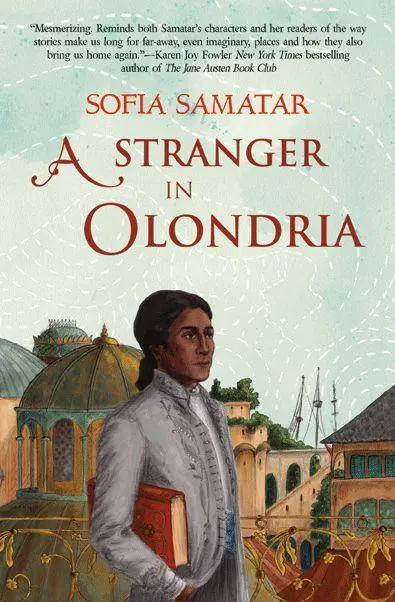
- Название:A Stranger in Olondria
- Автор:
- Жанр:
- Год:неизвестен
- ISBN:нет данных
- Рейтинг книги:5 / 5. Голосов: 1
-
Избранное:Добавить в избранное
- Отзывы:
-
Ваша оценка:
A Stranger in Olondria: краткое содержание, описание и аннотация
Предлагаем к чтению аннотацию, описание, краткое содержание или предисловие (зависит от того, что написал сам автор книги «A Stranger in Olondria»). Если вы не нашли необходимую информацию о книге — напишите в комментариях, мы постараемся отыскать её.
In desperation, Jevick seeks the aid of Olondrian priests and quickly becomes a pawn in the struggle between the empire’s two most powerful cults. Yet even as the country shimmers on the cusp of war, he must face his ghost and learn her story before he has any chance of becoming free by setting her free: an ordeal that challenges his understanding of art and life, home and exile, and the limits of that seductive necromancy, reading.
A Stranger in Olondria — читать онлайн бесплатно полную книгу (весь текст) целиком
Ниже представлен текст книги, разбитый по страницам. Система сохранения места последней прочитанной страницы, позволяет с удобством читать онлайн бесплатно книгу «A Stranger in Olondria», без необходимости каждый раз заново искать на чём Вы остановились. Поставьте закладку, и сможете в любой момент перейти на страницу, на которой закончили чтение.
Интервал:
Закладка:
Miros was coming back to life. He walked around the garden, first leaning on a stick, then upright, by himself. His face was still gaunt and fierce with beard, but his eyes had regained their brightness and his body the strength to haul water and split wood. To restore his muscles, he had begun practicing kankelde , the soldier’s art, on a horizontal branch of a plum tree in the garden. He startled me when I came upon him swinging upside down, his face wine-dark, in the figure called Garda’s Pendulum.
In the evenings we ate whatever scraps we had in the ravaged sitting room. Firelight flashed on the tangle of his hair. He said: “You saved my life this winter.” He said: “I don’t know how you did it. It’s a miracle.”
I smiled and said softly: “You really don’t know?”
He gave me a guilty glance. “Well. Yes, I know. But I’m not—I’m not like my uncle.”
He tugged at his earring and went on slowly: “Knowing there’s an angel in the place doesn’t make me want to ask it questions. It doesn’t seem right.”
I cleaned the last streaks of yom afer from my bowl and sucked my fingers. “You sound like an islander.”
He shrugged and smiled through his beard. “Perhaps. I don’t know.”
When the meal was over we stood and he clapped my shoulder, and for a moment, grateful, I leaned into his rough, human embrace.
And then I went upstairs, and read to the angel.
I opened Lantern Tales again, old highland stories retold by Ethen of Ur-Fanlei. This time I read not the angel’s tale but the story printed there. Its ornate diction recalled an earlier time, before the war in the east. Ethen at the window of her room above the river where she spent several years as the guest of the Duchess of Tevlas, the tall floor lamps on the balcony after dark, burnt nath to keep away the mosquitoes, Ethen barefoot, massaging her perennially swollen ankles. This tale was told to me by Karth, a gaunt manservant with a lazy eye, who claims to have seen the White Crow himself on more than one occasion. I read aloud, haltingly, translating as I went. Each time I glanced up the angel was looking at me, resting her cheek in her hand.
I read. I read her My Chain of Nights by the famous Damios Beshaid, Elathuid’s Journey to the Duoronwei, Fanlero’s Song of the Dragon . Limros’s Social Organization of the Kestenyi Nomads , which calls the east “this vast theater of miserable existences.” She listened, a moth at a window. I read On the Plant Life of the Desert, by the great botanist of Eiloki, who succumbed to thirst in the sands, with its spidery watercolors of desert flowers such as tras , “whose yellow spines are lined with dark hairs like eyelashes.” Sometimes she stopped me with questions. I created new words in Kideti: the Olondrian water clock was “that which follows the sun even after sunset.” Some books she attended to more closely than others. She grew so still she almost faded away while I read Kahalla the Fearless:
What do they say of the desert? What they say of it is not true. What do they say of the dunes, the salt flats, the cities of broken gravel, and the fields of quartz and chalcedony thrown down by the majestic volcanoes of Iva? Nothing. They say nothing. They speak shrilly of the feredhai, and they smile and add more pounded cloves to their tea. They are unacquainted with heat and cold, they are utter strangers to death, they speak like people who have never even seen horses…
I looked up. She was still there, her light pale as a fallen leaf. “I’ll have to stop,” I chattered. “I’m too cold to go on.” She nodded, sighing. “It is a great magic, this vallon. ” My lips cracked when I smiled; the evening light was rarefied with cold. My breath poured out of me as whiteness, traveling on the draft. I felt it go like an ache, a tearing of cloth. I moved to the balcony doors and saw, in the instant before I closed them, the stars of the desert branching like candelabra.
I read to her from Firfeld’s Sojourns , too: the two of us wandered together among the fragrant trees of the Shelemvain, and encountered on the fringes of the forest Novannis the False Countess, smoking her beaded pipe among the acacias. We dined at the court of Loma, where women wore tall coiffures made of hollyhocks, and sampled, in the dim greenness of the oak forests, the brains of a wild pig fried with chicory in its own skull, a delicacy of the soft-spoken Dimai. We shivered as we read of the nameless desert in the center of the plateau, which the feredhai call only suamid , “the place,” where no water comes from the sky, not even the snow that falls near the mountains, “and one lives under the tyranny of the wells.” And we read of our own islands, of Vad-Von-Poi, the “city of water-baskets.” Jissavet’s fingers flared above the page. Later, when I was almost asleep, she spoke to me suddenly out of the dark.
“I know what the vallon is,” she said. “It’s jut .”
The gods must have loved her, and they had taken her.
In Pitot they say the elephant god, Old Grandfather, is jealous. He steals children, he steals wives. This much, he says, and no more. He is the Limiter, the controller of human happiness. He must have seen her; they all must have looked at her, even when she was a child, when she paddled her tiny boat made out of skins. They must have seen her bold eyes and her arms, dark, sunlit, polished, reflected in the brown mirrors of the pools. This girl, small and already so headstrong, with hair in those days of an iridescent black. But with the eyes, the mouth, the expression, with the waywardness and audacity which I would come to love when it was too late, when the gods had claimed her for themselves.
Those years, the years she lay in the doorway: every one of them hurts me, and every hour has an individual pain. Lost hours, irretrievable, hours that I would have taken up and treasured and which were scattered abroad in the mud. Hours in which she lay alone and deserted by her friends. But had I been one of her friends, had I eaten those stolen fish in the fields, had I been blessed, like them, with that inconceivable good fortune—nothing could have parted me from her. Not the kyitna , not that hair with the color of poisonous berries, which I would weave into ropes to bind me close to her side, not the hatred of all the world, not the danger of sickness, contamination, which I would have welcomed with tears of joy. Yes, I would have clasped that hair, that waist, and inhaled her frightened breath in the hope that the curse would swell to make room for me, that we might be together, safe, removed from everyone else in the honor and preference which death had shown for us. To be, like her, an aristocrat of death, who would bury us under his scarlet blossoms. To suffer, like her, from torrid fevers. To clutch her hand as I struggled for life, to hear her words of comfort gathering the transparent coolness beyond the stars.
For the first time in many months I prayed to the god with the black-and-white tail, incoherent and extravagant prayers. I prayed that once, just once, the laws of time might be suspended and I might find myself, ten years ago, in Kiem. I prayed that she would stay with me forever, that somehow we would enter the magical, intimate purlieus of her book. And I called down terrible punishments on the playmates of her childhood: that they might first love her memory, and then perish. “Let them die,” I begged, “but only after they’ve suffered as I’m suffering.” It seemed to me that the whole world must know of her, must recognize that with her death the universe had altered and the fields, the forests, the rivers were full of ashes.
Читать дальшеИнтервал:
Закладка:
Похожие книги на «A Stranger in Olondria»
Представляем Вашему вниманию похожие книги на «A Stranger in Olondria» списком для выбора. Мы отобрали схожую по названию и смыслу литературу в надежде предоставить читателям больше вариантов отыскать новые, интересные, ещё непрочитанные произведения.








Обсуждение, отзывы о книге «A Stranger in Olondria» и просто собственные мнения читателей. Оставьте ваши комментарии, напишите, что Вы думаете о произведении, его смысле или главных героях. Укажите что конкретно понравилось, а что нет, и почему Вы так считаете.