Sofia Samatar - A Stranger in Olondria
Здесь есть возможность читать онлайн «Sofia Samatar - A Stranger in Olondria» весь текст электронной книги совершенно бесплатно (целиком полную версию без сокращений). В некоторых случаях можно слушать аудио, скачать через торрент в формате fb2 и присутствует краткое содержание. Жанр: Фэнтези, на английском языке. Описание произведения, (предисловие) а так же отзывы посетителей доступны на портале библиотеки ЛибКат.
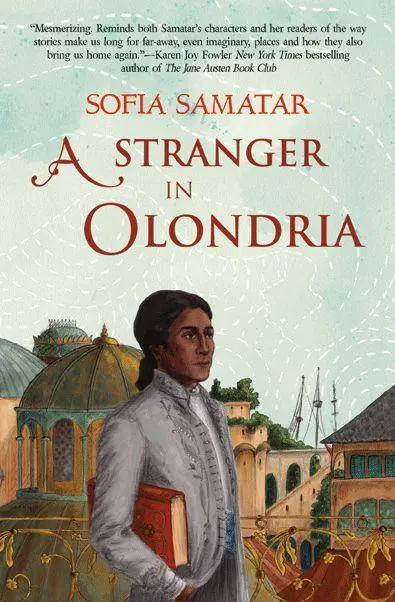
- Название:A Stranger in Olondria
- Автор:
- Жанр:
- Год:неизвестен
- ISBN:нет данных
- Рейтинг книги:5 / 5. Голосов: 1
-
Избранное:Добавить в избранное
- Отзывы:
-
Ваша оценка:
A Stranger in Olondria: краткое содержание, описание и аннотация
Предлагаем к чтению аннотацию, описание, краткое содержание или предисловие (зависит от того, что написал сам автор книги «A Stranger in Olondria»). Если вы не нашли необходимую информацию о книге — напишите в комментариях, мы постараемся отыскать её.
In desperation, Jevick seeks the aid of Olondrian priests and quickly becomes a pawn in the struggle between the empire’s two most powerful cults. Yet even as the country shimmers on the cusp of war, he must face his ghost and learn her story before he has any chance of becoming free by setting her free: an ordeal that challenges his understanding of art and life, home and exile, and the limits of that seductive necromancy, reading.
A Stranger in Olondria — читать онлайн бесплатно полную книгу (весь текст) целиком
Ниже представлен текст книги, разбитый по страницам. Система сохранения места последней прочитанной страницы, позволяет с удобством читать онлайн бесплатно книгу «A Stranger in Olondria», без необходимости каждый раз заново искать на чём Вы остановились. Поставьте закладку, и сможете в любой момент перейти на страницу, на которой закончили чтение.
Интервал:
Закладка:
“No one can read Kideti,” the angel laughed.
“I can,” I said. I showed her how I had used Olondrian characters for the sounds the two languages shared. Sometimes I used a letter for a neighboring sound in Kideti: so our j sound was the Olondrian shi . And sometimes I altered the characters to make new ones: our tch sound was also a shi , but one that carried a plume-like curve above it.
“Listen,” I said. The sun was sinking, flooding the desert with scarlet. It seemed to blaze up unnaturally, casting a threatening glow on the book in my hands. I fumbled with the pages. Suddenly my chest felt tight; distress seized me as I read the opening lines:
I already know about writing. We made maps: maps of the sea, of the waters between Tinimavet, Sedso, and Jiev. And maps of the rivers, the great ones, Dyet and Katapnay and Tadbati-Nut, the ones that made our country of mud on their way to the girdling sea…
“Stop,” she whispered at last.
I had not finished the anadnedet . My voice faded uncertainly from the air.
“I’m sorry,” I said. “I’ve hurt you.” I felt the distress again, more intensely than before. My fingers curled around the page.
“No,” she said hoarsely. She was weeping somewhere far away, inconsolable, beyond my reach. The pain it gave me, the sense of helplessness, was so exquisitely sharp I closed my eyes.
“It’s a terrible story,” she sobbed.
“No,” I said. “No. It’s a beautiful story. Jissavet? Can you hear me? You’ve told it beautifully.”
“I miss him,” she said. “I think he’s dead, but I can’t find him anywhere.”
“You’ll find him,” I said. “You’ll find him, I’ll help you to find him…”
Still she wept, devastating me with a flood of grief. So I spoke to her, willing her to be comforted. I snatched my words from anywhere, from the poetry of the desert and the Valley, from the songs of Tinimavet. I imagined I had met her at home in the south. I told her about this meeting, how she rowed her boat on a languid tributary of Tadbati-Nut. I evoked the tepid light, the bristling stillness of the leaves. “And I was riding a white mule,” I said, “bringing pepper to sell on the hill…”
And Jissavet, you drove your oar into the shallow stream, arresting the movement of your little boat, and you looked at me with startled eyes, those eyes which have the strange power to penetrate anything: a stone, a heart. I reined the mule in sharply. Can I deny that I was riveted by those eyes, with their low light, their impalpable darkness? By that shoulder, thin and flexible, that flawless skin on which the unctuous light fell, drop by drop, like honey? We were engulfed in the forest, the opaque air was hard to breathe. Your expression altered subtly but unmistakably. You were no longer surprised. You sat up, quickly withdrawing the light of your glance, and faced me instead with a look of offended hauteur… Then I thought, my stare has insulted the daughter of a chief. But what chief’s daughter is this who, bold and careless, paddles her boat through the forest alone, regardless of her beauty which must attract the unwanted notice of her inferiors? And I greeted you, emboldened by the fact that you had not rowed away. Then your expression, so mutable, changed again. In it were all the hidden laughter, the irony, and intelligence which, now, you allowed to sparkle for the first time…
Her misery had grown silent. Now she interrupted bitterly: “That’s all nonsense. You don’t know what you’re saying.”
But I told her that I knew. “I remember it,” I said. “I saw everything that day, aboard the Ardonyi .”
I told her, too, of the days before the Ardonyi , my days in Tyom. In the ossified glitter of the abandoned garden, where the immobility of the trees was as deep and abiding as winter itself, I spoke to her of my parents, my brother, my master. My breath made clouds of fog as if my words had condensed in the air; and when the angel spoke, her breath made light. I told her that I agreed with her father, that sorrow was everywhere, and I described the rain, the frustration, my father’s wife. I think she saw Tyom then. She imagined, vaguely, the house of yellow stone on its hill overlooking the deep green of the fields. She imagined my father observing his quiet farm, monumental on the terraced hillside under his reed umbrella. “He must have looked like Jabjabnot,” she said. My laughter rang in the frozen air, making the blue trees tremble. “He was,” I said. “He was, he was like a god. We lived in terror of him. He was disappointed in us to the day he died.”
She did not speak. I saw that I was alone. “Show yourself,” I whispered.
There she was, seated on the rim of the fountain, coming into being like the letters drawn in a magical northern ink which is revealed only when held close to a flame. She rested her hands on the edge of the fountain’s bowl; her feet dangled.
“Not like that,” I said. “In something else. In—a coat. You couldn’t sit outside like that, half naked.”
She raised her eyes and looked at me gravely.
“I know,” I said with a harsh laugh. “You don’t feel the cold. You couldn’t do this small thing just to please me? You couldn’t—just to make it seem—”
She let me talk until, hearing the foolishness of my words, I fell silent.
“Then I’m all alone,” I said at last.
She smiled, wise and sad. “Tell me more about your tchavi —Lunre?”
“Good pronunciation for an islander,” I muttered. “My mother always insisted on calling him ‘Lunle.’…”
“And was he really from Bain, from that terrible city?”
“That wonderful city,” I said. I tilted my head back, looking up through the trees. I glanced at her, her incandescent darkness against the marble.
“I’ll tell you his love story,” I said.
I told her the story of Tialon and Lunre, and she wept. I told her everything, all of my secret things. I felt myself disintegrating, fading, turning to smoke, becoming pure thought, pure energy, like her. I wanted this dissolution, sought it eagerly. It was never enough. Never, although we clung together like two orphans in a forest. “Now you’re not afraid of me anymore,” she whispered, shivering. “No,” I said, closing my eyes as I reached for her, touching marble.
I could not touch her. And yet she seemed so close, the glow of her skin against my hand, her voice in my ear a private music. I read her anadnedet again and again. I wanted to write there too, to inscribe myself among the Olondrian and Kideti words on the page. My own wild poetry scattered there like grain. I thought of her playing with her friends, and I could see her so clearly: satin-eyed, dictatorial. And it seemed to me that she had been made to answer a desire which I had carried all of my life, without knowing it.
Dark nights of Kestenya. Lamplit hours in the library. And that voice, laughing, restless, proud and forlorn. The voice that inhabited the wind and rang in the sun on the trees of ice and occupied the empty space in my heart. I had not known of this empty space, but now I recognized it, and it bled; and I was wretched, distracted, and happy. I ran in the snow, shouted, and broke the icicles on the gate in the wall, stabbing her nebulous image with those bright knives.
And in the box bed I wept. “Stop,” she said. “Stop, Jevick, it’s over, it’s finished.”
“It’s too late,” I choked. “I’ll never know you.”
“You know me now.”
“But I can’t do anything. I can’t do anything for you. If I’d known I might have done something—found you—”
“Hush,” she said. “Sit up, now. Light the candle.” She asked me to throw shadows on the wall while she guessed their shapes. This was the way to play tchoi , the shadow game of Tinimaveti nights. But as for my angel, my love—she cast no shadow.
Читать дальшеИнтервал:
Закладка:
Похожие книги на «A Stranger in Olondria»
Представляем Вашему вниманию похожие книги на «A Stranger in Olondria» списком для выбора. Мы отобрали схожую по названию и смыслу литературу в надежде предоставить читателям больше вариантов отыскать новые, интересные, ещё непрочитанные произведения.








Обсуждение, отзывы о книге «A Stranger in Olondria» и просто собственные мнения читателей. Оставьте ваши комментарии, напишите, что Вы думаете о произведении, его смысле или главных героях. Укажите что конкретно понравилось, а что нет, и почему Вы так считаете.