Дэн Симмонс - The Fall of Hyperion
Здесь есть возможность читать онлайн «Р”СЌРЅ РЎРёРјРјРѕРЅСЃ - The Fall of Hyperion» весь текст электронной книги совершенно бесплатно (целиком полную версию без сокращений). В некоторых случаях можно слушать аудио, скачать через торрент в формате fb2 и присутствует краткое содержание. Город: London, Год выпуска: 2006, ISBN: 2006, Издательство: Orion Publishing Group, Жанр: Эпическая фантастика, Космическая фантастика, на английском языке. Описание произведения, (предисловие) а так же отзывы посетителей доступны на портале библиотеки ЛибКат.
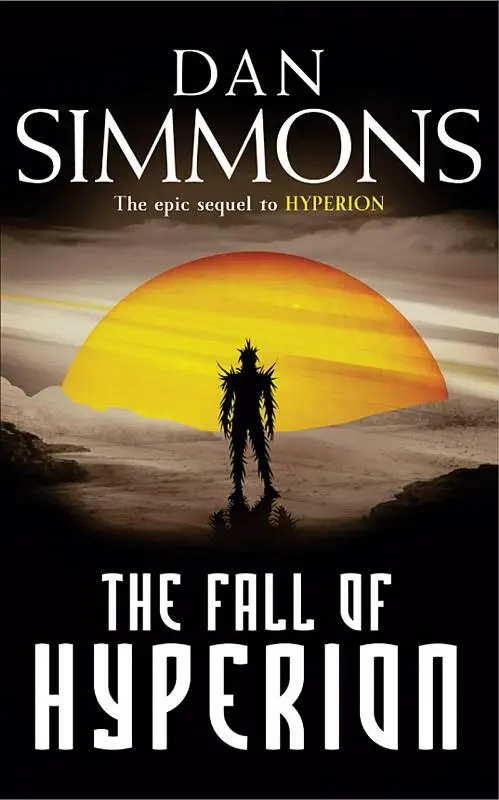
- Название:The Fall of Hyperion
- Автор:
- Издательство:Orion Publishing Group
- Жанр:
- Год:2006
- Город:London
- ISBN:9780575076389
- Рейтинг книги:5 / 5. Голосов: 1
-
Избранное:Добавить в избранное
- Отзывы:
-
Ваша оценка:
The Fall of Hyperion: краткое содержание, описание и аннотация
Предлагаем к чтению аннотацию, описание, краткое содержание или предисловие (зависит от того, что написал сам автор книги «The Fall of Hyperion»). Если вы не нашли необходимую информацию о книге — напишите в комментариях, мы постараемся отыскать её.
The Fall of Hyperion — читать онлайн бесплатно полную книгу (весь текст) целиком
Ниже представлен текст книги, разбитый по страницам. Система сохранения места последней прочитанной страницы, позволяет с удобством читать онлайн бесплатно книгу «The Fall of Hyperion», без необходимости каждый раз заново искать на чём Вы остановились. Поставьте закладку, и сможете в любой момент перейти на страницу, на которой закончили чтение.
Интервал:
Закладка:
I followed Hunt’s gaze and noticed a skimmer moving toward us.
The blue and gold geodesic symbol of the Hegemony on one of its skirts was illuminated by its running lights; rain streaked the forward blisters and whipped away from the fans in a violent curtain of mist.
The skimmer settled, a Perspex blister split and folded, and a man stepped out and hurried across the tarmac toward us.
He held out his hand to Hunt. “M. Hunt? I’m Theo Lane.”
Hunt shook the hand, nodded toward me. “Pleased to meet you, Governor-General. This is Joseph Severn.”
I shook Lane’s hand, a shock of recognition coming with the touch.
I remembered Theo Lane through the déjà vu mists of the Consul’s memory, recalling the years when the young man was the Vice-Consul; also from a brief meeting a week earlier when he greeted all of the pilgrims before they departed upriver on the levitation barge Benares. He seemed older than he had appeared just six days before. But the unruly lock of hair on his forehead was the same, as were the archaic eyeglasses he wore, and the brisk, firm handshake.
“I’m pleased you could take the time to make planetfall,” Governor-General Lane said to Hunt. “I have several things I need to communicate to the CEO.”
“That’s why we’re here,” said Hunt. He squinted up at the rain. “We have about an hour. Is there somewhere we can dry off?”
The Governor-General showed a youthful smile. “The field here is a madhouse, even at 0520 hours, and the consulate is under siege. But I know a place.” He gestured toward the skimmer.
As we lifted off, I noticed the two Marine skimmers keeping pace with us but I was still surprised that the Governor-General of a Protectorate world flew his own vehicle and did not have constant bodyguards.
Then I remembered what the Consul had told the other pilgrims about Theo Lane—about the young man’s efficiency and self-effacing ways—and realized that such a low profile was in keeping with the diplomat’s style.
The sun rose as we lifted off from the spaceport and banked toward town. Low clouds glowed brilliantly as they were lighted from below, the hills to the north sparkled a bright green, violet, and russet, and the strip of sky below the clouds to the east was that heart-stopping green and lapis which I remembered from my dreams. Hyperion, I thought, and felt a thick tension and excitement catch in my throat.
I leaned my head against the rain-streaked canopy and realized that some of the vertigo and confusion I felt at that moment came from a thinning of the background contact with the datasphere. The connection was still there, carried primarily on microwave and fatline channels now, but more tenuous than I had ever experienced—if the datasphere had been the sea in which I swam, I was now in shallow water indeed, perhaps a tidal pool would be a better metaphor, and the water grew even shallower as we left the envelope of the spaceport and its crude microsphere. I forced myself to pay attention to what Hunt and Governor-General Lane were discussing.
“You can see the shacks and hovels,” said Lane, banking slightly so we had a better view of the hills and valleys separating the spaceport from the suburbs of the capital.
Shacks and hovels were too-polite terms for the miserable collection of fiberplastic panels, patches of canvas, heaps of packing crates, and shards of flowfoam that covered the hills and deep canyons. What obviously had once been a scenic seven-or eight-mile drive from the city to the spaceport through wooded hills now showed land stripped of all trees for firewood and shelter, meadows beaten to barren mudflats by the press of feet, and a city of seven or eight hundred thousand refugees sprawled over every flat piece of land in sight. Smoke from thousands of breakfast fires floated toward the clouds, and I could see movement everywhere, children running in bare feet, women carrying water from streams that must be terribly polluted, men squatting in open fields and waiting in line at makeshift privies. I noted that high razorwire fences and violet containment field barriers had been set along both sides of the highway, and military checkpoints were visible every half mile. Long lines of FORCE camouflaged ground vehicles and skimmers moved both directions along the highway and low-level flyways.
“…most of the refugees are indigenies,” Governor-General Lane was saying, “although there are thousands of displaced landowners from the southern cities and the large fiberplastic plantations on Aquila.”
“Are they here because they think the Ousters will invade?” asked Hunt.
Theo Lane glanced at Gladstone’s aide. “Originally there was panic at the thought of the Time Tombs opening,” he said. “People were convinced that the Shrike was coming for them.”
“Was it?” I asked.
The young man shifted in his seat to look back at me. “The Third Legion of the Self-Defense Force went north seven months ago,” he said. “It didn’t come back.”
“You said at first they were fleeing the Shrike,” said Hunt. “Why did the others come?”
“They’re waiting for the evacuation,” said Lane. “Everyone knows what the Ousters… and the Hegemony troops… did to Bressia. They don’t want to be here when that happens to Hyperion.”
“You’re aware that FORCE considers evacuation an absolute last resort?” said Hunt.
“Yes. But we’re not announcing that to the refugees. There have been terrible riots already. The Shrike Temple has been destroyed… a mob laid siege, and someone used shaped plasma charges stolen from the mineworks on Ursus. Last week there were attacks on the consulate and the spaceport, as well as food riots in Jacktown.”
Hunt nodded and watched the city approach. The buildings were low, few over five stories, and their white and pastel walls glowed richly in the slanting rays of morning light. I looked over Hunt’s shoulder and saw the low mountain with the carved face of Sad King Billy brooding over the valley. The Hoolie River twisted through the center of the old town, straightening before it headed northwest toward the unseen Bridle Range, twisting out of sight in the weirwood marshes to the southeast, where I knew it widened to its delta along the High Mane. The city looked uncrowded and peaceful after the sad confusion of the refugee slums, but even as we began to descend toward the river, I noticed the military traffic, the tanks and APCs and GAVs at intersections and sitting in parks, their camouflage polymer deliberately deactivated so the machines would look more threatening. Then I saw the refugees in the city: makeshift tents in the squares and alleys, thousands of sleeping forms along the curbs, like so many dull-colored bundles of laundry waiting to be picked up.
“Keats had a population of two hundred thousand two years ago,” said Governor-General Lane. “Now, including the shack cities, we’re nearing three and a half million.”
“I thought that there were fewer than five million people on the planet,” said Hunt. “Including indigenies.”
“That’s accurate,” said Lane. “You see why everything’s breaking down. The other two large cities, Port Romance and Endymion, are holding most of the rest of the refugees. Fiberplastic plantations on Aquila are empty, being reclaimed by the jungle and flame forests, the farm belts along the Mane and the Nine Tails aren’t producing—or if they are, can’t get their food to market because of the breakdown of the civilian transport system.”
Hunt watched the river come closer. “What is the government doing?”
Theo Lane smiled. “You mean what am I doing? Well, the crisis has been brewing for almost three years. The first step was to dissolve the Home Rule Council and formally bring Hyperion into the Protectorate. Once I had executive powers, I moved to nationalize the remaining transit companies and dirigible lines—only the military moves by skimmer here now—and to disband the Self-Defense Force.”
Читать дальшеИнтервал:
Закладка:
Похожие книги на «The Fall of Hyperion»
Представляем Вашему вниманию похожие книги на «The Fall of Hyperion» списком для выбора. Мы отобрали схожую по названию и смыслу литературу в надежде предоставить читателям больше вариантов отыскать новые, интересные, ещё непрочитанные произведения.





Обсуждение, отзывы о книге «The Fall of Hyperion» и просто собственные мнения читателей. Оставьте ваши комментарии, напишите, что Вы думаете о произведении, его смысле или главных героях. Укажите что конкретно понравилось, а что нет, и почему Вы так считаете.