Дэн Симмонс - The Fall of Hyperion
Здесь есть возможность читать онлайн «Р”СЌРЅ РЎРёРјРјРѕРЅСЃ - The Fall of Hyperion» весь текст электронной книги совершенно бесплатно (целиком полную версию без сокращений). В некоторых случаях можно слушать аудио, скачать через торрент в формате fb2 и присутствует краткое содержание. Город: London, Год выпуска: 2006, ISBN: 2006, Издательство: Orion Publishing Group, Жанр: Эпическая фантастика, Космическая фантастика, на английском языке. Описание произведения, (предисловие) а так же отзывы посетителей доступны на портале библиотеки ЛибКат.
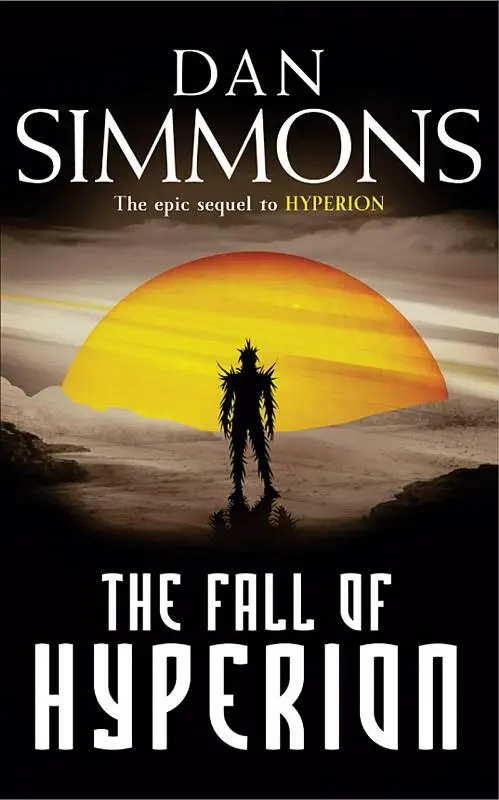
- Название:The Fall of Hyperion
- Автор:
- Издательство:Orion Publishing Group
- Жанр:
- Год:2006
- Город:London
- ISBN:9780575076389
- Рейтинг книги:5 / 5. Голосов: 1
-
Избранное:Добавить в избранное
- Отзывы:
-
Ваша оценка:
The Fall of Hyperion: краткое содержание, описание и аннотация
Предлагаем к чтению аннотацию, описание, краткое содержание или предисловие (зависит от того, что написал сам автор книги «The Fall of Hyperion»). Если вы не нашли необходимую информацию о книге — напишите в комментариях, мы постараемся отыскать её.
The Fall of Hyperion — читать онлайн бесплатно полную книгу (весь текст) целиком
Ниже представлен текст книги, разбитый по страницам. Система сохранения места последней прочитанной страницы, позволяет с удобством читать онлайн бесплатно книгу «The Fall of Hyperion», без необходимости каждый раз заново искать на чём Вы остановились. Поставьте закладку, и сможете в любой момент перейти на страницу, на которой закончили чтение.
Интервал:
Закладка:
Obvious risk, I thought. But how many less-than-obvious-risks were there in a war zone, near a world where a creature like the Shrike roamed free? “Yes,” I said, “I’ll go. But there’s one thing…”
“Yes?”
“I need to know why you want me to go. It seems that if you just want me for my connection to the pilgrims, you’re running a needless risk in sending me away.”
Gladstone nodded. “M. Severn, it’s true that your connection to the pilgrims… although somewhat tenuous… is of interest to me. But it is also true that I am interested in your observations and evaluations. Your observations.”
“But I’m nothing to you,” I said. “You don’t know who else I might be reporting to, deliberately or otherwise. I’m a creature of the TechnoCore.”
“Yes,” said Gladstone, “but you also may be the least-affiliated person on Tau Ceti Center at this moment, perhaps in the entire Web. Also, your observations are those of a trained poet, a man whose genius I respect.”
I barked a laugh. “He was a genius,” I said. “I’m a simulacrum. A drone. A caricature.”
“Are you so sure?” asked Meina Gladstone.
I held up empty hands. “I haven’t written a line of poetry in the ten months I have been alive and aware in this strange afterlife,” I said. “I do not think in poetry. Isn’t that proof enough that this Core retrieval project is a sham? Even my false name is an insult to a man infinitely more talented than I will ever be… Joseph Severn was a shade in comparison to the real Keats, but I sully his name by using it.”
“That may be true,” said Gladstone. “And it may not. In either case, I’ve requested that you go with M. Hunt on this brief trip to Hyperion.”
She paused. “You have no… duty… to go. In more than one sense, you are not even a citizen of the Hegemony. But I would appreciate it if you did go.”
“I’ll go,” I said again, hearing my own voice as if from a distance.
“Very good. You’ll need warm clothes. Wear nothing that would come loose or cause embarrassment in free-fall, although there is little likelihood that you will encounter that. Meet M. Hunt in the primary Government House farcaster nexus in…” She glanced at her comlog. “…twelve minutes.”
I nodded and turned to go.
“Oh, M. Severn…”
I paused by the door. The old woman behind the desk suddenly looked rather small and very tired.
“Thank you, M. Severn,” she said.
It was true that millions wanted to farcast to the war zone. The All Thing was shrill with petitions, arguments for letting civilians ’cast to Hyperion, requests by cruise lines to run brief excursions, and demands by planetary politicians and Hegemony representatives to be allowed to tour the system on “fact-finding missions.” All such requests had been denied. Web citizens—especially Web citizens with power and influence—were not used to being denied access to new experiences, and for the Hegemony, all-out war remained one of the few experiences still untried.
But the CEO’s office and the FORCE authorities remained adamant: no civilian or unauthorized farcasting to the Hyperion system, no uncensored newsteep coverage. In an age where no information was inaccessible, no travel denied, such exclusion was maddening and tantalizing.
I met M. Hunt at the executive farcaster nexus after showing my authorization pip to an even dozen security nodes. Hunt was wearing black wool, undecorated but evocative of the FORCE uniforms present everywhere in this section of Government House. I had had little time to change, returning to my apartments only to grab a loose vest with many pockets to hold drawing materials and a 55-mm imager.
“Ready?” said Hunt. The basset-hound face did not look pleased to see me. He carried a plain black valise.
I nodded.
Hunt gestured toward a FORCE transport technician, and a onetime portal shimmered into existence. I knew that the thing was tuned to our DNA signatures and would admit no one else. Hunt took a breath and stepped through. I watched the quicksilver portal surface ripple after his passage like a stream returning to calm after the slightest of breezes, and then I stepped through myself.
It was rumored that the original farcaster prototypes had offered no sensation during transition and that the AI and human designers had altered the machinery to add that vague prickling, ozone-charged feeling to give the traveler a sense of having traveled. Whatever the truth of that, my skin was still alive with tension as I took a step away from the portal, paused, and looked around.
It’s strange but true that war-going spacecraft have been depicted in fiction, film, holo, and stimsim for more than eight hundred years; even before humankind had left Old Earth in anything but atmosphere-skimming converted airplanes, their flatfilms had shown epic space battles, huge interstellar dreadnoughts with incredible armament lunging through space like streamlined cities. Even the spate of recent war holies after the Battle of Bressia showed great fleets battling it out at distances two ground soldiers would find claustrophobic, ships ramming and firing and burning like Greek triremes packed into the straits of Artemisium.
It’s little wonder then that my heart was pounding and my palms were a bit moist as I stepped onto the flagship of the fleet, expecting to emerge onto the broad bridge of a warship out of the holies, giant screens showing enemy ships, klaxons sounding, craggy commanders huddled over the tactical command panels as the ship lurched first right, then left.
Hunt and I were standing in what could have been a narrow corridor of a power plant. Color-coded pipes twisted everywhere, occasional handholds and airtight hatches at regular intervals suggested that we were indeed in a spacecraft, state-of-the-art diskey and interact panels showed that the corridor served some purpose other than access to elsewhere, but the overall effect was one of claustrophobia and primitive technology. I half expected to see wires running from circuit nodes. A vertical shaft intersected our corridor; other narrow, cluttered avenues were visible through other hatches.
Hunt looked at me and shrugged slightly. I wondered if it was possible that we had farcast to the wrong destination.
Before either of us said anything, a young FORCE:space ensign in black battle dress appeared from one of the side corridors, saluted Hunt, and said, “Welcome to HS Hebrides, gentlemen. Admiral Nashita has asked me to convey his compliments and to invite you to the combat control center. If you will follow me, please.” With that the young ensign wheeled, reached for a rung, and pulled himself into a cramped vertical shaft.
We followed as best we could. Hunt struggling not to drop his valise and me trying not to have my hands ground under Hunt’s heels as we climbed. After only a few yards, I realized that the gravity was far less than one-standard here, was not, in fact, gravity at all, but felt more like a multitude of small but insistent hands pressing me “down.” I knew about spacecraft using a class-one containment field throughout a ship to simulate gravity, but this was my first direct experience of it. It was not a truly pleasant sensation; the constant pressure was rather like leaning into a wind, and the effect added to the claustrophobic qualities of the narrow corridors, small hatches, and equipment-cluttered bulkheads.
The Hebrides was a Three-C ship, Communication-Control-Command, and the combat control center was its heart and brain—but it was not a very impressive heart and brain. The young ensign passed us through three airtight hatches, led us down a final corridor past Marine guards, saluted, and left us in a room perhaps twenty yards square, but one so crowded with noise, personnel and equipment that one’s first instinct was to step back outside the hatch to get a breath of air.
Читать дальшеИнтервал:
Закладка:
Похожие книги на «The Fall of Hyperion»
Представляем Вашему вниманию похожие книги на «The Fall of Hyperion» списком для выбора. Мы отобрали схожую по названию и смыслу литературу в надежде предоставить читателям больше вариантов отыскать новые, интересные, ещё непрочитанные произведения.










Обсуждение, отзывы о книге «The Fall of Hyperion» и просто собственные мнения читателей. Оставьте ваши комментарии, напишите, что Вы думаете о произведении, его смысле или главных героях. Укажите что конкретно понравилось, а что нет, и почему Вы так считаете.