Дэн Симмонс - The Fall of Hyperion
Здесь есть возможность читать онлайн «Р”СЌРЅ РЎРёРјРјРѕРЅСЃ - The Fall of Hyperion» весь текст электронной книги совершенно бесплатно (целиком полную версию без сокращений). В некоторых случаях можно слушать аудио, скачать через торрент в формате fb2 и присутствует краткое содержание. Город: London, Год выпуска: 2006, ISBN: 2006, Издательство: Orion Publishing Group, Жанр: Эпическая фантастика, Космическая фантастика, на английском языке. Описание произведения, (предисловие) а так же отзывы посетителей доступны на портале библиотеки ЛибКат.
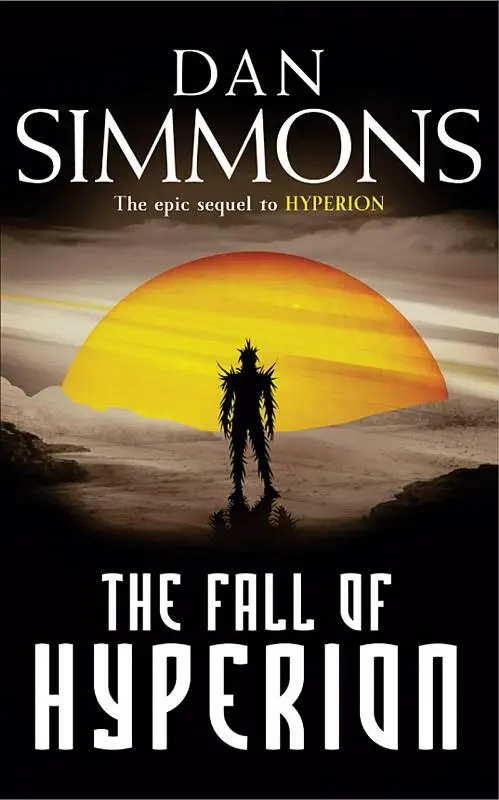
- Название:The Fall of Hyperion
- Автор:
- Издательство:Orion Publishing Group
- Жанр:
- Год:2006
- Город:London
- ISBN:9780575076389
- Рейтинг книги:5 / 5. Голосов: 1
-
Избранное:Добавить в избранное
- Отзывы:
-
Ваша оценка:
The Fall of Hyperion: краткое содержание, описание и аннотация
Предлагаем к чтению аннотацию, описание, краткое содержание или предисловие (зависит от того, что написал сам автор книги «The Fall of Hyperion»). Если вы не нашли необходимую информацию о книге — напишите в комментариях, мы постараемся отыскать её.
The Fall of Hyperion — читать онлайн бесплатно полную книгу (весь текст) целиком
Ниже представлен текст книги, разбитый по страницам. Система сохранения места последней прочитанной страницы, позволяет с удобством читать онлайн бесплатно книгу «The Fall of Hyperion», без необходимости каждый раз заново искать на чём Вы остановились. Поставьте закладку, и сможете в любой момент перейти на страницу, на которой закончили чтение.
Интервал:
Закладка:
The Consul turned, opened his mouth, and closed it without speaking.
“A test,” said Freeman Ghenga.
The Consul’s voice was almost inaudible. “But the Tombs… opened.”
“We knew when they would open,” said Coredwell Minmun. “The decay rate of the anti-entropic fields was known to us. The device was a test.”
“A test,” repeated the Consul. “I killed those four people for nothing. A test.”
“Your wife and child died at Ouster hands,” said Freeman Ghenga. “The Hegemony raped your world of Maui-Covenant. Your actions were predictable within certain parameters. Gladstone counted on this. So did we. But we had to know those parameters.”
The Consul stood, took three steps, and kept his back turned to the others. “Wasted.”
“What was that?” asked Freeman Ghenga. The tall woman’s bare scalp glowed in the starlight and the reflected sunlight from a passing comet farm.
The Consul was laughing softly. “Everything wasted. Even my betrayals. Nothing real. Wasted.”
Spokesman Coredwell Minmun stood and arranged his robes. “This Tribunal has passed sentence,” he said. The other sixteen Ousters nodded.
The Consul turned. There was something like eagerness on his tired face. “Do it, then. For God’s sake get it over with.”
Spokesman Freeman Ghenga stood and faced the Consul. “You are condemned to live. You are condemned to repair some of the damage you have done.”
The Consul staggered as if struck in the face. “No, you can’t… you must…”
“You are condemned to enter the age of chaos which approaches,” said Spokesman Hullcare Amnion. “Condemned to help us find fusion between the separated families of humankind.”
The Consul raised his arms as if trying to defend himself from physical blows. “I can’t… won’t… guilty…”
Freeman Ghenga took three strides, grasped the Consul by the front of his formal bolo jacket, and shook him unceremoniously. “You are guilty. And that is precisely why you must help ameliorate the chaos which is to come. You helped free the Shrike. Now you must return to see that it is caged once again. Then the long reconciliation must begin.”
The Consul had been released, but his shoulders were still shaking.
At that moment, the mountain rotated into sunlight, and tears sparkled in the Consul’s eyes. “No,” he whispered.
Freeman Ghenga smoothed his rumpled jacket and moved her long fingers to the diplomat’s shoulders. “We have our own prophets. The Templars will join us in the reseeding of the galaxy. Slowly, those who had lived in the lie called the Hegemony will climb out of the ruins of their Core-dependent worlds and join us in true exploration… exploration of the universe and of that greater realm which is inside each of us.”
The Consul had not seemed to have heard. He turned away brusquely. “The Core will destroy you,” he said, not facing any of them. “Just as it has destroyed the Hegemony.”
“Do you forget that your homeworld was founded on a solemn covenant of life?” said Coredwell Minmun.
The Consul turned toward the Ouster.
“Such a covenant governs our lives and actions,” said Minmun. “Not merely to preserve a few species from Old Earth, but to find unity in diversity. To spread the seed of humankind to all worlds, diverse environments, while treating as sacred the diversity of life we find elsewhere.”
Freeman Ghenga’s face was bright in the sun. “The Core offered unity in unwitting subservience,” she said softly. “Safety in stagnation. Where are the revolutions in human thought and culture and action since the Hegira?”
“Terraformed into pale clones of Old Earth,” answered Coredwell Minmun. “Our new age of human expansion will terraform nothing. We will revel in hardships and welcome strangeness. We will not make the universe adapt… we shall adapt.”
Spokesman Hullcare Amnion gestured toward the stars. “If humankind survives this test, our future lies in the dark distances between as well as on the sunlit worlds.”
The Consul sighed. “I have friends on Hyperion,” he said. “May I return to help them?”
“You may,” said Freeman Ghenga.
“And confront the Shrike?” said the Consul.
“You will,” said Coredwell Minmun.
“And survive to see this age of chaos?” said the Consul.
“You must,” said Hullcare Amnion.
The Consul sighed again and moved aside with the others as, above them, a great butterfly with wings of solar cells and glistening skin impervious to hard vacuum or harder radiation lowered itself toward the Stonehenge circle and opened its belly to receive the Consul.
In the Government House infirmary on Tau Ceti Center, Father Paul Duré slept a shallow and medically induced sleep, dreaming of flames and the death of worlds.
Except for the brief visit by CEO Gladstone and an even briefer visit by Bishop Edouard, Duré had been alone all day, drifting in and out of a pain-filled haze. The doctors here had asked for twelve more hours before their patient should be moved, and the College of Cardinals on Pacem had agreed, wishing the patient well and making ready for the ceremonies—still twenty-four hours away—in which Jesuit priest Paul Duré of Villefranche-sur-Saône would become Pope Teilhard I, the 487th Bishop of Rome, direct successor of the disciple Peter.
Still healing, flesh reweaving itself with the guidance of a million RNA directors, nerves similarly regenerating, thanks to the miracle of modern medicine—but not so miraculous, Duré thought, that it keeps me from itching almost to death—the Jesuit lay abed and thought about Hyperion and the Shrike and his long life and the confused state of affairs in God’s universe. Eventually Duré slept and dreamed of God’s Grove burning while the Templar True Voice of the Worldtree pushed him through the portal, and of his mother and of a woman named Semfa, now dead, but formerly a worker on Perecebo Plantation in the outback of the Outback in fiberplastic country east of Port Romance.
And in these dreams, primarily sad, Duré suddenly was aware of another presence there: not of another dream presence, but of another dreamer.
Duré was walking with someone. The air was cool, and the sky was a heart-rending blue. They had just come around a bend in a road, and now a lake became visible before them, its shores lined with graceful trees, mountains framing it from behind, a line of low clouds adding drama and scale to the scene, and a single island seeming to float far out on the mirror-still waters.
“Lake Windermere,” said Duré’s companion.
The Jesuit turned slowly, his heart pounding with anxious anticipation.
Whatever he expected, the sight of his companion did not inspire awe.
A short young man walked next to Duré. He wore an archaic jacket with leather buttons and a broad leather belt, sturdy shoes, an old fur cap, a battered knapsack, oddly tailored and frequently patched trousers, and carried a great plaid thrown over one shoulder and a solid walking stick in his right hand. Duré stopped walking, and the other man paused as if welcoming a break.
“The Fells of Furness and the Cumbrian Mountains,” said the young man, using his stick to gesture beyond the lake.
Duré saw the auburn locks curling out from under the odd cap, noted the large hazel eyes and the man’s short stature, and knew that he had to be dreaming even as he thought I’m not dreaming!
“Who…” began Duré, feeling fear surge in him as his heart pounded.
“John,” said his companion, and the quiet reasonableness of that voice set some of Duré’s fear aside. “I believe we’ll be able to stay in Bowness tonight. Brown tells me that there’s a wonderful inn there hard on the lake.”
Читать дальшеИнтервал:
Закладка:
Похожие книги на «The Fall of Hyperion»
Представляем Вашему вниманию похожие книги на «The Fall of Hyperion» списком для выбора. Мы отобрали схожую по названию и смыслу литературу в надежде предоставить читателям больше вариантов отыскать новые, интересные, ещё непрочитанные произведения.





Обсуждение, отзывы о книге «The Fall of Hyperion» и просто собственные мнения читателей. Оставьте ваши комментарии, напишите, что Вы думаете о произведении, его смысле или главных героях. Укажите что конкретно понравилось, а что нет, и почему Вы так считаете.