Kim Robinson - Galileo's Dream
Здесь есть возможность читать онлайн «Kim Robinson - Galileo's Dream» — ознакомительный отрывок электронной книги совершенно бесплатно, а после прочтения отрывка купить полную версию. В некоторых случаях можно слушать аудио, скачать через торрент в формате fb2 и присутствует краткое содержание. Год выпуска: 2009, ISBN: 2009, Издательство: HarperVoyager, Жанр: Фантастика и фэнтези, на английском языке. Описание произведения, (предисловие) а так же отзывы посетителей доступны на портале библиотеки ЛибКат.
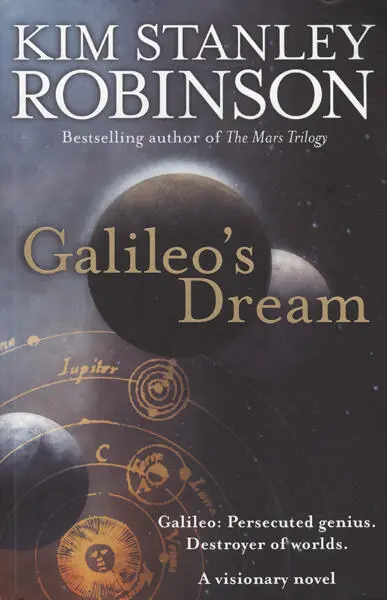
- Название:Galileo's Dream
- Автор:
- Издательство:HarperVoyager
- Жанр:
- Год:2009
- ISBN:978-0-00-726033-1
- Рейтинг книги:5 / 5. Голосов: 1
-
Избранное:Добавить в избранное
- Отзывы:
-
Ваша оценка:
Galileo's Dream: краткое содержание, описание и аннотация
Предлагаем к чтению аннотацию, описание, краткое содержание или предисловие (зависит от того, что написал сам автор книги «Galileo's Dream»). Если вы не нашли необходимую информацию о книге — напишите в комментариях, мы постараемся отыскать её.
Galileo's Dream — читать онлайн ознакомительный отрывок
Ниже представлен текст книги, разбитый по страницам. Система сохранения места последней прочитанной страницы, позволяет с удобством читать онлайн бесплатно книгу «Galileo's Dream», без необходимости каждый раз заново искать на чём Вы остановились. Поставьте закладку, и сможете в любой момент перейти на страницу, на которой закончили чтение.
Интервал:
Закладка:
And so when sometimes you feel strange, when a pang tugs at your heart or it seems like the moment has already happened—or when you look up in the sky and are surprised by the sight of bright Jupiter between clouds, and everything suddenly seems stuffed with a vast significance—consider that some other person somewhere is entangled with you in time, and is trying to give some push to the situation, some little help to make things better. Then put your shoulder to whatever wheel you have at hand, whatever moment you’re in, and push too! Push like Galileo pushed! And together we may crab sideways toward the good.
Acknowledgments
But truly to find a way to adapt physical, metaphysical, and theological senses to words that may have been but a simple fantasy, not to say a chimera of your spokesman, redoubles in me my marvel at minds so acute and speculative.
—GALILEO, LETTER TO LICETI, 1640Thanks for help with this to:
Charlene Anderson, Terry Bisson, Roland Boer, Linda Burbank, Sam Burbank, Joy Chamberlain, Ron Drummond, Joe Dumit, Karen Fowler, Louis Friedman, Dana Gioia, Jane Johnson, Chris McKay, Colin Milburn, Lisa Nowell, Katharine Park, David Robinson, Don Robinson, Carter Scholz, Ralph Vicinanza, and Joëlle Wintrebert.
A special thanks to Mario Biagioli.
Author’s note
“My book sprang wholly from the application of a special sense, very difficult to describe. It is perhaps like a telescope pointed at time.”
—MARCEL PROUSTThe italicized passages in this novel are mostly from Galileo’s writing or that of his contemporaries, with a few visitors from other times. I made some changes in these texts, and many elisions that I did not mark, but I was always relying on the translators who translated the source material from Italian or Latin or French into English. In particular I would like to acknowledge and thank Mary Allan-Olney, Mario Biagioli, Henry Crew and Alfonso de-Salvio, Giorgio de Santillana, Stillman Drake, John Joseph Fahie, Ludovico Geymonat, Maurice A. Finocchiaro, Pietro Redondi, James Reston, Jr., Rinaldina Russell, Dava Sobel, and Albert van Helden.
Despite the work of these translators and many more, not all of Galileo’s writing has yet been translated into English. This is a real shame, not only for novelists writing novels about him, but for anyone who doesn’t speak Italian but does speak English, and wants to learn more about the history of science, or one of its greatest characters. His complete works were first edited by Antonio Favaro at the turn of the last century, then recently revised and updated by a communal effort. Surely some English-language history of science program, or Italian department, or university press, could perform the great service of publishing a complete English translation of the Opere . The project could even be done as a wiki, in a communal online effort. I hope it happens. It would be good to read more of Galileo’s words—even after this moment, when with the writing of this sentence, for me he slips back into the pages. Good-bye maestro! Thank you!
Galileo’s Dream is a work of historical fiction. Apart from the well-known actual people, events, and locales that figure in the narrative, all names, characters, places, and incidents are the products of the author’s imagination or are used fictitiously. Any resemblance to currect events or locales, or to living persons, is entirely coincidental.
Copyright © 2009 by Kim Stanley Robinson
All rights reserved.
Published in the United States by Spectra, an imprint of The Random House Publishing Group, a division of Random House, Inc., New York.
SPECTRA and the portrayal of a boxed “s” are trademarks of Random House, Inc.
Library of Congress-in-Publication Data
Robinson, Kim Stanley.
Galileo’s dream / Kim Stanley Robinson.
p. cm.
eISBN: 978-0-345-51966-5
1. Galilei, Galileo, 1564–1642—Trials, litigation, etc.—Fiction. 2. Religion and science—Italy—History—17th century—Fiction. 3. Space colonies—Fiction.
4. Outer space—Fiction. I. Title.
PS3568.O2893G35 2010
813’.54—dc22 2009042729
www.ballantinebooks.com
v3.0
Интервал:
Закладка:
Похожие книги на «Galileo's Dream»
Представляем Вашему вниманию похожие книги на «Galileo's Dream» списком для выбора. Мы отобрали схожую по названию и смыслу литературу в надежде предоставить читателям больше вариантов отыскать новые, интересные, ещё непрочитанные произведения.





Обсуждение, отзывы о книге «Galileo's Dream» и просто собственные мнения читателей. Оставьте ваши комментарии, напишите, что Вы думаете о произведении, его смысле или главных героях. Укажите что конкретно понравилось, а что нет, и почему Вы так считаете.