Tim Horvath - Understories
Здесь есть возможность читать онлайн «Tim Horvath - Understories» весь текст электронной книги совершенно бесплатно (целиком полную версию без сокращений). В некоторых случаях можно слушать аудио, скачать через торрент в формате fb2 и присутствует краткое содержание. Год выпуска: 2012, Издательство: Bellevue Literary Press, Жанр: Фантастика и фэнтези, на английском языке. Описание произведения, (предисловие) а так же отзывы посетителей доступны на портале библиотеки ЛибКат.
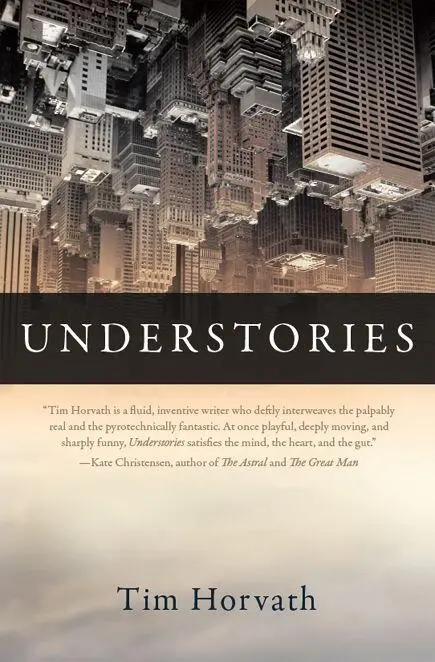
- Название:Understories
- Автор:
- Издательство:Bellevue Literary Press
- Жанр:
- Год:2012
- ISBN:нет данных
- Рейтинг книги:3 / 5. Голосов: 1
-
Избранное:Добавить в избранное
- Отзывы:
-
Ваша оценка:
Understories: краткое содержание, описание и аннотация
Предлагаем к чтению аннотацию, описание, краткое содержание или предисловие (зависит от того, что написал сам автор книги «Understories»). Если вы не нашли необходимую информацию о книге — напишите в комментариях, мы постараемся отыскать её.
, author of Tim Horvath is a fluid, inventive writer who deftly interweaves the palpably real and the pyrotechnically fantastic. At once playful, deeply moving, and sharply funny,
satisfies the mind, the heart, and the gut.” —
, author of
and Remarkable writing and remarkably rewarding reading: stories equally saturated in contemporary fact and transfactual acids. An atlas of canny and uncanny maps, mainly cityscapes, of the branching imagination and convoluted heart. Move over, Mercator and Google Earth: make way for Horvath’s haunting projections.” —
, author of Understories
Cataclysm Baby MATT BELL What if there were a city that consisted only of restaurants? What if Paul Gauguin had gone to Greenland instead of Tahiti? What if there were a field called umbrology, the study of shadows, where physicists and shadow puppeteers worked side by side? Full of speculative daring though firmly anchored in the tradition of realism, Tim Horvath’s stories explore all of this and more— blending the everyday and wondrous to contend with age-old themes of loss, identity, imagination, and the search for human connection. Whether making offhand references to
providing a new perspective on Heidegger’s philosophy and forays into Nazism, or following the imaginary travels of a library book, Horvath’s writing is as entertaining as it is thought provoking.
Tim Horvath
Understories — читать онлайн бесплатно полную книгу (весь текст) целиком
Ниже представлен текст книги, разбитый по страницам. Система сохранения места последней прочитанной страницы, позволяет с удобством читать онлайн бесплатно книгу «Understories», без необходимости каждый раз заново искать на чём Вы остановились. Поставьте закладку, и сможете в любой момент перейти на страницу, на которой закончили чтение.
Интервал:
Закладка:
“So you stargazed inside the school,” Lena said.
“That’s precisely what we did. And not just once, a few times. We had the complete getup. Learned to spot the constellations. Good for romantic purposes, heh. Told stories. Just like we were a thousand miles from the city, in the middle of nowhere. I remember I never wanted to leave that place. Knew I’d been born in the wrong place or the wrong time or somethin’, knew it truer than I’d ever known anything.”
“So what happened to it?” asked Lena.
“Guess. Someone took it too far. We were going to do it every month, was the idea. We’d even imitate the position of the stars across the sky; remember, this was a science and math school. But then one kid— not a rocket scientist, this one — decides he’s gonna make s’mores, and tries to light an actual fire in a wastebasket. Freakin’ idiot, pardon my language,” said Scully. “Set off the smoke alarm. Duh. We had to clear out of there, which we managed to do before the fire department shows up. The next week, there’s a new electronic alarm system on the planetarium door, like nothing you’ve ever seen. It’s like Area 51, ‘Closed to the General Public.’ I doubt if even the parents got to see it again after that.”
“How sad,” said Lena. “I mean, there’s something so innocent about what you were doing. It’s not like you were. . up to no good.”
“Well, it wasn’t entirely pure,” said Scully. “We did everything — I mean everything —that you do while stargazing.” Suddenly he drew up.
“This is it,” he said. By now I’d almost forgotten why we were out here. The trail ahead hugged the side of the cliff for about a hundred feet. You could see the road below like an ancient riverbed. The bare exposure meant that the sides did not look so steep, because you could see if you slipped the several places where you might cling to a flatter patch if you slipped. But I thought that might have been illusion. Scully strutted out onto the ravine. He looked remarkably like one of those goats. I examined his cable. It looked like a bike lock that had been uncoiled and stretched out and every few feet secured to the rock. He gave it a yank. “It’ll hold. Most of the time, you don’t even need it, but it’s there for you just in case.” Emmett shied back, and Kelly looked like she wanted to approach it, like the cage of a dangerous animal. She put her hand out from afar. Lena had her hand on Kelly’s shoulder. She reached for the cable and he pulled it toward her, but it did not quite meet, and she leapt back. You could hear the wind moving things, shifting rocks. “I think this is as far as we go, Scully,” I said.
We began silently making our way back. Sure enough, I was lofting Emmett onto my back before long. In my mind, I started cross-examining Scully on how the drilling had been done to stabilize the cable, how the core samples might have been taken. I figured he probably didn’t know the first thing about how it had been done. I pictured him aiming a drill bit at that rock and gouging it again and again. I pictured him flustered by my questions, trying to dance his way through them, or sidestepping and changing the subject.
For a while, there was nothing but the sound of our sneakers crunching gravel and thumping on dirt. Then Scully said, “So how come you never joined the Planetarium Club? I mean, you must have known about it. Carl, John Paul. You were friends with those guys.”
I squinted. “I think I remember hearing something about it. But I don’t think I ever got the word, the signal.”
“You had,” said Scully, “maybe you’d have cleared out of the city, like me. Maybe you’d have gotten a yearning for remote places.”
“It’s certainly possible,” I said. “Then again, it’s possible that I wouldn’t have. You never know how something is going to affect a person.”
“That much is true,” said Scully, shaking his head, looking off again, like he was grateful anew for something. Suddenly, Scully elbowed me and said loudly, “Now wait a minute, you were there, weren’t you?”
“Nope,” I said. “If only I had been.”
Lena said, “But then maybe you wouldn’t have stayed in New York. And you wouldn’t have met me. And you wouldn’t have these lovelies.” She patted the backs of their shoulders, and the pair of them looked up as if right then I was deciding whether or not to keep them.
We kept going up the trail, and even though I didn’t want to stop, I had to put Emmett down. “You’re getting too big for me to do that for very long,” I said.
As if no time had elapsed, Scully said again, “You were there.”
I denied it again.
He paused, suddenly, hands on his hips. “Well, maybe you don’t remember.”
“That doesn’t sound like the kind of thing you ‘don’t remember,’” I said.
Lena said, “I would hope not.”
We continued up the trail, and I could hear Kelly, bored by now with plain old walking, break into her little rhyme. It went, “Dah, dah, DAH!” sounds that kept almost forming themselves into words, but falling short. It sounded like a story that she was telling only herself. For a couple of minutes, it was just that and the rustle of our feet and Emmett’s sneaker-flickers. We all fell into a rhythm. So it took me by surprise when Scully stopped short and pinched the flap of my shirt pocket, like he was grabbing for the compass, and said, “Come here for a second, I want to show you something. Just you.” He called out to my wife and kids, “It’s just an old Tompk tradition. I’ll have him back in a jiffy.” I hadn’t heard that mpk sound in a long time.
Lena, her eyebrows raised, glanced tellingly at her watch. Kelly skipped in a circle, but Emmett stood forlornly. I shrugged to them. I said, “Be right back,” then added, “Holler if you spot more mountain goats.”
Scully led me just off the trail, through patches of scrub and taut branches. He was just a step in front of me. The crunch of scrabble and dry grass below and the hiss of the wind created two discrete strata of sound. He bent back a branch, a real gentleman, so I could pass. It snapped back behind me. As it did, I found myself on a narrow rock that jutted out sheer into space. In a Western, our horses would’ve had to rear back, whinnying. I aligned myself with the rock’s width, what there was of it, checked my footing. The drop was precipitous. The Skull came out onto the rock, so he was facing me. Then, with his hands turned sideways, he touched my shoulders, so that the lower edges were resting right on my scapula.
I panted. “What are you doing there, Scully, hanging up a portrait?” I could hear the pounding of breath, as though one of us had just hoisted the other one up, right over the lip of the ravine.
He stared at me. “Admit it now. You were there.”
“You’re crazy,” I said. I meant it.
He shook his head. “Why won’t you just admit you were there?” He was all throat now.
“Let’s just say I was, Scully. Then what?” I heard my heartbeat. “But of course I wasn’t.”
His mouth was tight. I could see the imprint of his tongue on the inside of his cheek. “I can’t figure it out,” he said. “It’s not as if it’s something to be ashamed of.”
“On the contrary,” I said. “I’m ashamed to have missed out.”
His hands stayed wedged there. I couldn’t tell whether they’d begun pushing down or whether my shoulders were rising, but either way I could feel little balls of bone against his thick fingers on either side. It reminded me of a building I’d worked on. Prestressed cables to offset unknown load combinations. And I zeroed in on that building. I became it, poised between evenly spaced twinges of pain. Under his flannel, the road looked so far away and weirdly proportioned that it could have as easily been up or down. Looking back up at him, I caught menace moving quickly like a sheath of cloud. I imagined him explaining to my wife in a calm voice that I’d fallen, somehow.
Читать дальшеИнтервал:
Закладка:
Похожие книги на «Understories»
Представляем Вашему вниманию похожие книги на «Understories» списком для выбора. Мы отобрали схожую по названию и смыслу литературу в надежде предоставить читателям больше вариантов отыскать новые, интересные, ещё непрочитанные произведения.









Обсуждение, отзывы о книге «Understories» и просто собственные мнения читателей. Оставьте ваши комментарии, напишите, что Вы думаете о произведении, его смысле или главных героях. Укажите что конкретно понравилось, а что нет, и почему Вы так считаете.