Dan Vyleta - Smoke
Здесь есть возможность читать онлайн «Dan Vyleta - Smoke» весь текст электронной книги совершенно бесплатно (целиком полную версию без сокращений). В некоторых случаях можно слушать аудио, скачать через торрент в формате fb2 и присутствует краткое содержание. Год выпуска: 2016, Издательство: W&N, Жанр: Фантастика и фэнтези, на английском языке. Описание произведения, (предисловие) а так же отзывы посетителей доступны на портале библиотеки ЛибКат.
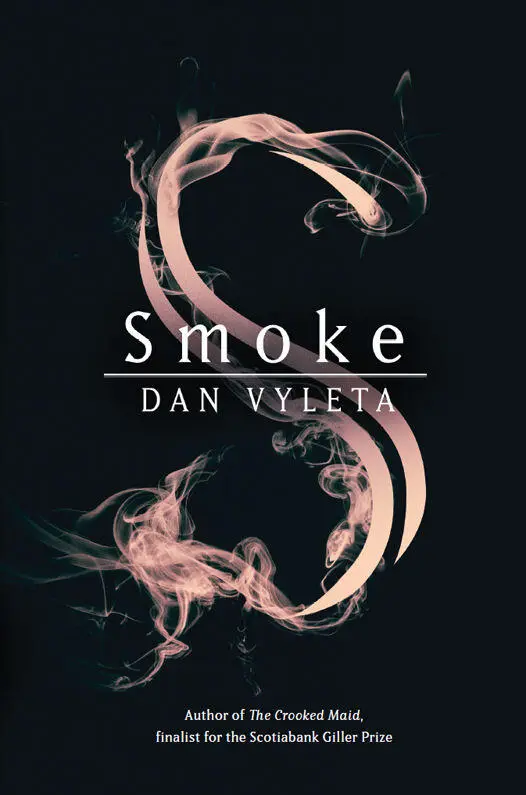
- Название:Smoke
- Автор:
- Издательство:W&N
- Жанр:
- Год:2016
- ISBN:нет данных
- Рейтинг книги:4 / 5. Голосов: 1
-
Избранное:Добавить в избранное
- Отзывы:
-
Ваша оценка:
Smoke: краткое содержание, описание и аннотация
Предлагаем к чтению аннотацию, описание, краткое содержание или предисловие (зависит от того, что написал сам автор книги «Smoke»). Если вы не нашли необходимую информацию о книге — напишите в комментариях, мы постараемся отыскать её.
If sin were visible and you could see people's anger, their lust and cravings, what would the world be like?
Smoke opens in a private boarding school near Oxford, but history has not followed the path known to us. In this other past, sin appears as smoke on the body and soot on the clothes. Children are born carrying the seeds of evil within them. The ruling elite have learned to control their desires and contain their sin. They are spotless.
It is within the closeted world of this school that the sons of the wealthy and well-connected are trained as future leaders. Among their number are two boys, Thomas and Charlie. On a trip to London, a forbidden city shrouded in smoke and darkness, the boys will witness an event that will make them question everything they have been told about the past. For there is more to the world of smoke, soot and ash than meets the eye and there are those who will stop at nothing to protect it. .
Smoke — читать онлайн бесплатно полную книгу (весь текст) целиком
Ниже представлен текст книги, разбитый по страницам. Система сохранения места последней прочитанной страницы, позволяет с удобством читать онлайн бесплатно книгу «Smoke», без необходимости каждый раз заново искать на чём Вы остановились. Поставьте закладку, и сможете в любой момент перейти на страницу, на которой закончили чтение.
Интервал:
Закладка:
“How many humiliations has he witnessed?
“ Father. A poor surrogate this: stupid, coarse, clumsy like a fool. A caricature bought to mock him; kept in service as an admonition, as a joke. The thought thickens the Smoke in his mask, flavours it with childhood. Our friend’s an orphan, you see, or something very like. His parents were a picture frame on the table by his boyhood bed. ‘This one’s a snake,’ his grandfather explained, ‘and that one was a sissy. It’s a wonder he sired you at all.’ No good-night kisses, just the heavy touch of the old man’s hand. A boy not bred for weakness. Crosshairs drawn on his father’s chest. A curl of the finger. The smoke of the gun swallowed by the billows of his personal pyre.
“Parricide. You might think it’d be enough, the wages paid, the mask satisfied. But the lad has already worked the bolt. He sights another target; a young man standing in the open door of the coach. The telescope brings him ever so close. Fun-house mirror: like a twin born to different loins. Gawking, not yet in fear; the mouth an arching O. Three shots. The third one hits him, right in the head. The whiplash of impact. By rights he should be dead.
“Then the coach tilts and is swallowed by a hole. Our prince does not understand it, thinks the earth has opened for his prey. Birds in the sky. The chamber empty; the hammer falling useless; fingers too Soot-slick to reload.
“By now the mask owns him, has grown into his skin. It is also suffocating him. It’s in his struggle for air that he manages to rip it off. Dry heaves and tears: the wind has turned, his own Smoke is stinging in his eyes. On the floor, the barrel of his rifle trips up his feet.
“How does he get down? It might be said that he’s gone mad. Only a madman would risk the windmill’s ladder while his body is shivering with cold and shock; would walk the hundred yards clothed only in a coat of Soot; would crouch, naked, over the broken body of his man and christen it, gape-mouthed, with his snot. Our friend loses his balance when he tries to blow his nose; he falls in the dirt, faceup, and watches starlings dance dark clouds into the sky.
“The coach, meanwhile, lies at the bottom of a steep ravine. He looks down at it, sees a threesome of figures disappear into the woods. They may have seen him, recognised him. Hence he must follow. But how? He is naked and dirty and left his horse in the stable so no one knows he ever left. Something else holds him back, a discovery. He finds that, without the mask, he is once again a schoolboy, a coward. There’s a creek on the way home where he washes his hands, his neck and face with soap of lavender and lye. Only then does he step into his clothes, the Soot so thick on his thighs and knees that it chafes raw his skin on the three-mile jog home. He slips inside through a back gate and then makes sure he is seen to emerge from his room late-morning, his usual time. Kippers for breakfast, and a potful of strong tea.
“Do you know something? Tea tastes better, the thinner the cup. The china is so fine in this house, if you hold it up into the light it shines right through. And so she finds him, distracted, his empty cup raised into the morning sun: a servant girl, replenishing the toast.
“‘Is everything all right, sir?’ she asks in her simple way.
“ Is everything all right? Have you ever tried to picture the moment, my friends, when a moth first slips the confines of its pupal prison and wonders at the colour of its new-grown wings? Sitting wet and sticky in the wind, waiting to take flight. I imagine it is terrified at first. It is only later that it begins to see itself reborn.
“‘Never better,’ I say, and surprise the girl with the shy twitch of a smile.”
ф
And so it passes, our evening, the jug making its rounds, the liquor churning in me till I get up and vomit half-cooked rabbit. They tell me about leaving Ireland. The father who gambled; the sister they buried; the Englishman who cheated them out of shop and land. Talk is like Smoke, I discover: once in the air, it breeds with abandon. I tell them many things. My plans and secrets; my life and dreams. I talk and talk.
It does me the world of good.
ф
I wake before them, with the first hazy light. I have heard about the price of consuming alcohol, but my head is clear and my blood oddly eager, embracing its fate. I do not get dressed at once. The two Irishmen made no attempt to rob me: Nótt kept watch. Besides, we are friends now. Daniel and Stephen. From Donegal.
The knife cuts Daniel’s throat like butter. The blood spurts up, onto the mask: smears against the eyeglass, seeing red. What’s in my lungs, what’s rising up the insect’s snout and coating my mouth, has no need for sight. It guides my hands by touch. As for the boy beneath the mask, he has no wish to see.
Stephen I beat with the barrel of my gun. He wakes on the second blow and is dead on the third. Pale green eyes; the eyelashes sticky with sleep.
I leave them with ten silver guineas. The rifle I also leave behind, slip it loosely into Daniel’s hands so that his fingers rest on the silver butt he so admired. Two dead Irishmen with money in their pockets and a foreign gun. Show me a magistrate in England who can’t close an inquest based on evidence as good as this.
By the time dawn proper breaks I am two miles west. Snow is coming down in thick, wet flakes. It will be rough going today. There is not a soul to be seen. It is midmorning by the time I realise I am still wearing the mask. Its buckles are stiff under my frozen fingers.
“Abomination,” I rage as I wrestle to take it off. “Freak, monster, elephant man.”
Soon it will own me, body and soul.
Perhaps Mother would help me. I could still turn around.
But there is no time.
Charlie Cooper is spreading stories about me down the road.
QUESTIONS AND ANSWERS
When Charlie wakes the room is flooded with daylight. He senses rather than sees it, has trouble opening his eyes. His body does not follow orders, lies leaden under the down bedding, a stranger to his will. He mutters in surprise and finds his tongue sitting dry and heavy in his mouth, so swollen he has to breathe around it. No sound will come. As he struggles against his eyelids’ weight, a soothing voice sounds close by.
“Easy now, Mr. Cooper, take your time. There was a sleeping draught in the milk. You were in need of rest. Here, I will help you sit up.”
The dark shadow of Renfrew bends over him, slips a second pillow behind Charlie’s back, then sits down again on the stool he has drawn up to Charlie’s bedside.
“There, that’s better.”
Renfrew reaches forward with a washcloth and wets Charlie’s lips.
“You must be quite parched. It is one of the draught’s side effects.”
Embarrassed at being the subject of such mothering, Charlie once again attempts to shake off his drowsiness or at any rate take charge of his limbs. It is then he realises his wrists are manacled to the bed frame with leather restraints. A vision of Baron Naylor shoots through him, strapped onto his bed, smoking darkly in the attic. It helps in its way.
Fear bids Charlie wake.
“Ah, I think you are coming round now. Very good. I was starting to be afraid I had given you too much. It’s gone ten o’clock. Not that it would have been a day for travelling. The snow has been coming down thick and fast. I imagine the road is quite impassable.”
Renfrew places a hand onto Charlie’s forehead, checking his temperature, then slips a finger between Charlie’s wrists and the restraints, making sure they are not cutting into Charlie’s skin. The finger lingers a moment, takes Charlie’s pulse. Throughout, Renfrew’s movements are unhurried, efficient. He would have made a good doctor, or better yet, a surgeon, excising rotten flesh with a steady hand. His task accomplished, Renfrew straightens, smoothes his necktie and collar, and looks Charlie straight in the eye.
Читать дальшеИнтервал:
Закладка:
Похожие книги на «Smoke»
Представляем Вашему вниманию похожие книги на «Smoke» списком для выбора. Мы отобрали схожую по названию и смыслу литературу в надежде предоставить читателям больше вариантов отыскать новые, интересные, ещё непрочитанные произведения.






Обсуждение, отзывы о книге «Smoke» и просто собственные мнения читателей. Оставьте ваши комментарии, напишите, что Вы думаете о произведении, его смысле или главных героях. Укажите что конкретно понравилось, а что нет, и почему Вы так считаете.