Dan Vyleta - Smoke
Здесь есть возможность читать онлайн «Dan Vyleta - Smoke» весь текст электронной книги совершенно бесплатно (целиком полную версию без сокращений). В некоторых случаях можно слушать аудио, скачать через торрент в формате fb2 и присутствует краткое содержание. Год выпуска: 2016, Издательство: W&N, Жанр: Фантастика и фэнтези, на английском языке. Описание произведения, (предисловие) а так же отзывы посетителей доступны на портале библиотеки ЛибКат.
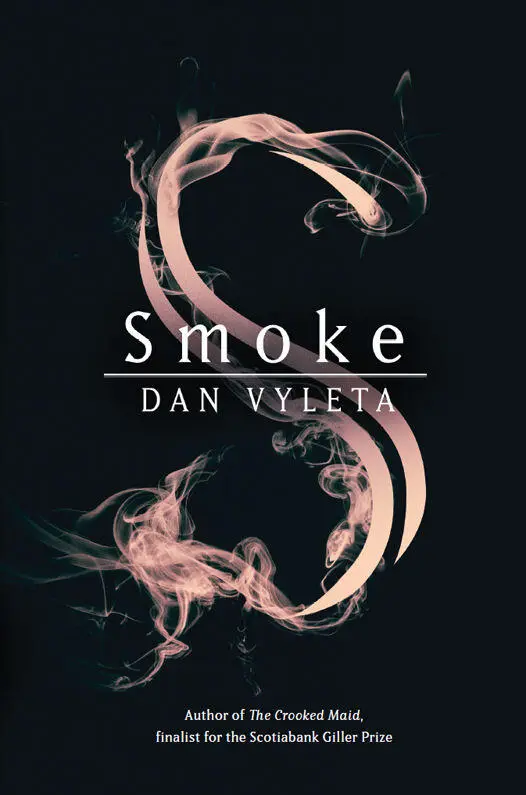
- Название:Smoke
- Автор:
- Издательство:W&N
- Жанр:
- Год:2016
- ISBN:нет данных
- Рейтинг книги:4 / 5. Голосов: 1
-
Избранное:Добавить в избранное
- Отзывы:
-
Ваша оценка:
Smoke: краткое содержание, описание и аннотация
Предлагаем к чтению аннотацию, описание, краткое содержание или предисловие (зависит от того, что написал сам автор книги «Smoke»). Если вы не нашли необходимую информацию о книге — напишите в комментариях, мы постараемся отыскать её.
If sin were visible and you could see people's anger, their lust and cravings, what would the world be like?
Smoke opens in a private boarding school near Oxford, but history has not followed the path known to us. In this other past, sin appears as smoke on the body and soot on the clothes. Children are born carrying the seeds of evil within them. The ruling elite have learned to control their desires and contain their sin. They are spotless.
It is within the closeted world of this school that the sons of the wealthy and well-connected are trained as future leaders. Among their number are two boys, Thomas and Charlie. On a trip to London, a forbidden city shrouded in smoke and darkness, the boys will witness an event that will make them question everything they have been told about the past. For there is more to the world of smoke, soot and ash than meets the eye and there are those who will stop at nothing to protect it. .
Smoke — читать онлайн бесплатно полную книгу (весь текст) целиком
Ниже представлен текст книги, разбитый по страницам. Система сохранения места последней прочитанной страницы, позволяет с удобством читать онлайн бесплатно книгу «Smoke», без необходимости каждый раз заново искать на чём Вы остановились. Поставьте закладку, и сможете в любой момент перейти на страницу, на которой закончили чтение.
Интервал:
Закладка:
“There has to be a letter,” I say. “An investigation.”
Trout won’t have it. Soft, he is, or else adaptable . Changing times: turning with how the wind blows.
“Confiscate the book,” he says, “and let it rest.”
Let it rest indeed. He didn’t hear the boy: “Please, sir. I don’t understand. Why is it forbidden?” Snot on his lip from all the crying, sitting there like a wet moustache.
I could have told him, of course, could have recited the Stratford Verdict, chapter and verse ( Seeing that theatre depicteth sin and maketh it a matter of entertainment; that it maketh bad actors commit the action of sin without the sign of Smoke, and good actors inhabit sin so thoroughly that their crime showeth on the skin; that the former createth an illusion that sin be possible without Smoke, and the latter forceth paid servants to distort their souls for the sake of spectacle; that in short the whole enterprise be lewd and filthy, unbecoming to gentlemen and dangerous for the crowd; that its lessons and morals, however pious, be lost behind intemperate words and idle shouting; and theatres be cow barns plastered with Soot; for all these reasons, and by the power invested in us by the Crown, we henceforth forbid and banish the performance, circulation, writing, and reading of theatre plays, be they comedy or tragedy, history or romance, from this our realm from this day forward etc. etc. ), but that is hardly the point. Obedience is. A boy must not question. A new wind is blowing indeed. Renfrew’s kind of wind. Some mornings one can smell its stench all the way from London.
There are other portents. Spencer has begun to smoke. Julius, the head boy, primus inter pares . He has been seen, coming out of Renfrew’s office, with Soot on his sleeve. A pure boy, the purest we’ve had. Corrupted by his own master.
And by the presence of that other boy. Argyle, Thomas Winfried. A child of sin. He smokes most every day, like a workman’s boy in puberty. Even the servants avoid him, the kitchen hands, the groundsman living in his shed on the south field. Noble by birth, Mr. Argyle is, if we have faith in the honour of his mother. Yet common as dirt. There is some mystery attached to his father’s name, but Trout forbade all questions and discussion on pain of suspension. Argyle must have a powerful sponsor indeed.
For now he has been summoned by one of the highest in the land. Baron Naylor, lord of Stanley Hall, Marquess of Thomond. Nobody’s seen hide nor hair of him for nigh on ten years. Fell out with the Queen, some say; lost her trust. Trout’s sending Cooper, Charles Henry Ferdinand. The future Earl of Shaftesbury. A redhead, more pedigree than a prizewinning bitch; his father a beacon in this, our dusk. He must be disappointed with his son.
Naturally Trout will want a report from the boy. I wonder. Is it the state’s business, or his own? And if the state’s, which corner of its civil service? There are divisions now, where there once was unity: the commonweal crumbling like a slice of sailors’ rusk.
The New Liberalism. Science. Self-Governance. Progress. Fancy words harbouring heresy. A sin turned political movement. Sitting there, in Parliament, in plain sight.
Renfrew is a liberal.
Ask yourself: who studies his linen?
PART TWO THE MANOR
The crew, man, the crew! Are they not one and all with Ahab, in this matter of the whale? See Stubb! he laughs! See yonder Chilian! He snorts to think of it. Stand up amid the general hurricane, thy one tost sapling cannot, Starbuck!. . (Aside) Something shot from my dilated nostrils, he has inhaled it in his lungs. Starbuck now is mine; cannot oppose me now, without rebellion.
HERMAN MELVILLE, MOBY-DICK (1851)LESSONS
They take a late-morning train. Thomas calculates they should get there well before nightfall, but they have to change twice and miss their connection at Rugby. The station is dreary and empty, the waiting room a row of wooden benches clustered around an oven without heat. A conductor tells them there will be a train within the hour, but three o’clock passes, then four, then five, before he reappears, buttoned up tight and smelling of Smoke and brandy, informing them there has been a delay.
It is eight by the time they board the train and they are frozen through. In their compartment a stack of blankets sits folded on the luggage rack. They fetch them down and wrap themselves in the plain brown wool which appears clean but gives off a bitter, funky smell, as of soiled sawdust.
Thomas and Charlie have spoken little in the past hour. The long day of waiting has exhausted their conversation and they are both busy with their hunger, having shared the last sandwich and the last apple not an hour after pulling out of Oxford, taking turns, bite for bite, each making sure he did not get the last. It left them nibbling at scraps in the end, laughing, passing the wretched piece of apple core back and forth, until Thomas swallowed it, seeds, stem, and all, and nearly choked himself with laughter. Now their silence sits with them in the compartment while, outside, high winds batter the train.
“You hungry?” Charlie asks at one point, his own stomach growling in the dark.
“No,” Thomas lies. “You?”
“No.”
“Tired?”
“Not a bit.”
“Same here.”
ф
They both startle awake as the train comes to a stop. Mechanically they shake off the blankets and fetch their luggage down only to realise it isn’t yet their station. It is hard to say how much time has passed. Darkness presses in on them, seems confirmed rather than relieved by a single gas flame shivering in its glass cage on the station platform. The wind is like a living thing, searching their windows for purchase, pushing fingers, tongues in through the cracks.
As his eyes adjust, Thomas comes to realise that the platform is not as deserted as he had assumed. A group of men, women, and children huddle against the wall at the far side of the building, downwind from the storm. There may be as many as a dozen of them; have formed a circle, their faces focussed on the centre. When the train starts up again, they draw level. It is too dark to read any features, but their gestures and stance speak of a violent excitement, clenched fists and wide-open mouths, the feet planted wide apart. At the centre of their man-made ring, two figures are wrestling, one atop the other, the upper stripped to his waist. They pass too quickly to say whether it is two men or a man and a woman; whether they are fighting or engaged in something yet more intimate. The whole group is steaming with a misty Smoke, snatched off their bodies by the storm and blown down-country where it will plaster a barn, a house, a shade tree with their wind-borne sin.
Then they are gone.
Charlie and Thomas go on looking out the window long after they have passed the group, though now, coated by country dark, the pane has turned into a rain-streaked mirror.
“Pedlars?” Charlie asks at last. “Circus people? Irishmen?”
Thomas shakes his head. “Who knows.”
The words are laced with a familiar flavour; the mirror shows a shadow darting from his mouth.
“A group like that,” Charlie goes on, “they infect each other over and over. Like a tiny, travelling London.” He sighs. “I wish we could find a way to save them.”
“Save them? Whatever for? Leave them in their filth. They deserve it. Isn’t that the point of Smoke?”
The words come out wrong, hard and flat and ugly. Charlie looks at him in shock. Afraid that Thomas means them, aware of the smell that’s filling the compartment. For a moment, Thomas searches for a phrase that will explain. But you cannot unsay the said. And how do you account for the yearning, distinct in his chest, to go back and join the men and women in their circle, find out what it was that those two figures did, half naked on the freezing brick of the station platform?
Читать дальшеИнтервал:
Закладка:
Похожие книги на «Smoke»
Представляем Вашему вниманию похожие книги на «Smoke» списком для выбора. Мы отобрали схожую по названию и смыслу литературу в надежде предоставить читателям больше вариантов отыскать новые, интересные, ещё непрочитанные произведения.






Обсуждение, отзывы о книге «Smoke» и просто собственные мнения читателей. Оставьте ваши комментарии, напишите, что Вы думаете о произведении, его смысле или главных героях. Укажите что конкретно понравилось, а что нет, и почему Вы так считаете.