Jaroslav Kalfař - Spaceman of Bohemia
Здесь есть возможность читать онлайн «Jaroslav Kalfař - Spaceman of Bohemia» весь текст электронной книги совершенно бесплатно (целиком полную версию без сокращений). В некоторых случаях можно слушать аудио, скачать через торрент в формате fb2 и присутствует краткое содержание. Город: New York, Год выпуска: 2017, ISBN: 2017, Издательство: Little, Brown and Company, Жанр: Фантастика и фэнтези, на английском языке. Описание произведения, (предисловие) а так же отзывы посетителей доступны на портале библиотеки ЛибКат.
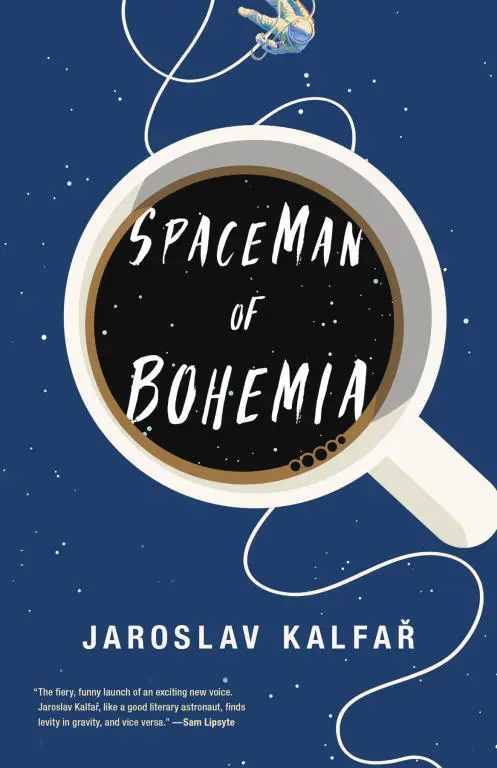
- Название:Spaceman of Bohemia
- Автор:
- Издательство:Little, Brown and Company
- Жанр:
- Год:2017
- Город:New York
- ISBN:978-0-316-27340-4
- Рейтинг книги:4 / 5. Голосов: 1
-
Избранное:Добавить в избранное
- Отзывы:
-
Ваша оценка:
Spaceman of Bohemia: краткое содержание, описание и аннотация
Предлагаем к чтению аннотацию, описание, краткое содержание или предисловие (зависит от того, что написал сам автор книги «Spaceman of Bohemia»). Если вы не нашли необходимую информацию о книге — напишите в комментариях, мы постараемся отыскать её.
quickly turn weird, and, to make matters worse, he soon learns that his wife has disappeared without a trace back on Earth.
As his spaceship hurtles toward an unknown danger and his sanity wavers, Jakub encounters an unlikely fellow passenger—a giant alien spider. He and his strange arachnid companion form an unlikely bond over late-night refrigerator encounters, where they talk philosophy, love, life, death, and the incomprehensible deliciousness of bacon. But when their mission is thrown into crisis by secret Russian rivals, Jakub is forced to make violent decisions—recalling the tortured past and dark political heritage he’s buried—in a desperate quest to return to his Earthly life.
Packed with nail-biting thrills, exuberant heart, and surprising and absurd humor in the lineage of Kafka and Vonnegut, Spaceman of Bohemia offers an extraordinary vision of the endless human capacity to persist—and risk everything—in the name of love and home.
Spaceman of Bohemia — читать онлайн бесплатно полную книгу (весь текст) целиком
Ниже представлен текст книги, разбитый по страницам. Система сохранения места последней прочитанной страницы, позволяет с удобством читать онлайн бесплатно книгу «Spaceman of Bohemia», без необходимости каждый раз заново искать на чём Вы остановились. Поставьте закладку, и сможете в любой момент перейти на страницу, на которой закончили чтение.
Интервал:
Закладка:
I closed the email. Male acquaintance. Possible involvement . Perhaps the surveillance was a terrible idea—the guilt was not worth the minimal relief it provided. But the guilt of spying on Lenka did not overpower the sudden thirst this report had created in me to know her every meal, every conversation, every sigh that could possibly be dedicated to me, perhaps a scent that reminded her we used to wake up to each other. Anything could be a clue to her return.
Thanks, I wrote to Petr, this means everything .
I rubbed my sore eyes and shut off the Lounge lights, a habit from home I could not shake, despite having limitless solar energy at my disposal. Somehow, not flicking a switch still seemed wasteful.
I made my way to the kitchen for a midnight snack, and recoiled at the sight.
The open refrigerator door was, along with the counters, covered in thin blotches of chocolate spread. A white lid floated across the room, cracked in two, and in front of me, suspended in midair, was the creature, two of its legs scratching along the inside of the Nutella jar. The creature blinked a few times, then extended the jar toward me.
“I am ashamed,” it said. “I seem to have acquired an inability to resist impulses when it comes to Earth’s hazelnut.”
With a trembling hand, I recovered the jar. “You’re back.”
“After our unpleasant confrontation, I needed to meditate and reconsider. You must understand that our encounter is not a simple matter for me.”
I approached the pantry and removed a package of tortillas. I spread the hazelnut miracle on the tortillas and rolled them up into anorexic burritos. The creature’s legs quivered as it watched me, possibly a sign of excitement.
“I’m happy you’re here,” I said.
“Before my departure, you asked about a name. My kind has no need for distinguishing marks, identities. We simply are. Would it help you to call me by a name, skinny human?”
“It would.”
“Call me by a smart human’s name. The name of a philosopher king, or a great mathematician.”
I revisited the catalog of great humans, the astonishing chronicle shining through the stained pages of history. There were so many—enough to convert anyone, briefly, to a perky optimist—but the correct one presented itself with absolution, as if the ghost of Adam’s first naming were speaking through me. Once upon a time, Adam pointed at what then was nothing, and he declared, Rabbit. And thus nothing became a rabbit .
“Hanuš,” I said.
And thus nothing became Hanuš.
“What has he done?” Hanuš asked.
I offered the burrito. With a grin, Hanuš accepted it between his teeth. He chewed with his lips and eyes closed, the bottom of his belly swinging from side to side as he emitted a low-pitched grumble resembling the sound of a large dog begging for treats. I was not sure why I had taken to calling him a he, as there was no sign of genitals.
“He constructed the astronomical clock in Prague. Orloj,” I said. “Later the city hired thugs to stick hot iron rods in his eyes, so that he would never build another. With blood dripping from his sockets, Hanuš reached inside the clock and interrupted its functions with a single flick of his hand. No one could fix the clock for the next hundred years.”
“He was an astronomer.”
“Yes. An explorer. Like yourself.”
“I will be called Hanuš.”
The creature settled on the floor, suddenly unaffected by zero gravity. He extended a leg toward me, his lips spread into a wide smile, regaining their previous bright red color. I touched the pointed tip of the leg, felt the hard sleek shell beneath the hairs. The tip was hot, like a freshly poured cup of tea. I made two more burritos.
“Why did you choose me?” I asked Hanuš.
“I have surveyed Earth from its orbit, skinny human. I have studied your history and learned your languages. Yet, having accessed all knowledge, I do not seem to understand. My original intent was to study you for a day or two, observe your habits. But access into your memory trapped me. I wished to know more, always. The great human specimen, an ideal subject.”
“If you say so.”
“Your question, of course, is what you can receive from me.”
“A hair sample. Blood sample. Anything you can give. The greatest gift would be for you to come to Earth.”
“Humanry does not inspire the trust required,” Hanuš said. “There is no benefit for my tribe. And I regret I cannot give you a piece of myself. The body cannot be violated. It is the law.”
“Is there nothing we could exchange?”
“Let us begin with the two of us—the awareness of single beings—and see where our cohabitation takes us.”
I nodded, and bit into the burrito. Could Hanuš presently read my thoughts of desperation? Czech astronaut discovers intelligent life in Space. The Czech president is the first world leader to shake hands with the extraterrestrial, and gives him a tour of the Prague Castle. State heads overwhelm the Prague airport with their aircrafts and stand in line to meet the new life-form. Hanuš agrees to noninvasive research by Czech scientists, and his organic functions lead to stunning advances in biology and medicine. The question of God’s death is debated more hotly than ever. Atheists reaffirm his nonexistence; Catholics speak against the demon spreading Satan’s deception. I am at the center of it all. Hanuš refuses to travel anywhere without my company.
“Do not hope for such things, skinny human,” Hanuš said, “though I must ask—is it possible to share more of Earth’s hazelnut?”
After making another wrap, I slid my hand inside the jar and the tortilla package to confirm that the ingredients I had used for Hanuš were truly vanishing. Madness remained an option, despite everything. That night, I slept without needing medication.
THE FOLLOWING DAY, I was scheduled to engage with selected citizens in a videoblog session. The first barrage of questions was business as usual—my religious beliefs, my opinion on wasting taxpayers’ money on the mission, the workings of Space toilets. The last question of the day came from a young man, a university type, with thin-lensed eyeglasses and a lisp. His awkward throat-clearing reminded me of my old university friends, those manic beings racing through downtown Prague with backpacks and McDonald’s sacks in hand, always frantic, always fidgeting, their hyperactive disorders a manifestation of sincere beliefs that they will, they must change the world. As soon as the young man asked his question, Petr’s eyes widened in horror on the second screen. It was obvious that the young man had lied about his question during the prescreening. His inquiry was number one on Central’s blacklist.
“How often do you think about dying due to mission failure?” he asked. “Does it make you feel anxious, or numb?”
I looked at Petr. He fondled his forehead and nodded weakly. The question had been posed, and cutting the live feed would only make it obvious to the nation that secrets were being kept, narratives manipulated, public perception controlled. No, in a democracy, a raised question resonates with a never-ending echo. I was to answer.
“When I think about death,” I said, “I think of a sun-covered porch in the mountains. I take a sip of hot rum. I take a bite of cheesecake, and I ask the woman I love to sit on my lap. Then, death.”
The ease with which I invented this false fantasy sent guilt aches into my head. The moderator announced the end of the session and the screen went dark, and I imagined the young man being roughly escorted outside the Central headquarters. Petr apologized, but I waved it off. My duties to the public were fulfilled for the day, and I’d stripped into my underpants and set out to find Hanuš.
Читать дальшеИнтервал:
Закладка:
Похожие книги на «Spaceman of Bohemia»
Представляем Вашему вниманию похожие книги на «Spaceman of Bohemia» списком для выбора. Мы отобрали схожую по названию и смыслу литературу в надежде предоставить читателям больше вариантов отыскать новые, интересные, ещё непрочитанные произведения.






Обсуждение, отзывы о книге «Spaceman of Bohemia» и просто собственные мнения читателей. Оставьте ваши комментарии, напишите, что Вы думаете о произведении, его смысле или главных героях. Укажите что конкретно понравилось, а что нет, и почему Вы так считаете.