Linda Nagata - Memory
Здесь есть возможность читать онлайн «Linda Nagata - Memory» весь текст электронной книги совершенно бесплатно (целиком полную версию без сокращений). В некоторых случаях можно слушать аудио, скачать через торрент в формате fb2 и присутствует краткое содержание. Город: New York, Год выпуска: 2003, ISBN: 2003, Издательство: Tor Books, Жанр: Фантастика и фэнтези, на английском языке. Описание произведения, (предисловие) а так же отзывы посетителей доступны на портале библиотеки ЛибКат.
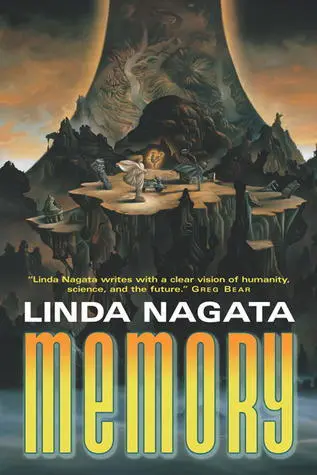
- Название:Memory
- Автор:
- Издательство:Tor Books
- Жанр:
- Год:2003
- Город:New York
- ISBN:0-312-70999-4
- Рейтинг книги:5 / 5. Голосов: 1
-
Избранное:Добавить в избранное
- Отзывы:
-
Ваша оценка:
Memory: краткое содержание, описание и аннотация
Предлагаем к чтению аннотацию, описание, краткое содержание или предисловие (зависит от того, что написал сам автор книги «Memory»). Если вы не нашли необходимую информацию о книге — напишите в комментариях, мы постараемся отыскать её.
Young Jubilee is devastated when her brother Jolly is caught and taken by the silver. But when a forbidding stranger with the incredible power to control the silver comes seeking Jolly—and claiming that Jolly knows him—Jubilee first distrusts the man, then fears him and flees. For she has learned an impossible secret: Jolly may still be alive… and may somehow become the catalyst for the annihilation of everything she knows if she does not find him first.
Jubilee’s flight will lead her to discoveries she could never have imagined, from the secret history of her civilization and her people’s origins to the true nature of the silver, to the awesome forgotten memories within her. And with these she will forever alter her world’s future… unless the dark stranger, relentless in his pursuit, achieves his goal of destroying it. One way or another, Jubilee’s final confrontation will change everything….
Memory — читать онлайн бесплатно полную книгу (весь текст) целиком
Ниже представлен текст книги, разбитый по страницам. Система сохранения места последней прочитанной страницы, позволяет с удобством читать онлайн бесплатно книгу «Memory», без необходимости каждый раз заново искать на чём Вы остановились. Поставьте закладку, и сможете в любой момент перейти на страницу, на которой закончили чтение.
Интервал:
Закладка:
I set out with that purpose in mind, but the dread of that place that had stirred in me upon our arrival was still strong. Fear seized me as I started to climb the grand staircase to the second floor, so I went outside instead, with Moki following at my heel.
The sun was warm and the air cool. I did not see any mechanics about.
I circled the courtyard, and in that way came to the temple gates. They were three times my height, fitted beneath a horizontal span of stone. I knew Jolly used to walk in the meadow beyond the wall, and climb the ridges around the temple, but in his stories he had never mentioned the strange creatures I had seen lurking on the forest’s edge. Instinct warned me against them, and I did not dare to open the gates. Instead I climbed the nearest stairs, thinking to look for the creatures from the safety of the wall.
I spied them almost immediately: a band of five just at the edge of the trees, and this time there was no doubt in my mind. Though they walked on two legs and in every general way resembled men and women, they were not players. They were too tiny and too lithe, and gravity did not seem to chain them, for they would bounce and float at every step, sometimes drifting several inches into the air. They were ephemeral too. They began to disappear, one by one. I would look away, and when I looked back one more would be gone, reappearing sometimes a little farther along the forest’s edge.
Moki growled, and I turned, to see Kaphiri coming up the stair. “Where is Yaphet?” I demanded.
“In the paradise of my library. He will not miss us for a little while.”
“I feel as if I have been in this temple before.”
He came to stand beside me. “You have been here before.”
Across the wide meadow, the creatures paused in their random wandering. They looked toward the temple, and one cried out in a high, strange voice something that sounded like La-zur-i , with the syllables all drawn out. Another took up the cry, and another, and there was nothing of friendliness in the sound.
“It sounds like a malediction,” I said, feeling shaken.
“I think it’s a name.” He watched the forest creatures with an expression that was part amusement, part contempt.
“Are they bogies?”
He nodded. “Though they don’t seem to be attached to any ruin. They came out of the silver only a few days ago, but they have already demonstrated some skill with poison darts. They seem to have assumed the task of murdering me.”
Startled, I stepped back from the edge of the wall. “You alone?”
“It’s a hard assumption to test. There is only me and the woman here, but she does not come out on the walls.” His brow wrinkled. “Still, I think it is only me. Some kind of vendetta, I suspect. They believe I am this Lazuri —”
“We should not be standing on the wall.”
“There are mechanics in the meadow. We are safe enough.”
“Are you Lazuri?”
“It’s not a name I remember using. But come. There are more interesting sights than this.”
We walked around the wall until we came to the side that looked down over the canyon.
On our flight south, silver had covered all the desert, but the sun had been at work since dawn and the silver had burned away. I looked down into the canyon and saw a thread of water sparkling within a forest far below, but my gaze did not rest there long, for the vast Iraliad lay before us. There was no wind, so no dust had risen to haze the view. We were high in the mountains, and through the crystalline air I could see farther—I could see more—than I ever had before. The desert glowed in the morning light, warm yellows and tans and rust red colors, with bright sparks of reflected light hinting at the presence of follies and precious veins of silver-spawned minerals. Far to the north—a hundred miles? two hundred?—the plain dissolved into a haze of blue distance.
All this came to me in a glance, before my attention was seized by the great pit of the Cenotaph. I had glimpsed its storm-wracked edge once before, from the southern escarpment of the Kalang, but now I saw it clearly, and I shuddered.
The goddess had called it a wound in the world, and that was what it looked like: if the golden desert was the world’s flesh, then the Cenotaph was a great bullet wound.
It was a crater, fifty miles or more across, its rim a chaos of colored sand and slag—pink and putrid green and black and a poisonous, electric blue—with thin mists of silver steaming here and there from vents and fissures, sparkling brightly before dissolving in the sunlight.
Lying within the pit was a lake of silver, and it was boiling. Even at such a distance I could see great bubbles rising up from its surface and bursting, throwing drops of silver in all directions. How large must those “drops” be, if I could see them?
Kaphiri said, “It is the pressure of sunlight that makes it bubble. At night it is still.”
“I did not know it was so close.”
For several minutes I could not look away, but finally I raised my gaze, to see the dark, blocky mass of a distant plateau beyond the pit. “The Kalang,” I whispered, but my memory of that place felt borrowed, as if it was the memory of someone else… someone I used to be.
“What would happen if you hurled a stone into the mud?” Kaphiri asked.
I gave him a puzzled look. “What kind of question is that?”
“A straightforward one, so think on it. What would happen if you hurled a stone into the mud?”
I scowled, annoyed that he would toy with me. “I would not do it, for it would dirty my clothes, with the mud spattering everywhere.”
He nodded. Then he looked again over the plain, to the distant clouds of silver steaming from the great pit of the Cenotaph. “A god was cast down to the world like a stone, and we are all dirty still. How are you going to fix it, my love? When even the goddess will not dare to try? And why is it you?”
Chapter 32
I could not answer Kaphiri’s questions. I was too tired to do anything but wander aimlessly and worry. “You are no good to me like this,” he said, and he led me to a bedroom Mari had made up.
When I awoke it was deep in the night. Through the window I could see stars, but they were pale in the sky, their light faded by the gleam of silver from beyond the temple walls. Moki stirred beside me, and I gave him a quick hug. “Yaphet?” I whispered, hoping he had come to the room while I slept. I listened for his breathing, but all was silent.
Fear drove away the last of my sleepiness. I was supposed to protect Yaphet, but I had hardly seen him since we arrived. All that day and night I had left him to Kaphiri’s mercies. Quickly I rose, and found that I had slept in my clothes.
I did not know where the light might be, and I didn’t want to spend time looking for it, so I groped my way to the door. It was not locked.
In the hallway the light tubes were dim amber, emitting hardly enough illumination to reach the floor. The hallway looked the same in both directions, but I knew to turn left. I had been asleep on my feet when Kaphiri brought me to my room, and I should not have known my way around his temple, but I did. I knew that wide hallway, and the turnings I would have to take to reach the great room. Even the echo of my footsteps I had heard before.
I passed the kitchen and went on, until I came to the great central hall with its tall doors to the courtyard. Moki whined to go out, but I did not dare let him, fearing the mechanics that patrolled there. So I called him with me as I approached the grand staircase.
Ever since I’d arrived, a strange, remembered fear had lived within me. It grew suddenly stronger as I set foot on that stair. The steps were made of massive blocks of the same gray stone used in the walls. I had climbed them before. I knew their number. When I reached the top, I paused to gaze warily across a wide landing at a closed door. I knew that door. I knew its bronze gleam, and the raised scene worked into its surface, of a sun rising beyond the horizon of a ring-shaped world. The door must have weighed several hundred pounds, but it was perfectly balanced. At a touch it swung soundlessly open… and my memory failed.
Читать дальшеИнтервал:
Закладка:
Похожие книги на «Memory»
Представляем Вашему вниманию похожие книги на «Memory» списком для выбора. Мы отобрали схожую по названию и смыслу литературу в надежде предоставить читателям больше вариантов отыскать новые, интересные, ещё непрочитанные произведения.







Обсуждение, отзывы о книге «Memory» и просто собственные мнения читателей. Оставьте ваши комментарии, напишите, что Вы думаете о произведении, его смысле или главных героях. Укажите что конкретно понравилось, а что нет, и почему Вы так считаете.