Olaf Stapledon - Odd John
Здесь есть возможность читать онлайн «Olaf Stapledon - Odd John» весь текст электронной книги совершенно бесплатно (целиком полную версию без сокращений). В некоторых случаях можно слушать аудио, скачать через торрент в формате fb2 и присутствует краткое содержание. Город: London, Год выпуска: 2012, ISBN: 2012, Издательство: Hachette UK, Жанр: Фантастика и фэнтези, на английском языке. Описание произведения, (предисловие) а так же отзывы посетителей доступны на портале библиотеки ЛибКат.
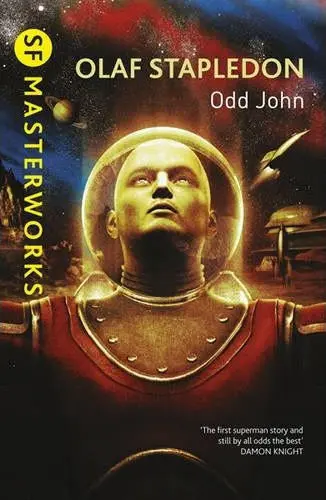
- Название:Odd John
- Автор:
- Издательство:Hachette UK
- Жанр:
- Год:2012
- Город:London
- ISBN:9780450038570
- Рейтинг книги:5 / 5. Голосов: 1
-
Избранное:Добавить в избранное
- Отзывы:
-
Ваша оценка:
Odd John: краткое содержание, описание и аннотация
Предлагаем к чтению аннотацию, описание, краткое содержание или предисловие (зависит от того, что написал сам автор книги «Odd John»). Если вы не нашли необходимую информацию о книге — напишите в комментариях, мы постараемся отыскать её.
Odd John — читать онлайн бесплатно полную книгу (весь текст) целиком
Ниже представлен текст книги, разбитый по страницам. Система сохранения места последней прочитанной страницы, позволяет с удобством читать онлайн бесплатно книгу «Odd John», без необходимости каждый раз заново искать на чём Вы остановились. Поставьте закладку, и сможете в любой момент перейти на страницу, на которой закончили чтение.
Интервал:
Закладка:
As the months protracted themselves into years, John’s letters became less frequent and more brief. He was evidently entirely absorbed in the affairs of the colony; and as the party became more and more concerned with supernormal activities, he found it increasingly difficult to give us an intelligible account of their life.
In the spring of 1932, however, I was greatly surprised to receive a long letter from John, the main purport of which was to urge me to visit the island as soon as possible. I quote the essential passage. “You will laugh when I tell you I want you to come and use your journalistic prowess upon us. In fact I want you to write that threatened biography after all, not for our sakes but for your own species. I must explain. We have made a wonderful start. Sometimes it was a bit grim, but now we have worked out a very satisfactory life and society. Our practical activities run smoothly, delightfully, and we are able at last to join in a great effort to reach the higher planes of experience. Already we are very different mentally from what we were when we landed. Some of us have seen far and deep into reality, and we have at least gained a clear view of the work we have undertaken. But a number of signs suggest that before very many months have passed the colony will be destroyed. If your species discovers us, it will certainly try to smash us; and we are not yet in a position to defeat it. Langatse has urged us (and he is right) to push on with the spiritual part of our work, so as to complete as much as possible of it before the end. But also we may as well leave records of our little adventure as an example for any future supernormals who may attempt to found the new world, and for the benefit of the more sensitive members of Homo sapiens . Langatse will take charge of the record for supernormals; the record for your species entails only normal powers and can be done satisfactorily by yourself.”
I was now a tolerably successful free-lance journalist, and I had a full programme before me. I was married, and Bertha was expecting a child. Yet I eagerly accepted the invitation. That afternoon I made inquiries about steamers for Valparaiso, and replied to John ( post restante at that city), telling him when to expect me.
Guiltily, I broke my news to Bertha. She was hard hit by it, but she said, “Yes, if John wants you, of course you must go.” Then I went round to the Wainwrights’. Pax greatly surprised me, for no sooner had I begun to tell her about the letter than she interrupted me. “I know,” she said, “for some weeks he has been giving me little stray visions of the island, and even talking to me. He said he would be asking for you.”
CHAPTER XX
THE COLONY IN BEING
WHEN I arrived at Valparaiso the Skid was waiting for me, manned by Ng-Gunko and Kemi. Both lads had appreciably matured since I had last seen them, nearly four years earlier. Those crowded years seemed to have speeded up the slow growth natural to their kind. Ng-Gunko, in particular, who was actually sixteen and might have been taken for twelve, had acquired a grace and a seriousness which I never expected of him. Both seemed in a great hurry to put to sea. I asked if there was any special engagement to keep on the island. “No,” said Ng-Gunko, “but we may have less than a year to live, and we love the island, and all our friends. We want to go home.”
As soon as my baggage and some cases of books and stores had been transhipped in the Skid’s dinghy, we got under way. Ng-Gunko and Kemi promptly divested themselves of their clothes, for it was a hot day. Kemi’s fair skin had been burnt to the colour of the teak woodwork of the Skid .
When we had come within about forty miles of the island, Kemi, who was at the helm, said, glancing from the magnetic to the gyroscopic compass, “They must be using the deflector. That means some ship has come too close, and they’re heading her off.” He went on to explain that on the island they had an instrument for deflecting a magnetic compass at any range up to about fifty miles. This was the fourth occasion for its use.
At last we sighted the island, a minute grey hump on the horizon. As we approached, it rose and displayed itself as a double mountain. Even when we were quite close to land I failed to detect any sign of habitation. Ng-Gunko explained that the buildings had all been placed in such a manner as to escape detection. Not till the island had opened out its little harbour to embrace us did I see the corner of one wooden building protruding from behind some trees. Not till we had entered the inner harbour did the whole settlement appear. It consisted of a score or more of small wooden buildings, with a larger stone building behind them and slightly higher up the slope. Most of the little wooden buildings, I was told, were the private houses of the residents. The stone building was the library and meeting-house. There were also buildings on the quayside, including a stone power-station. Somewhat remote from the rest of the settlement was a collection of wooden sheds which were said to be temporary labs.
The Skid was moored alongside the lowest of three stone quays, for the tide was out. The colonists were waiting to receive us and unload. They were a bunch of naked, sunburnt youngsters of both sexes and very diverse appearance. John sprang on board to greet me, and I found myself tongue-tied. He had become a dazzling figure, at least to my faithful eyes. There was a new firmness and a new dignity about him. His face was brown and smooth and hard like a hazel nut. His whole body was like shaped and bees-waxed oak. His hair was bleached to a dazzling whiteness. I noted among the party several unfamiliar faces, the Asiatics, of course, from China, Tibet and India. Seeing all these supcrnormals together, I was struck by a pervading Chinese or Mongolian expression about them. They had conic from many lands, but they had a family likeness. John might well he right in guessing that all had sprung from a single “sporting point” centuries ago, probably in Central Asia. From that original mutation, or perhaps from a number of similar mutations, successive generations of offspring had spread over Asia, Europe, Africa, interbreeding with the normal kind, but producing occasionally a true supernormal individual.
Subsequently I learned that Shên Kuo’s direct researches in the past had confirmed this theory.
I had been dreading life in this colony of superior persons. I expected to feel unwanted, to be as useless and distracting as a dog at a highbrow concert. But my reception reassured me. The younger members accepted me gaily and carelessly, treating me much as nieces and nephews might treat an uncle whose special office it was to make a fool of himself. The elders of the party were more restrained, but genial.
I was assigned one of the wooden cottages or shacks as my private residence. It was surrounded by a verandah. “You may prefer to have your bed out here,” said John. “There are no mosquitoes.” I noticed at once that the cottage had been made with the care and accuracy of fine cabinet-making. It was sparsely furnished with solid and simple articles of waxed wood. On one wall of the sitting-room was a carved panel representing in an abstract manner a boy and a girl (of the supernormal type) apparently at sea in a canoe, and hunting a shark. In the bedroom was another carving, much more abstract, but vaguely suggestive of sleep. On the bed were sheets and blankets, woven of rough yarns unknown to me. I was surprised to see electric light, an electric stove, and beyond the bedroom a minute bathroom with hot and cold taps. The water was heated by an electric contrivance in the bathroom itself. Fresh water was plentiful, I was told, for it was distilled from the sea as a sort of by-product of the psycho-physical power-station.
Читать дальшеИнтервал:
Закладка:
Похожие книги на «Odd John»
Представляем Вашему вниманию похожие книги на «Odd John» списком для выбора. Мы отобрали схожую по названию и смыслу литературу в надежде предоставить читателям больше вариантов отыскать новые, интересные, ещё непрочитанные произведения.










Обсуждение, отзывы о книге «Odd John» и просто собственные мнения читателей. Оставьте ваши комментарии, напишите, что Вы думаете о произведении, его смысле или главных героях. Укажите что конкретно понравилось, а что нет, и почему Вы так считаете.