Olaf Stapledon - Odd John
Здесь есть возможность читать онлайн «Olaf Stapledon - Odd John» весь текст электронной книги совершенно бесплатно (целиком полную версию без сокращений). В некоторых случаях можно слушать аудио, скачать через торрент в формате fb2 и присутствует краткое содержание. Город: London, Год выпуска: 2012, ISBN: 2012, Издательство: Hachette UK, Жанр: Фантастика и фэнтези, на английском языке. Описание произведения, (предисловие) а так же отзывы посетителей доступны на портале библиотеки ЛибКат.
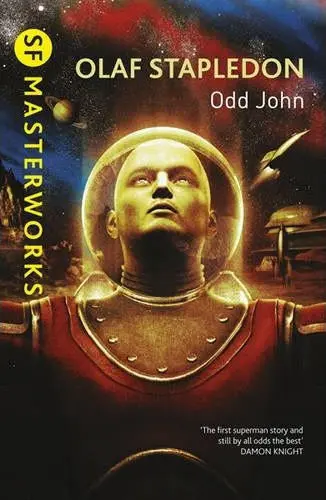
- Название:Odd John
- Автор:
- Издательство:Hachette UK
- Жанр:
- Год:2012
- Город:London
- ISBN:9780450038570
- Рейтинг книги:5 / 5. Голосов: 1
-
Избранное:Добавить в избранное
- Отзывы:
-
Ваша оценка:
Odd John: краткое содержание, описание и аннотация
Предлагаем к чтению аннотацию, описание, краткое содержание или предисловие (зависит от того, что написал сам автор книги «Odd John»). Если вы не нашли необходимую информацию о книге — напишите в комментариях, мы постараемся отыскать её.
Odd John — читать онлайн бесплатно полную книгу (весь текст) целиком
Ниже представлен текст книги, разбитый по страницам. Система сохранения места последней прочитанной страницы, позволяет с удобством читать онлайн бесплатно книгу «Odd John», без необходимости каждый раз заново искать на чём Вы остановились. Поставьте закладку, и сможете в любой момент перейти на страницу, на которой закончили чтение.
Интервал:
Закладка:
This analysis made me feel uncomfortable, for though I was not one of “them” I could not disguise from myself that the same sort of condemnation might apply to me. John evidently saw my thoughts, for he grinned, and moreover indulged in an entirely vulgar wink. Then he said, “Strikes home, old thing, doesn’t it? Never mind, you’re not in the web. You’re an outsider. Fate has kept you safely fluttering in the backward North.”
Some weeks after this conversation John’s mood seemed to change. Hitherto he had been light-hearted, sometimes even ribald, both in the actual pursuit of his investigation and in his comments. In his more serious phases he displayed the sympathetic though aloof interest of an anthropologist observing the customs of a primitive tribe. He had always been ready to talk about his experiences and to defend his judgements. But now he began to be much less communicative, and, when he did condescend to talk, much more terse and grim. Banter and friendly contemptuousness vanished. In their place he developed a devastating habit of coldly, wearily pulling to pieces whatever one said to him. Finally this reaction also vanished, and his only response to any remark of general interest was a steady gloomy stare. So might a lonely man gaze at his frisking dog when the need of human intercourse was beginning to fret him. Had any one other than John treated one in that way, the act would have been offensive. Coming from John it was merely disturbing. It roused in me a painful self-consciousness, and an irresistible tendency to look away and busy myself with something.
Once only did John express himself freely. By appointment I had met him in his subterranean workshop to discuss a financial project which I proposed to undertake. He was lying in his little bunk, swinging one leg over the side. Both hands were behind his head. I embarked on my theme, but his attention was obviously elsewhere. “Damn it, can’t you listen?” I said. “Are you inventing a gadget or what?”
“Not inventing,” he replied, “discovering.”
There was such solemnity in his voice that a wave of irrational panic seized me. “Oh, for God’s sake do be explicit. What’s up with you these days? Can’t you tell a fellow?” He transferred his gaze from the ceiling to my face. He stared. I started to fill my pipe.
“Yes, I’ll tell you,” he said, “if I can, or as much as I can. Some time ago I asked myself a question, namely this. Is the plight of the world to-day a mere incident, an illness that might have been avoided and may be cured? Or is it something inherent in the very nature of your species? Well, I have got my answer. Homo sapiens is a spider trying to crawl out of a basin. The higher he crawls, the steeper the hill. Sooner or later, down he goes. So long as he’s on the bottom, he can get along quite nicely, but as soon as he starts climbing, he begins to slip. And the higher he climbs the farther he falls. It doesn’t matter which direction he tries. He can make civilization after civilization, but every time, long before he begins to be really civilized, skid!”
I protested against John’s assurance. “It may be so,” I said, “but how can you possibly know ? Hom. sap . is an inventive animal. Might not the spider some time or other contrive to make his feet sticky? Or—well, suppose he’s not a spider at all but a beetle. Beetles have wings. They often forget how to use them, but—aren’t there signs that Hom. sap’s present climb is different from all the others? Mechanical power is a stickiness for his feet. And I believe his wing-cases are stirring, too.”
John regarded me in silence. Pulling himself together, he said, as if from a great distance, “No wings. No wings.” Then, in a more normal voice, “And as for mechanical power, if he knew how to use it, it might help him up a few steps farther, but he doesn’t. You see, for every type of creature there’s a limit of possible development of capacity, a limit inherent in the ground plan of its organization. Homo sapiens reached his limit a million years ago, but he has only recently begun to use his powers dangerously. In achieving science and mechanism he has brought about a state of affairs which cannot be dealt with properly save by capacity which is much more developed than his. Of course, he may not slip just yet. He may succeed in muddling through this particular crisis of history. But if he does, it will only be muddling through to stagnation, not to the soaring that even he in his own heart is desperately craving. Mechanical power, you see, is indeed vitally necessary to the full development of the human spirit; but to the sub-human spirit it is lethal.”
“But, how can you know that? Aren’t you being a bit too confident in your own judgement?”
John’s lips compressed themselves and assumed a crooked smile. “You’re right,” he said. “There’s just one possibility that I have not mentioned. If the species as a whole, or a large proportion of the world population, were to be divinely inspired, so that their nature became truly human at a stride, all would soon be well.”
I took this for irony, but he went on to say, “Oh, no, I’m quite serious. It’s possible; if you interpret ‘divinely inspired’ to mean lifted out of their pettiness by a sudden and spontaneous access of strength to their own rudimentary spiritual nature. It happens again and again in individuals here and there. When Christianity came, it happened to large numbers. But they were a very small proportion of the whole, and the thing petered out. Short of that kind of thing, or rather something much more widespread and much more powerful than the Christian miracle, there’s no hope. The early Christians, you see, and the early Buddhists and so on, remained at bottom what I should call sub-human, in spite of their miracle. In intelligence they remained what they were before the miracle; and in will, though they were profoundly changed by the new thing in them, the change was insecure. Or rather the new thing seldom managed to integrate their whole being into a new and harmonious order. Its rule was precarious. The new psychological compound, so to speak, was a terribly unstable compound. Or, putting it in another way, they managed to become saints, but seldom angels. The sub-human and the human were always in violent conflict in them. And so they mostly got obsessed with the idea of sin, and saving their souls, instead of being able to pass on to live the new life with fluency and joy, and with creative effect in the world.”
At this point we fell silent. I relit my pipe, and John remarked, “Match number nine, you funny old thing!” It was true. There lay the eight burnt matches, though I had no recollection of using them. John from his position on the bed could not see the ash-tray. He must have noticed the actual re-lightings. It was simply that he observed whatever happened however engrossed he might be. “You funnier young thing!” I retorted.
Presently he began talking again. He kept his eye on me, but I felt that he was talking rather to himself than to me. “At one time,” he said, “I thought I should simply take charge of the world and help Homo sapiens to remake himself on a more human plan. But now I realize that only what men call ‘God’ could do that. Unless perhaps a great invasion of superior beings from another planet, or another dimension, could do it. But I doubt if they would trouble to do it. They would probably merely use the Terrestrials as cattle or museum pieces or pets, or just vermin. All the same, if they wanted to make a better job of Hom. sap . I expect they could. But I can’t do it. I believe, if I set my mind to it, I could fairly easily secure power and take charge of the normal species; and, once in charge, I could make a much more satisfactory world, and a much happier world; but always I should have to accept the ultimate limitations of capacity in the normal species. To make them try to live beyond their capacity would be like trying to civilize a pack of monkeys. There would be worse chaos than ever, and they would unite against me, and sooner or later destroy me. So I’d just have to accept the creature with all its limitations. And that would be to waste my best powers. I might as well spend my life chicken-farming.”
Читать дальшеИнтервал:
Закладка:
Похожие книги на «Odd John»
Представляем Вашему вниманию похожие книги на «Odd John» списком для выбора. Мы отобрали схожую по названию и смыслу литературу в надежде предоставить читателям больше вариантов отыскать новые, интересные, ещё непрочитанные произведения.










Обсуждение, отзывы о книге «Odd John» и просто собственные мнения читателей. Оставьте ваши комментарии, напишите, что Вы думаете о произведении, его смысле или главных героях. Укажите что конкретно понравилось, а что нет, и почему Вы так считаете.