Arthur Clarke - Sunstorm
Здесь есть возможность читать онлайн «Arthur Clarke - Sunstorm» весь текст электронной книги совершенно бесплатно (целиком полную версию без сокращений). В некоторых случаях можно слушать аудио, скачать через торрент в формате fb2 и присутствует краткое содержание. Город: New York, Год выпуска: 2005, ISBN: 2005, Издательство: Del Rey, Жанр: Фантастика и фэнтези, на английском языке. Описание произведения, (предисловие) а так же отзывы посетителей доступны на портале библиотеки ЛибКат.
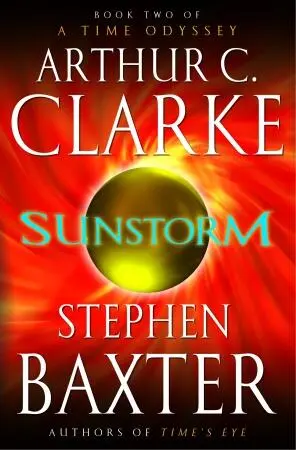
- Название:Sunstorm
- Автор:
- Издательство:Del Rey
- Жанр:
- Год:2005
- Город:New York
- ISBN:0-345-45252-6
- Рейтинг книги:3 / 5. Голосов: 1
-
Избранное:Добавить в избранное
- Отзывы:
-
Ваша оценка:
Sunstorm: краткое содержание, описание и аннотация
Предлагаем к чтению аннотацию, описание, краткое содержание или предисловие (зависит от того, что написал сам автор книги «Sunstorm»). Если вы не нашли необходимую информацию о книге — напишите в комментариях, мы постараемся отыскать её.
Bisesa’s questions receive a chilling answer when scientists discover an anomaly in the sun’s core-an anomaly that has no natural cause is evidence of alien intervention over two thousand years before. Now plans set in motion millennia ago by inscrutable watchers light-years away are coming to fruition in a sunstorm designed to scour the Earth of all life in a bombardment of deadly radiation.
Thus commences a furious race against a ticking solar time bomb. But even now, as apocalypse looms, cooperation is not easy for the peoples and nations of the Earth. Religious and political differences threaten to undermine every effort.
And all the while, the Firstborn are watching …
Sunstorm — читать онлайн бесплатно полную книгу (весь текст) целиком
Ниже представлен текст книги, разбитый по страницам. Система сохранения места последней прочитанной страницы, позволяет с удобством читать онлайн бесплатно книгу «Sunstorm», без необходимости каждый раз заново искать на чём Вы остановились. Поставьте закладку, и сможете в любой момент перейти на страницу, на которой закончили чтение.
Интервал:
Закладка:
But it was not sunspots that Bisesa had bought her telescope to see.
A line crossed the face of the sun, a stripe of watery gray that traversed from northeast to southwest. It was, of course, the shield. Hanging up there at its station at L1, it was still turned almost edge-on to the sun. But already it cast a shadow on the Earth.
Bisesa hugged Myra. “You see? There it is. It’s real. Now do you believe?”
Myra stared at the shadow. Now thirteen years old, she was a bit too quiet for her age. Bisesa had meant this display to comfort Myra, who was not alone in having trouble believing in the reality of the great project in space.
But her reaction wasn’t what Bisesa had anticipated. She seemed afraid. This was a human-made object, four times as remote as the Moon, and yet visible from Earth. Standing here in the watery sunlight of a London morning, the cosmic vision was astonishing, awe inspiring—crushing.
This is why the Greeks coined the word hubris, Bisesa thought.
31: Perspectives
For lovers, zero G was a lot trickier than the low gravity of the Moon.
That was despite decades of experience, Siobhan had learned. In the days of low Earth orbit flights there had been something called the “Dolphin Club,” so named because in the analogous conditions of floating in the ocean, a dolphin couple would sometimes be helped in their intimacy by the bracing support of a third … Siobhan was the Astronomer Royal; she wasn’t about to put up with any of that.
So Bud had improvised equipment to enable her to retain her privacy. With its cuffs, ropes, and restraints his cabin now looked like a bondage parlor, but in giving you something to grip and push against, this stuff supported the ancient arts surprisingly well. But in the isolated little zero-G township of the shield Bud had clearly had help figuring all this out. She made him take down the little plaque above his bed:
COURTESY OF
U.S. ASTRONAUTICAL ENGINEERING CORPS
ENJOY!
Still, the sex was as deep and rich and satisfying and, damn it, comforting as ever; she was old enough to admit she needed consolation as much as passion.
Afterward, though, as they lay under a thick blanket, with Bud a silent warm mass beside her, her thoughts turned to the reasons she had come here.
This cabin had once been a storeroom; you could still see the marks where shelving and cupboards had been ripped off the walls. Over the years Aurora had been cannibalized, and now it was a husk containing nothing but life support systems, comms centers, and hastily improvised living quarters. But to Bud, she knew, this battered old ship was home. Even when the project was over, no doubt he would always miss it.
It was going to break his heart if she had to bring him home before the job was done. But that was one possible outcome of her visit, and they both knew it.
Bud said at last, “You know, at times like this I still miss a cigarette.”
“At heart you’re just an unreconstructed high school jock, aren’t you?”
“Salt of the earth.” He stared at the ceiling. “But this trip is business, not pleasure, isn’t it?”
“I’m sorry.”
He shrugged. “Don’t be. But look—as far as everybody else is concerned, you’re here for the AI switch-on. Nobody but my PA knows about the other stuff.”
Faintly irritated she said, “I’m not here to hurt morale, Bud. I’m supposed to be strengthening the project, not weakening it. That’s the whole point. But—”
“But this business of the audit has to be cleared up.” He held her hand. “I know. And I trust you to handle it well.”
She churned with guilt. “Bud, we both have our duty. And we can’t let anything get in the way of that.”
“I understand. But a bit more pleasure before business.” He sat up. “We’ve got twelve hours before we boot up the AI. Let’s go do some sightseeing.”
They washed, dressed, and drank a coffee. Then Bud escorted her to the little ship he called the V-Eye-P.
The project’s one and only one pressurized inspection module was just a platform laden with spherical fuel and oxidizer tanks and a small set of hydrazine rocket motors—actually attitude thrusters cannibalized from a retired spaceplane. On top was a pressurized tent of Kevlar and aluminum, within which two people could stand side by side. That was it, save for a simple set of controls based on a joystick that sprouted from the floor, and a life support system that would keep you alive for six hours at a pinch.
The shield engineers used variants on this design, but just the platform and the engines, without the tent: why bother with a pressure cabin when you had a perfectly good spacesuit? So you would see engineers skimming over the surface of the shield riding their rocket-propelled boxes like scooters. Only this one special little craft was kept aside for VIPs, visitors like Siobhan who didn’t have the time or inclination to get trained up on how to use a pressure suit.
“Not,” Bud said with a faintly malicious grin, “that this Kevlar tent would be much protection if anything went wrong …”
The V-Eye-P was launched from Aurora by an electromagnetic induction rail, like a miniature version of the Sling, the giant mass driver on the Moon. The acceleration was smooth, like a rapid elevator; Siobhan quite enjoyed the feeling of her feet being pressed to the floor.
When they had climbed sufficiently far, Bud tested the little ship’s rockets, “burping” them as he called it. It sounded as if small explosions were going off all around the Kevlar hull. Bud explained that there was no exhaust from the induction rail, and rockets, however small, were never used close to the shield. “We’re building a mirror made of frost laced on spiderweb,” he said. “We try not even to breathe on it.”
The craft swiveled and pitched to and fro. It was like being aboard a rather odd fairground ride.
When he was satisfied, Bud brought the craft to a halt and tipped it forward so Siobhan could see down. “Behold the mother ship,” he said.
The venerable old Aurora 2 was still the centerpiece of the shield, still the spider at the center of the web. Despite extensive cannibalization, Siobhan could make out the main features she remembered: the long, elegant spine with the fat habitation module at one end, and the complex clusters of power plants, fuel tanks, and rocket engines at the other. “She’s a game old bird,” Bud said fondly. “I hope she forgives us. She still has a role to play, keeping the shield spun up and oriented correctly. Of course all that will change when the AI comes online and the shield starts to control itself.”
He pulled back on his control stick, and the platform’s thrusters banged. The little ship rose up smoothly, rising away from the shield along an axial line that led straight up from the embedded Aurora .
Siobhan stared out, fascinated, as the shield opened up beneath her. Away from the old Mars ship the shield was a floor so flat and smooth it was like a mathematical abstraction, a semi-infinite plane that cut the universe in half. The surface shimmered, as delicate as a soap bubble, and as she rose higher prismatic rainbows fled across the surface. But the shield was still edge-on to the sun, and the low light streamed through that delicate membrane, so that she could make out the spindly skeleton beneath, struts, spars, and ribs of delicate lunar glass, a fairyland scaffolding that cast long, slim shadows.
“It’s wonderful,” she said. “The most massive engineering project anybody ever undertook, and yet it is nothing but glass and light. Like something from a dream.”
Читать дальшеИнтервал:
Закладка:
Похожие книги на «Sunstorm»
Представляем Вашему вниманию похожие книги на «Sunstorm» списком для выбора. Мы отобрали схожую по названию и смыслу литературу в надежде предоставить читателям больше вариантов отыскать новые, интересные, ещё непрочитанные произведения.


Обсуждение, отзывы о книге «Sunstorm» и просто собственные мнения читателей. Оставьте ваши комментарии, напишите, что Вы думаете о произведении, его смысле или главных героях. Укажите что конкретно понравилось, а что нет, и почему Вы так считаете.