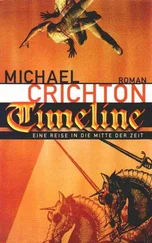
Michael Crichton - Timeline
Здесь есть возможность читать онлайн «Michael Crichton - Timeline» весь текст электронной книги совершенно бесплатно (целиком полную версию без сокращений). В некоторых случаях можно слушать аудио, скачать через торрент в формате fb2 и присутствует краткое содержание. Жанр: Фантастика и фэнтези, на английском языке. Описание произведения, (предисловие) а так же отзывы посетителей доступны на портале библиотеки ЛибКат.
- Название:Timeline
- Автор:
- Жанр:
- Год:неизвестен
- ISBN:нет данных
- Рейтинг книги:3 / 5. Голосов: 1
-
Избранное:Добавить в избранное
- Отзывы:
-
Ваша оценка:
Timeline: краткое содержание, описание и аннотация
Предлагаем к чтению аннотацию, описание, краткое содержание или предисловие (зависит от того, что написал сам автор книги «Timeline»). Если вы не нашли необходимую информацию о книге — напишите в комментариях, мы постараемся отыскать её.
Timeline — читать онлайн бесплатно полную книгу (весь текст) целиком
Ниже представлен текст книги, разбитый по страницам. Система сохранения места последней прочитанной страницы, позволяет с удобством читать онлайн бесплатно книгу «Timeline», без необходимости каждый раз заново искать на чём Вы остановились. Поставьте закладку, и сможете в любой момент перейти на страницу, на которой закончили чтение.
Интервал:
Закладка:
Marek stared at her. "And then what happened?"
"Then de Kere whispered to a soldier… And I couldn't hear what he said."
"Right. Because he didn't have an earpiece. If he had an earpiece, you would have heard everything, including whispers. But he didn't. It's Sir Guy. Who cut Gomez's head off? Sir Guy and his men. Who was most likely to go back to the body and retrieve the earpiece? Sir Guy. The other men were terrified of the flashing machine. Only Sir Guy was not afraid. Because he knew what it was. He's from our century."
"I don't think Guy was there," Chris said, "when the machine was flashing."
"But the clincher that it is Sir Guy," Marek said, "is that his Occitan is terrible. He sounds like a New Yorker, speaking through his nose."
"Well, isn't he from Middlesex? And I don't think he's well-born. I get the impression he was knighted for bravery, not family."
"He wasn't a good-enough jouster to take you out with the first lance," Marek said. "He wasn't a good-enough swordsman to kill me hand-to-hand. I'm telling you. It's Guy de Malegant."
"Well," Chris said, "whoever it is, now they know we're going to the monastery."
"That's right," Marek said, stepping away from Kate and looking at her hair appraisingly. "So let's go."
Kate touched her hair cautiously. She said, "Should I be glad I don't have a mirror?"
Marek nodded. "Probably."
"Do I look like a guy?"
Chris and Marek exchanged glances. Chris said, "Kind of."
"Kind of?"
"Yes. You do. You look like a guy."
"Close enough, anyway," Marek said.
They got to their feet.
15:12:09
The heavy wooden door opened a crack. From the darkness inside, a shadowed face in a white cowl peered out at them. "God grant you growth and increase," the monk said solemnly.
"God grant you health and wisdom," Marek replied in Occitan.
"What is your business?"
"We come to see Brother Marcel."
The monk nodded, almost as if he had been expecting them. "Certes, you may enter," the monk said. "You are in good time, for he is still here." He opened the door a little wider, so they were able to pass through, one at a time.
They found themselves in a small stone anteroom, very dark. They smelled a fragrant odor of roses and oranges. From within the monastery itself, they heard the soft sound of chanting.
"You may leave your weapons there," the monk said, pointing to the corner of the room.
"Good brother, I fear we cannot," Marek said.
"You have nothing to fear here," he said. "Disarm, or depart."
Marek started to protest, then unbuckled his sword.
The monk glided ahead of them down a quiet hallway. The walls were bare stone. They turned a corner and went down another hallway. The monastery was very large, and mazelike.
This was a Cistercian monastery; the monks wore white robes of plain cloth. The austerity of the Cistercian order stood as a deliberate reproach to the more corrupt orders of Benedictines and Dominicans. Cistercian monks were expected to keep rigid discipline, in an atmosphere of severe asceticism. For centuries, the Cistercians did not permit any carved decoration on their plain buildings, nor any decorative illustrations to their manuscripts. Their diet consisted of vegetables, bread and water, with no meats or sauces. Cots were hard; rooms were bare and cold. Every aspect of their monastic life was determinedly Spartan. But, in fact, this quality of rigid discipline had-
Thwock!
Marek turned toward the sound. They were coming into a cloister - an open court within the monastery, surrounded by arched passages on three sides, intended as a place of reading and contemplation.
Thwock!
Now they heard laughter. Noisy shouts of men.
Thwock! Thwock!
As they came into the cloister, Marek saw that the fountain and garden in the center had been removed. The ground was bare, hard-packed dirt. Four men, sweating in linen smocks, were standing in the dirt, playing a kind of handball.
Thwock!
The ball rolled on the ground, and the men pushed and shoved each other, letting it roll. When it stopped, one man picked it up, cried, "Tenez!" and served the ball overhand, smacking it with his flat palm. The ball bounced off the side wall of the cloisters. The men yelled and jostled one another for position. Beneath the arches, monks and nobles shouted encouragement, clinking bags of gambling money in their hands.
There was a long wooden board attached to one wall, and every time a ball hit that board - making a loud bonk! - there were extra shouts of encouragement from the gamblers in the galleries.
It took Marek a moment to realize what he was looking at: the earliest form of tennis.
Tenez - from the server's shout, meaning, "Receive it!" - was a new game, invented just twenty-five years earlier, and it had become the instant rage of the period. Racquets and nets would come centuries later; for now, the game was a variety of handball, played by all classes of society. Children played in the streets. Among the nobility, the game was so popular that it provoked a trend to build new monasteries - which were abandoned unfinished, once the cloisters had been constructed. Royal families worried that princes neglected their instruction as knights in favor of long hours on the tennis court, often playing by torchlight far into the night. Gambling was ubiquitous. King John II of France, now captive in England, had, over the years, spent a small fortune to pay his tennis debts. (King John was known as John the Good, but it was said that whatever John was good at, it was certainly not tennis.)
Marek said, "Do you play here often?"
"Exercise invigorates the body and sharpens the mind," the monk replied immediately. "We play in two cloisters here."
As they passed through the cloister, Marek noticed that several of the gamblers wore robes of green, trimmed in black. They were rough, grizzled men with the manner of bandits.
Then they left the cloister behind, and went up a flight of stairs. Marek said to the monk, "It appears the order makes welcome the men of Arnaut de Cervole."
"That is sooth," the monk said, "for they shall do us a boon and return the mill to us."
"Was it taken?" Marek asked.
"In a manner of speaking." The monk walked to the window, which overlooked the Dordogne, and the mill bridge, a quarter mile upstream.
"With their own hands, the monks of Sainte-Mère have built the mill, at the bidding of our revered architect, Brother Marcel. Marcel is much venerated in the monastery. As you know, he was architect for the former Abbot, Bishop Laon. So the mill that he designed, and we built, is the property of this monastery, as are its fees.
"Yet Sir Oliver demands a mill tax to himself, though he has no just cause for it, except that his army controls this territory. Therefore my Lord Abbot is well pleased that Arnaut should vow to return the mill to the monastery, and end the tax. And thus are we friendly to the men of Arnaut."
Chris listened to all this, thinking, My thesis! It was all exactly as his research had shown. Although some people still thought of the Middle Ages as a backward time, Chris knew it had actually been a period of intense technological development, and in that sense, not so different from our own. In fact, the industrial mechanization that became a characteristic feature of the West first began in the Middle Ages. The greatest source of power available at the time - water power - was aggressively developed, and employed to do ever more kinds of work: not only grinding grain but fulling cloth, blacksmithing, beer mashing, woodworking, mixing mortar and cement, papermaking, rope making, oil pressing, preparing dyes for cloth, and powering bellows to heat blast furnaces for steel. All over Europe, rivers were dammed, and dammed again half a mile downstream; mill boats were tethered beneath every bridge. In some places, cascades of mills, one after another, successively used the energy of flowing water.
Читать дальшеИнтервал:
Закладка:
Похожие книги на «Timeline»
Представляем Вашему вниманию похожие книги на «Timeline» списком для выбора. Мы отобрали схожую по названию и смыслу литературу в надежде предоставить читателям больше вариантов отыскать новые, интересные, ещё непрочитанные произведения.








Обсуждение, отзывы о книге «Timeline» и просто собственные мнения читателей. Оставьте ваши комментарии, напишите, что Вы думаете о произведении, его смысле или главных героях. Укажите что конкретно понравилось, а что нет, и почему Вы так считаете.