Ross King - Ex Libris
Здесь есть возможность читать онлайн «Ross King - Ex Libris» весь текст электронной книги совершенно бесплатно (целиком полную версию без сокращений). В некоторых случаях можно слушать аудио, скачать через торрент в формате fb2 и присутствует краткое содержание. Жанр: Фантастика и фэнтези, на английском языке. Описание произведения, (предисловие) а так же отзывы посетителей доступны на портале библиотеки ЛибКат.
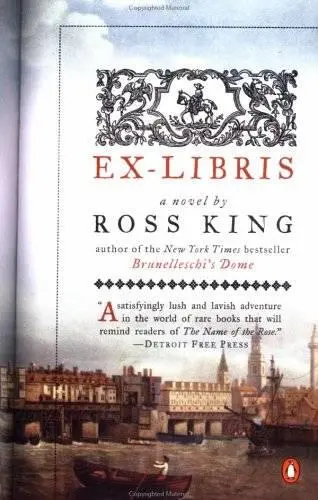
- Название:Ex Libris
- Автор:
- Жанр:
- Год:неизвестен
- ISBN:нет данных
- Рейтинг книги:3 / 5. Голосов: 1
-
Избранное:Добавить в избранное
- Отзывы:
-
Ваша оценка:
Ex Libris: краткое содержание, описание и аннотация
Предлагаем к чтению аннотацию, описание, краткое содержание или предисловие (зависит от того, что написал сам автор книги «Ex Libris»). Если вы не нашли необходимую информацию о книге — напишите в комментариях, мы постараемся отыскать её.
Ex Libris — читать онлайн бесплатно полную книгу (весь текст) целиком
Ниже представлен текст книги, разбитый по страницам. Система сохранения места последней прочитанной страницы, позволяет с удобством читать онлайн бесплатно книгу «Ex Libris», без необходимости каждый раз заново искать на чём Вы остановились. Поставьте закладку, и сможете в любой момент перейти на страницу, на которой закончили чтение.
Интервал:
Закладка:
A pint of Lambeth ale at lunch revived me, and I caught a hackney-coach to Westminster Hall, where, of course, I had no better luck than in either Little Britain or Paternoster Row. Yet the day was not an utter loss, for I did manage to learn something about the Prague edition of Ortelius's Theatrum orbis terrarum , though nothing that seemed to chime with anything I had so far discovered about either Sir Ambrose Plessington or his missing parchment. All of the booksellers and stallholders stocked copies of the Theatrum , and one even held the rare 1590 edition printed in Antwerp by the great Plantinus. But none had ever heard of the Prague edition, much less sold it. They were as puzzled by the edition as I had been. I therefore decided I must have misread the tailpiece; either that, or the 1600 edition was a forgery. I was about to return home, when I spotted, beneath the arcade of the New Exchange in the Strand, the shop of a map-seller, Molitor & Barnacle. I knew the establishment well. As an apprentice I always found it the most intriguing shop in London, for in those days I still dreamed of travelling the world, not fleeing from it, as I do now. Despatched on an errand by Mr. Smallpace, I sometimes used to duck inside and browse for hours among the maps and metal globes, my task completely forgotten until Mr. Molitor, an indulgent old soul, would chase me from the premises at closing-time.
Now it was almost closing-time as I stepped through the door to see that most of the globes and astrolabes had disappeared, as had the maps of the world, beautifully engraved reproductions of Ptolemy and Mercator that Mr. Molitor would pin to the walls like charts in the cabin of a ship. Eight or nine years must have passed since my last visit. Mr. Molitor, alas, had also disappeared-dead of consumption in '56, I was told by Mr. Barnacle. I was sorry to see that the shop had fallen on hard times and that Mr. Barnacle, now an elderly gentleman, failed to recognise me. Seeing him stooped behind his counter, breathing heavily, I had a chastening vision of myself twenty or thirty years hence.
But Mr. Barnacle knew his business as well as ever. He informed me that he knew of the Prague edition of the Theatrum but had never actually seen a copy. They were, he explained, exceedingly rare and even more valuable than the editions published by Plantinus, for only a very few copies had ever been printed. But this scarcity was not the sole reason for their great value. The edition was the first posthumous one, since Ortelius had died a year or two before its appearance. He was Flemish, suspected of Protestantism, but for a quarter of a century he had been Royal Cosmographer to the King of Spain. After Philip's death in 1598 he travelled to Prague at the invitation of the Emperor Rudolf II, but died before he could take up his post as Imperial Geographer. Mr. Barnacle alluded to a legend among map-makers, thoroughly unsubstantiated, that he had been poisoned. The Prague edition appeared a year or two later. The legend further suggested that it included some sort of variant, though Mr. Barnacle could not say precisely what. But it was for the sake of this new detail that the great cartographer was murdered.
'A variant? What do you mean?'
'I mean that the 1600 edition was different from all of the other editions, including those printed by Plantinus. Mr. Molitor had his own theory about it,' he said in a confidential tone, producing from his shelves a copy of the atlas. When he opened the cover I could see a plan of the Pacific Ocean and, inside a cartouche, the words NOVUS ORBIS. 'It involved the particular method of projection that Ortelius uses for the Prague edition.' He turned round again, suddenly spry, and reached down another text. The scale of latitude and longitude. 'All of the other editions use Mercator's projection. You know about the Mercator projection?'
'A little.' I was watching as he creaked open Mercator's famous atlas-an atlas whose maps I used to study with especial delight during my daydreaming apprenticeship. I am not mathematically inclined; far from it. Words, not numbers, are my métier . But I was able to appreciate a little of Gerardus Mercator's feat in representing a sphere, the earth, on a plane; in flattening the world and putting it in a book, its proportions more or less intact.
'His projection was created for the sake of navigators,' Mr. Barnacle was explaining as he tapped one of the sheets with a cracked yellow fingernail, then readjusted his spectacles-a pair with lenses almost as thick as my own-on the bridge of his nose. 'It was devised in 1569, during the great age of exploration and discovery. His scales of latitude and longitude form a grid of parallel lines and right angles that make it possible for mariners to plot compass courses along straight lines instead of curves. Most helpful, of course, for voyages across the ocean.'
He was tracing a thumbnail diagonally across the sheet, along a thumb-line that stretched like a spider's web across a grid of squares. Then abruptly he pushed both atlases aside and reached for one of the globes, an enormous paste-board model, some four feet in diameter, which he spun on its lacquered pedestal. Blue oceans and mottled land masses flashed past beneath the brass horizon-ring on the equator.
'But a map is not a globe,' he continued, peering at me over the top of the great spinning ball. 'All maps entail distortion. Mercator makes his meridians run parallel to each other, but everyone knows that meridians are not parallels like latitudes are.'
'Of course,' I murmured, made dizzy by the sight of the globe, which was still revolving swiftly, its axle squeaking as seas and continents reeled past. 'Meridians converge at the poles. The distances between them shrink as the lines extend north or south of the equator.'
'But Mercator's meridians never converge.' He was pecking at the map once again. 'They remain parallel to each other, something that distorts east-west distances. So Mercator changes the distances between the latitudes as well, increasing them as they move away from the equator and towards the poles. We therefore speak of his "waxing latitudes". The result of these alterations is a distortion towards the poles. Landmasses in the far north and south are exaggerated in size because the parallels and meridians are distended so that the grid of parallel lines and right angles can be preserved. Mercator's projection is therefore well and good if one is sailing along the equator or in the lower latitudes but not much use to someone exploring the high latitudes.'
'Not much use,' I was nodding eagerly, 'to someone exploring the northwest passage to Cathay.' I was remembering how, as a boy, I used to trace the voyages of Frobisher, Davis and Hudson-those great English heroes-through the ice-ridden Arctic seas and labyrinths of islands represented at the top of Mr. Molitor's globes.
'Or the sea route to the northeast through Archangel and Novaya Zemlya. Yes. Or the southwest passage to the South Seas through the Strait of Magellan or round Cape Horn.'
He was turning the sheets of the atlas and jabbing with a forefinger at the passages. When he raised his head and squinted at me I could smell his decaying teeth along with the fustiness of his threadbare garb. And for a second I thought I saw, reflected in one of his spectacle lenses, a shape in the bow-window behind me: a lone figure leaning forward as if to peer through the glass. But then Mr. Barnacle lowered his head and the reflection was lost.
'You see, all of these new sea routes, if they exist, will be found in the high latitudes, near the poles, places where Mercator's projection is next to useless. For this reason mariners have never discovered them. It's also the reason why the Spaniards and the Dutch have been at work on new and better methods of map projection. In 1616 the Dutch discovered a new route into the Pacific between the Strait of Magellan and Cape Horn, the so-called Le Maire Strait'-he was licking his finger and fumbling to unfurl another sheet-'which lies along the fifty-fifth parallel. Their fleets used the new passage to sail into the Pacific and attack the Spaniards at Guayaquil and Acapulco. So such routes were of obvious strategic importance,' he said, 'but a clue was needed to find them, something that would guide navigators through the labyrinths of islands and inlets.'
Читать дальшеИнтервал:
Закладка:
Похожие книги на «Ex Libris»
Представляем Вашему вниманию похожие книги на «Ex Libris» списком для выбора. Мы отобрали схожую по названию и смыслу литературу в надежде предоставить читателям больше вариантов отыскать новые, интересные, ещё непрочитанные произведения.


Обсуждение, отзывы о книге «Ex Libris» и просто собственные мнения читателей. Оставьте ваши комментарии, напишите, что Вы думаете о произведении, его смысле или главных героях. Укажите что конкретно понравилось, а что нет, и почему Вы так считаете.