Ross King - Ex Libris
Здесь есть возможность читать онлайн «Ross King - Ex Libris» весь текст электронной книги совершенно бесплатно (целиком полную версию без сокращений). В некоторых случаях можно слушать аудио, скачать через торрент в формате fb2 и присутствует краткое содержание. Жанр: Фантастика и фэнтези, на английском языке. Описание произведения, (предисловие) а так же отзывы посетителей доступны на портале библиотеки ЛибКат.
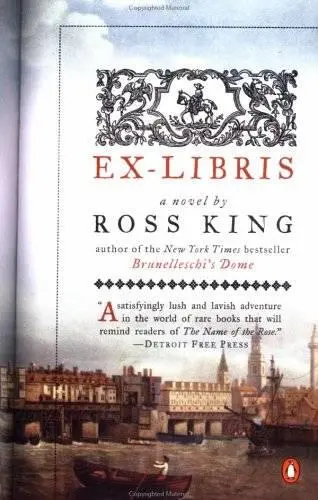
- Название:Ex Libris
- Автор:
- Жанр:
- Год:неизвестен
- ISBN:нет данных
- Рейтинг книги:3 / 5. Голосов: 1
-
Избранное:Добавить в избранное
- Отзывы:
-
Ваша оценка:
Ex Libris: краткое содержание, описание и аннотация
Предлагаем к чтению аннотацию, описание, краткое содержание или предисловие (зависит от того, что написал сам автор книги «Ex Libris»). Если вы не нашли необходимую информацию о книге — напишите в комментариях, мы постараемся отыскать её.
Ex Libris — читать онлайн бесплатно полную книгу (весь текст) целиком
Ниже представлен текст книги, разбитый по страницам. Система сохранения места последней прочитанной страницы, позволяет с удобством читать онлайн бесплатно книгу «Ex Libris», без необходимости каждый раз заново искать на чём Вы остановились. Поставьте закладку, и сможете в любой момент перейти на страницу, на которой закончили чтение.
Интервал:
Закладка:
And now it seemed that the books in the library had brought someone else to Prague, another agent who was equally mysterious. She shivered in the chill, watching as Sir Ambrose supervised the soldiers, who were now carrying a succession of crates and portmanteaux indoors for the night. The Queen's baggage had already been unloaded and the horses stabled. The remains of the convoy twisted around the square and into a dark side-street, where the oxen were coughing and lowing or else sticking their broad heads into nosebags. The soldiers wove their way among the vehicles, working silently and swiftly, until one of them, struggling to raise a crate from a wagon, stumbled in the snow. The crate tumbled to the ground with the sound of breaking glass.
'Oaf!'
Sir Ambrose struck the prone soldier sharply across the posteriors with the riding-stick, then drew his scimitar and violently prised the lid from the damaged crate. Emilia, still at the window, leaned forward. The crate appeared to be packed with straw and filled, not with books, like so many of the others, but, rather, with dozens of flasks and bottles, several of which had broken and were spilling their contents across the snow. Whatever the liquid, its stench must have been powerful, for the soldiers quickly retreated several steps, gagging and covering their noses. But Sir Ambrose knelt in the snow and carefully inspected the bottles before resealing the lid with a few blows of a mallet.
Emilia was puzzled by the sight. At first she thought the bottles must have come from the royal wine cellar: had Otakar not claimed that Frederick was shipping his wine collection from Prague along with everything else? But the bottles were too small; they looked more like flasks or vials. She decided they must have come instead from one of the castle's numerous laboratories. Prague Castle was honeycombed with such mysterious places; no one lived in Prague for a year without hearing tales about them. The Emperor Rudolf's dozens of alchemists and occultists had practised their secret arts, it was said, in special rooms tucked away in the Mathematics Tower. The library was crammed not only with their published works, Vilém once told her-with copies of Croll's Basilica chymica , Sendivogius's Novum lumen chymicum and Thurneysser's Magna alchemia -but also with their manuscripts, hundreds of documents inscribed in bizarre codes composed of astrological signs and other chicken-scratchings. She wondered if Sir Ambrose was transporting these dubious masterpieces across the snowy wastes along with the powders and potions from their hidden laboratories? Some strange business was afoot, of that she was certain. Perhaps Sir Ambrose had been, on top of all else, an alchemist, yet another of Rudolf's superstitious wizards?
She drew back the moth-eaten curtain a few more inches, pressed her brow against the frosted pane and searched for a last glimpse of Sir Ambrose. But he had already vanished into the darkness with the wooden crate clutched in his arms.
Chapter Three
Eight o'clock. Morning came seeping across London in pale-pink and pearl-grey veins of light. The city had been up for hours already: seething, clattering, belching, chiming, singing, sighing. But a darkness lingered in the sky despite the season. Gnarled strands of smoke rose upwards to filter and tease apart the morning light, like dozens of genies released from flanched bottles scattered from Smithfield to Ratcliff and for as far along the estuary as the eye could see. They returned to settle over the city in a fine black powder, tarnishing, coating and corroding, a steady dredging from which there was no escape. The gammons of bacon hanging in Leadenhall Market were already rimed with black, as was every collar, hat brim, awning and window-sill the city over. And matters would only get worse, because even at this early hour came the promise of heat, and with the heat would come the smell. Beside the Thames the stink of the silt mixed with the sweeter exhalations of the molasses, sugar and rum in the jumble of decrepit storehouses and manufactories that pressed up from the quays, together with the acrid tangs of the sea-wrack and snails exposed by the ebbing tide. The wind came from the east, unusual for that time of year, and guided the foul-smelling cloud upriver, through the endless reticulations of brick streets, sunless courts and alleys, half-opened doorways and windows, into the city's every fold or recess.
The stench was already catching in my throat and stinging my lungs as I crossed under the north gate of London Bridge and headed into Fish Street Hill. From Nonsuch House it would take me some twenty minutes to reach Little Britain, which was to be the first of my stops this morning. From there I would walk south into St. Paul's Churchyard and Paternoster Row. Then, if I still had not found what I sought, I would catch a hackney-coach to Westminster. Not that I really had expectations of finding anything in the clutter of second-hand bookstalls outside Westminster Hall, or even in the bookshops of St. Paul's Churchyard or Little Britain for that matter. As I limped forward on my thorn-stick I was frowning into my collar, which I had drawn up over my nose in an unsuccessful attempt to keep out the foul stink. It promised to be a long day.
I had decided over breakfast an hour earlier that it was time to begin my search for Sir Ambrose's parchment. But now, even before I was halfway up Fish Street Hill, I regretted my earlier resolve. Not only were the streets crowded and foul-smelling, but yesterday a search of my shelves and catalogues for editions and copies of the Corpus hermeticum had failed to turn up a single reference to The Labyrinth of the World . Yes, a long day. I ducked my head and hurried past a throng of people gathered to watch a cart-horse wallowing on its back in the middle of the street, hoofs wildly flailing.
Was it any wonder that I generally avoided the streets of London? I pushed along the pavement, through an obstacle course of rickety stalls and market porters struggling under the flayed carcasses of goats. The path was also blocked by old men trundling oyster-carts and others bearing trays heaped with combs and ink-horns. I stepped aside to let a pair of them pass but, pushed from behind, thrust my foot into a fresh heap of turd in the gutter. Scraping my boot on the kerb, I nearly came to grief beneath the hoofs of a lumbering dray-horse. Amid a chorus of rough laughter I cursed aloud and leapt to safety.
Not even these familiar humiliations, however, could quite manage to dampen my spirits. I may even have begun to whistle. For the night before-or, rather, at four o'clock the next morning-I had discovered the keyword and decrypted the mysterious leaf from Ortelius's Theatrum orbis terrarum .
Not having received a reply from my cousin after four days, it occurred to me that he might be on his long vacation, which invariably he spent in the Somersetshire countryside, at Pudney Court, a venerable wreck that served as the ancestral seat of the much-depleted Inchbold clan. So after closing up shop the previous evening I had decided to take the task of decipherment upon myself. Once again I sat in my candlelit study with the copy of Vigenère propped on one side of the desk, the leaf on the other, and a sheaf of paper in between. I had digested enough of the Traicté by the time the sentry was announcing one o'clock to satisfy myself about the operations of the substitution table, but also to appreciate that, ingenious as it was, without the keyword the table would be useless.
By two o'clock I had tried a great number of likely-and, increasingly, unlikely-words and phrases, beginning with Sir Ambrose's name and eventually even Alethea's, which I realised with a start must have been derived from alhqeia or a-letheia , the Greek word for truth, a concept which for the Athenian philosophers meant a process of unveiling, of flushing something into the open from where it lies coiled in hidden crevices. Yet even this promising name revealed no hidden truths as far as the cipher was concerned, only further nonsense, and I barely stopped work long enough to contemplate the curious irony of its connotations when applied to Lady Marchamont, who was hardly one to unveil anything. Hour after hour I hunched over the desk, humming and cursing, doodling endless figures, lighting the wick of each new candle from the stump of its predecessor. This was impossible, I kept telling myself, absolutely impossible: all of these hair-pulling labours. The decipherment could take months, and even then the scrap of paper might not have anything intelligible to say.
Читать дальшеИнтервал:
Закладка:
Похожие книги на «Ex Libris»
Представляем Вашему вниманию похожие книги на «Ex Libris» списком для выбора. Мы отобрали схожую по названию и смыслу литературу в надежде предоставить читателям больше вариантов отыскать новые, интересные, ещё непрочитанные произведения.








Обсуждение, отзывы о книге «Ex Libris» и просто собственные мнения читателей. Оставьте ваши комментарии, напишите, что Вы думаете о произведении, его смысле или главных героях. Укажите что конкретно понравилось, а что нет, и почему Вы так считаете.