Robert Wilson - The Chronoliths
Здесь есть возможность читать онлайн «Robert Wilson - The Chronoliths» весь текст электронной книги совершенно бесплатно (целиком полную версию без сокращений). В некоторых случаях можно слушать аудио, скачать через торрент в формате fb2 и присутствует краткое содержание. Год выпуска: 2001, ISBN: 2001, Издательство: TorBooks, Жанр: Фантастика и фэнтези, на английском языке. Описание произведения, (предисловие) а так же отзывы посетителей доступны на портале библиотеки ЛибКат.
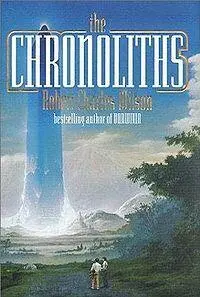
- Название:The Chronoliths
- Автор:
- Издательство:TorBooks
- Жанр:
- Год:2001
- ISBN:0-312-87384-0
- Рейтинг книги:4 / 5. Голосов: 1
-
Избранное:Добавить в избранное
- Отзывы:
-
Ваша оценка:
The Chronoliths: краткое содержание, описание и аннотация
Предлагаем к чтению аннотацию, описание, краткое содержание или предисловие (зависит от того, что написал сам автор книги «The Chronoliths»). Если вы не нашли необходимую информацию о книге — напишите в комментариях, мы постараемся отыскать её.
In early twenty-first-century Thailand, Scott is an expatriate slacker. Then, one day, he inadvertently witnesses an impossible event: the violent appearance of a 200-foot stone pillar in the forested interior. Its arrival collapses trees for a quarter mile around its base, freezing ice out of the air and emitting a burst of ionizing radiation. It appears to be composed of an exotic form of matter. And the inscription chiseled into it commemorates a military victory — sixteen years in the future.
Shortly afterwards, another, larger pillar arrives in the center of Bangkok-obliterating the city and killing thousands. Over the next several years, human society is transformed by these mysterious arrivals from, seemingly, our own near future. Who is the warlord “Kuin” whose victories they note?
Scott wants only to rebuild his life. But some strange loop of causality keeps drawing him in, to the central mystery and a final battle with the future.
The Chronoliths — читать онлайн бесплатно полную книгу (весь текст) целиком
Ниже представлен текст книги, разбитый по страницам. Система сохранения места последней прочитанной страницы, позволяет с удобством читать онлайн бесплатно книгу «The Chronoliths», без необходимости каждый раз заново искать на чём Вы остановились. Поставьте закладку, и сможете в любой момент перейти на страницу, на которой закончили чтение.
Интервал:
Закладка:
“It was the right thing to do.”
He shrugged. “Well, yeah, I think so too.” He was in a wheelchair, his damaged leg suspended in front of him, swathed in regenerative gels and wrapped in a cast. “They ought to hang a red flag on this,” he said.
“I owe you more than I can ever repay.”
“Don’t get sentimental, Scotty.” But he seemed a little teary himself. “Ashlee’s all right?”
“Improving,” I said.
“Kaitlin?”
“It’s hard to say. They’re bringing David home from Little Rock.”
He nodded. We sat silently for a time.
Then he said, “I saw it on the news. The Wyoming stone coming down. Took a while, but Sue got what she wanted, right?”
“She got what she wanted.”
“Shame about Hitch and Ray.”
I agreed.
“And Sue.” He gave me a meaningful look. “Hard to believe she’s really gone.”
“Believe it,” I said.
Because a secret isn’t a secret if you share it.
“You know I’m an old-fashioned Christian, Scotty. I’m not sure exactly what Sue believed in, unless it was that Hindu Shiva bullshit. But she was a good person, wasn’t she?”
“The best.”
“Right. Well. I couldn’t figure out why she asked me to stay here and took you to Wyoming with her. No offense, but that really bothered me. But I guess I served a purpose here.”
“That you did, my friend.”
“You think she had that in mind all along? I mean, she did have a thing for the future.”
“I think she knew us both pretty well.”
She took me, I thought, because Morris wouldn’t have served in my place. He would never have let her walk into the jaws of the wolf. He would certainly not have killed Hitch Paley.
Morris was a good man.
Twenty-eight
Lately I have visited two significant places.
Traveling isn’t easy for me these days. Medication keeps my various geriatric complaints under control — I’m healthier at seventy than my father was at fifty — but age breeds its own weariness. We are buckets of grief, I think, and eventually we fill to brimming.
I went alone to Wyoming.
The Wyoming Crater today is a minor, if unique, war memorial. For most Americans Wyoming was only the beginning of the twenty-year War of the Chronoliths. For that generation, Kait and David’s generation, the memorable battles were the Persian Gulf, Canberra, First Beijing, Canton Province. After all… no one much died at Wyoming.
No one much.
The crater is fenced and managed as a national monument now. Tourists can climb to a platform at the summit of the bluff and gaze down on the ruins from a distance. But I wanted to get closer than that. I felt entitled.
The Parks Service guard at the main entrance told me that would be impossible, until I explained that I’d been here in 2039 and showed him the scar that runs up from my left ear to my receding hairline. The guard was a veteran — armored cav, Canton, the bloody winter of 2050. He told me to stick around until the visitors’ center closed at five; then he’d see what he could do.
What he did was allow me to ride with him on the evening security inspection. We took a golf-cart-sized vehicle down a steep path and parked at the rim of the crater. The guard scrolled a newspaper and pretended not to keep an eye on me while I wandered a few minutes in the long shadows.
There had been almost an inch of rain this May. The shallow crater cupped a tiny brown pond at the bottom of it, and sagebrush bloomed along the rilled, eroded walls.
Some few fragments of the Kuin stone remained intact.
These had also eroded. Tau instability, the unraveling of complex Calabi-Yau knots, had rendered the final substance of the Chronolith as a simple fused silicate: gritty blue glass, nearly as fragile as sandstone.
There had been airstrikes here during the Western Secession, when American Kuinists had controlled these parts. The militias had claimed the state during the darkest hours of the War, had presumably (though there were no surviving witnesses) attempted to revise history by rebuilding and rebroadcasting the enormous Kuin of Wyoming. But they had been ill-advised. By someone. Someone who had convinced them to push the stability envelope past its limit.
History does not record the name of this benefactor.
A secret is a secret.
But, as Sue was also fond of saying, there is no such thing as a coincidence.
I stood for a time by a fragment of the Kuin’s head, a weathered piece of his brow and one intact eye. The pupil of the eye was a concave depression as wide as a truck tire. Dust and rain had accumulated in the bowl of it and a wild thistle had sprouted there.
The Chronoliths have proven as impervious to history as they are to logic. The act of creating such a device is so fraught with tau turbulence and outright paradox — cause and effect so tightly entangled — that no single narrative has emerged. The past (Ray’s “Minkowski ice,” I suppose) is immutable but its structure has been finely fractured, layers compressed and upturned, in places rendered chaotic and uninterpretable.
The stone was cold to the touch.
I cannot truthfully say that I prayed. I don’t know how to pray. But I pronounced a few names in the privacy of my mind, words addressed to the tau turbulence, if anything remains of it. Sue’s name, among others. I thanked her.
Then I begged the dead to forgive me.
The park guard eventually grew impatient. He escorted me back to the cart as the sun touched the horizon. “Guess you have some stories to tell,” he said.
A few. And a few I haven’t told. Until now.
Was there ever a single, substantial Kuin — a human Kuin, I mean?
If so, he remains an elusive figure, overshadowed by the armies who fought in his name and invented his ideology. There surely must have been an original Kuin, but I suspect he was overthrown by any number of successors. Perhaps, as Sue had speculated, each Chronolith required its own Kuin. “Kuin” became little more than a name for the vacuum at the heart of the whirlwind. The king is unborn; long live the king.
After Ashlee’s death late last year I was obliged to sort through her belongings. Deep in a box of ancient papers (expired ration coupons, tax forms, yellowed past-due notices from utility companies) I found Adam Mills’ birth certificate. The only striking thing about this was that Adam’s middle name happened to be Quinn, and that Ashlee had never mentioned it to me.
But this is, I think, at last, a genuine coincidence. At least, that’s what I prefer to believe. I’m old enough now to believe what I choose. To believe what I can bear to believe.
Kait left David at home and joined me at Boca Raton that summer, an unplanned vacation. We hadn’t seen each other since Ashlee’s funeral in December. I had come to Boca Raton on a whim: I wanted to see the Shipworks while I was still able to travel.
Nowadays everyone talks about the postwar recovery. We’re like terminal patients granted a miracle cure. Sunshine seems sunnier, the world (such as it is) is our oyster, and the future is infinitely bright. Inevitably, we will all be disappointed. But not, I hope, too badly.
And there are some things of which we are quite reasonably proud — the National Shipworks, for instance.
I remember, around the time of the Portillo arrival, Sue Chopra insisting that the technology of Calabi-Yau manipulation would yield a host of more enduring wonders than the Chronoliths. (“I mean, star travel, Scotty: that’s a real possibility!”) And Sue, as usual, had been right. She had an acute sense of the future.
Kait and I walked slowly up a long promenade to the observation level overlooking the launching bays, a vast half-moon-shaped structure walled with reinforced glass.
Читать дальшеИнтервал:
Закладка:
Похожие книги на «The Chronoliths»
Представляем Вашему вниманию похожие книги на «The Chronoliths» списком для выбора. Мы отобрали схожую по названию и смыслу литературу в надежде предоставить читателям больше вариантов отыскать новые, интересные, ещё непрочитанные произведения.



Обсуждение, отзывы о книге «The Chronoliths» и просто собственные мнения читателей. Оставьте ваши комментарии, напишите, что Вы думаете о произведении, его смысле или главных героях. Укажите что конкретно понравилось, а что нет, и почему Вы так считаете.