Robert Wilson - The Chronoliths
Здесь есть возможность читать онлайн «Robert Wilson - The Chronoliths» весь текст электронной книги совершенно бесплатно (целиком полную версию без сокращений). В некоторых случаях можно слушать аудио, скачать через торрент в формате fb2 и присутствует краткое содержание. Год выпуска: 2001, ISBN: 2001, Издательство: TorBooks, Жанр: Фантастика и фэнтези, на английском языке. Описание произведения, (предисловие) а так же отзывы посетителей доступны на портале библиотеки ЛибКат.
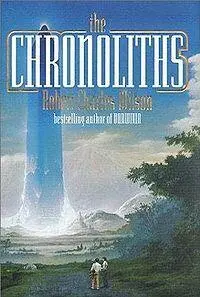
- Название:The Chronoliths
- Автор:
- Издательство:TorBooks
- Жанр:
- Год:2001
- ISBN:0-312-87384-0
- Рейтинг книги:4 / 5. Голосов: 1
-
Избранное:Добавить в избранное
- Отзывы:
-
Ваша оценка:
The Chronoliths: краткое содержание, описание и аннотация
Предлагаем к чтению аннотацию, описание, краткое содержание или предисловие (зависит от того, что написал сам автор книги «The Chronoliths»). Если вы не нашли необходимую информацию о книге — напишите в комментариях, мы постараемся отыскать её.
In early twenty-first-century Thailand, Scott is an expatriate slacker. Then, one day, he inadvertently witnesses an impossible event: the violent appearance of a 200-foot stone pillar in the forested interior. Its arrival collapses trees for a quarter mile around its base, freezing ice out of the air and emitting a burst of ionizing radiation. It appears to be composed of an exotic form of matter. And the inscription chiseled into it commemorates a military victory — sixteen years in the future.
Shortly afterwards, another, larger pillar arrives in the center of Bangkok-obliterating the city and killing thousands. Over the next several years, human society is transformed by these mysterious arrivals from, seemingly, our own near future. Who is the warlord “Kuin” whose victories they note?
Scott wants only to rebuild his life. But some strange loop of causality keeps drawing him in, to the central mystery and a final battle with the future.
The Chronoliths — читать онлайн бесплатно полную книгу (весь текст) целиком
Ниже представлен текст книги, разбитый по страницам. Система сохранения места последней прочитанной страницы, позволяет с удобством читать онлайн бесплатно книгу «The Chronoliths», без необходимости каждый раз заново искать на чём Вы остановились. Поставьте закладку, и сможете в любой момент перейти на страницу, на которой закончили чтение.
Интервал:
Закладка:
I crawled into my cot at sunrise bleeding from both my hands.
The siege was about to begin.
Twenty-three
Until now we’d had the site to ourselves. Shortly, the world would be with us.
And everything that implied. Not just press people, but Kuinists of all stripes… though we hoped the isolated location and short notice would preclude a massive haj. (“This is our haj,” Sue had said more than once. “This one belongs to us .”)
So our Uniforces troops arrayed themselves around our fenced perimeter and up along the bluff, and we notified the Highway Patrol and state officials, who were deeply unhappy with us for making our work public but lacked the authority to shut us down. Ray Mosely figured we had at most twelve hours before the first outsiders began to arrive. We had already managed to erect a cranelike superstructure above the poured foundation that would support the tau core, and to rig and test all our ancillary equipment. But we weren’t finished.
Sue hovered around the large flatbed truck which contained the core itself, second-guessing the engineers, until Ray and I distracted her with lunch. We choked down mil-surplus meals under a canvas tent while Ray walked us through a checklist. The work was ahead of schedule, which served to calm some of Sue’s fears.
At least briefly. Sue was what the doctors call “agitated.” In fact she gave every indication that she was on the brink of nervous collapse. She moved restlessly and aimlessly, drummed her fingers, blinked, confessed she hadn’t been able to sleep. Even when she was engaged in conversation, her eyes tended to stray toward the concrete core emplacement and the glittering steel tubing of the support structure.
She continued to talk relentlessly about the project. Her immediate fear was that the press might be delayed or the Chronolith arrive prematurely. “It’s not so much what we do here,” she said, “as what we’re seen to do here. We don’t succeed unless the world sees us succeed.”
(And I considered what a slender reed that really was. We had only Sue’s assurance that destroying a Chronolith at the moment of its arrival might tip the balance of this shadow war — might destabilize the feedback loop on which Kuin allegedly depended. But how much of that was calculation, how much wishful thinking? By virtue of her position and her fervent advocacy Sue had been able to carry us all along with her, invested as she was with the authority of her mathematics and her profound understanding of tau turbulence. But that didn’t mean she was necessarily right. Or even, necessarily, sane.)
After lunch we watched as a crew of stevedores and a crane operator lifted the tau core from its crate and hauled it as delicately as if it were compressed dynamite to its resting place. The core was a sphere three meters in diameter, anodized black and studded with electronic ports and cable bays. I gathered from what Sue had told me that it was essentially a magnetic bottle in which some exotic form of cold plasma was already contained. When the core was activated, an array of internal high-energy devices would initiate fermionic decohesion and a few nearly massless particles of tau-indeterminate matter would be created.
This material, Sue claimed, would be sufficient to destabilize the arriving Chronolith attempting to occupy its space. What that meant was still unclear, at least to me. Sue said the interaction of the competing tau spaces would be violent but not “unduly energetic,” i.e., it would probably not wipe out all of Modesty County and us along with it. Probably.
By sunset the core was fixed in place and linked to our electronics through a bundle of lightpipes and conductors jacketed in liquid nitrogen. We still had much to do, but the heavy lifting and digging was essentially finished. The civilians celebrated with grilled flank steaks and generous rations of bottled beer. A bunch of the older engineers gathered by the roadside after dinner, talked about better days and sang old Lux Ebone songs (much to the chagrin of the young Uniforces troops). I joined in on the choruses.
We suffered our first casualty that night.
Isolated we might have been, but there was still occasional traffic on the two-lane county road that had brought us here. We had men north and south along the roadside, soldiers wearing the orange brassards of a highway work crew. They carried glow torches and waved on anyone who seemed more than casually curious about our trucks and gear. The strategy had worked reasonably well so far.
Not long after moonrise, however, a man in a verdigris-green landau cut his motor and lights at the top of the northern rise and rolled silently into the breakdown lane not fifty feet from our lead truck, in the shadows where the glow of the camp lights began to fade.
He stepped out onto the gravel berm with his back to two approaching security personnel, and when he turned he revealed a heavy indeterminate shape that proved to be a pump-action shotgun of ancient provenance. He turned and fired it at the Uniforces men, killing one and permanently blinding the other.
Fortunately the chief of security that night was a bright and well-trained woman named Marybeth Pearlstein, who witnessed the act from a watch station fifty feet up the road. A scant few seconds later she came around the bumper of the nearest truck with her rifle at ready and took down the assailant with one well-placed shot.
The assailant turned out to be a Copperhead crank well known to local police. A County Coroner’s truck pulled up two hours later and took the bodies away; an ambulance carried the survivor into the Modesty County medical center. There might have been an inquest, I suppose, if events had turned out differently.
What I didn’t know—
That is, what I learned later—
Pardon me, but fuck these stupid and impotent words.
Can you hear it, grinding away under the printed page, this outrage disinterred from the soil of too many years?
What I didn’t know was that several of the Texas PK militia — the people Hitch had told me about, the people who had taken two of his fingers — had already followed a trail of clandestine connections as far as the home of Whitman Delahunt.
Whit, it seemed, had kept his colleagues informed of my comings and goings ever since I had traveled to Portillo in search of Kaitlin. Even then, the PK and Copperhead elites had taken an interest in Sue Chopra: as a potent enemy, or worse, a commodity, a potential resource.
I don’t imagine Whit could have foreseen the consequences of his actions. He was, after all, only sharing some interesting information with his Copperhead buddies (who shared it with their friends, and so on down the line from Whit’s suburban universe all the way to the underground militant cadres). In Whit’s world consequences were always remote; rewards were immediate, else they were not rewards. There was nothing genuinely political about Whit Delahunt’s Copperhead leanings. For Whit the movement was a kind of Rotary or Kiwanis, dues paid in the coin of information. I doubt he ever really believed in a physical, substantial Kuin. Had Kuin appeared before him, Whit would have been as dumbfounded as a Sunday Christian confronted by the Carpenter of Galilee.
Which is not, I hasten to add, an excuse .
But I’m sure Whit never envisioned these Texas militiamen knocking at his door well after midnight, entering his home as if it were their own (because he was one of their own) and extracting from him at gunpoint the address of the apartment where Ashlee and I lived.
Janice was present when this invasion took place. She tried to persuade Whit not to answer the invaders’ questions, and when he ignored her she tried to phone the police. For this unsuccessful effort she received a pistol-whipping that broke her jaw and fractured her collarbone. They both would have been killed, I’m sure, if not for Whit’s promise to keep Janice under control — he had nothing to gain by reporting any of this and I’m sure he told himself he was helpless to stop it — and his potential further utility to the movement.
Читать дальшеИнтервал:
Закладка:
Похожие книги на «The Chronoliths»
Представляем Вашему вниманию похожие книги на «The Chronoliths» списком для выбора. Мы отобрали схожую по названию и смыслу литературу в надежде предоставить читателям больше вариантов отыскать новые, интересные, ещё непрочитанные произведения.





Обсуждение, отзывы о книге «The Chronoliths» и просто собственные мнения читателей. Оставьте ваши комментарии, напишите, что Вы думаете о произведении, его смысле или главных героях. Укажите что конкретно понравилось, а что нет, и почему Вы так считаете.