Robert Wilson - The Chronoliths
Здесь есть возможность читать онлайн «Robert Wilson - The Chronoliths» весь текст электронной книги совершенно бесплатно (целиком полную версию без сокращений). В некоторых случаях можно слушать аудио, скачать через торрент в формате fb2 и присутствует краткое содержание. Год выпуска: 2001, ISBN: 2001, Издательство: TorBooks, Жанр: Фантастика и фэнтези, на английском языке. Описание произведения, (предисловие) а так же отзывы посетителей доступны на портале библиотеки ЛибКат.
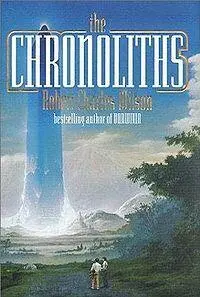
- Название:The Chronoliths
- Автор:
- Издательство:TorBooks
- Жанр:
- Год:2001
- ISBN:0-312-87384-0
- Рейтинг книги:4 / 5. Голосов: 1
-
Избранное:Добавить в избранное
- Отзывы:
-
Ваша оценка:
The Chronoliths: краткое содержание, описание и аннотация
Предлагаем к чтению аннотацию, описание, краткое содержание или предисловие (зависит от того, что написал сам автор книги «The Chronoliths»). Если вы не нашли необходимую информацию о книге — напишите в комментариях, мы постараемся отыскать её.
In early twenty-first-century Thailand, Scott is an expatriate slacker. Then, one day, he inadvertently witnesses an impossible event: the violent appearance of a 200-foot stone pillar in the forested interior. Its arrival collapses trees for a quarter mile around its base, freezing ice out of the air and emitting a burst of ionizing radiation. It appears to be composed of an exotic form of matter. And the inscription chiseled into it commemorates a military victory — sixteen years in the future.
Shortly afterwards, another, larger pillar arrives in the center of Bangkok-obliterating the city and killing thousands. Over the next several years, human society is transformed by these mysterious arrivals from, seemingly, our own near future. Who is the warlord “Kuin” whose victories they note?
Scott wants only to rebuild his life. But some strange loop of causality keeps drawing him in, to the central mystery and a final battle with the future.
The Chronoliths — читать онлайн бесплатно полную книгу (весь текст) целиком
Ниже представлен текст книги, разбитый по страницам. Система сохранения места последней прочитанной страницы, позволяет с удобством читать онлайн бесплатно книгу «The Chronoliths», без необходимости каждый раз заново искать на чём Вы остановились. Поставьте закладку, и сможете в любой момент перейти на страницу, на которой закончили чтение.
Интервал:
Закладка:
It was disturbing, then, to be back in the presence of Sue, whose obsessions still burned very brightly. She was polite when we talked about old times or familiar faces. But her eyes brightened and her voice gained a decibel as soon as talk turned to the recent advent of the Freetown Chronolith or the advance of the Kuinist armies into Nigeria.
I watched her while she talked. That gloriously uncontrollable crown of coiled hair had grayed at the fringes. When she smiled, the skin at the corners of her eyes wrinkled complexly. She was skinny and looked a little careworn whenever the glow of her fervency ebbed.
And Ray Mosely, incredibly, was still in love with her. He did not, of course, say this. I suspect Ray experienced his love for Sulamith Chopra as a private humiliation, forever invisible to outsiders. But it wasn’t invisible. And maybe he had made his own bargain with it: better to nurse a futile affection than to concede to lovelessness. Bearded as he was, thin now almost to the point of anorexia, his hair receding like a childhood memory, Ray still gave Sue those deferential glances, still smiled when she smiled, laughed when she laughed, rose to her defense at the first hint of criticism.
And when Sue nodded at Ashlee in the kitchen and said, “I envy you, Scotty. I always wanted to settle down with a good woman,” Ray chuckled obediently. And winced, all at once.
Before I went to bed I turned out the sofa-bed and shook out a set of spare blankets. This could only have been torture for Ray, sleeping next to Sue in absolute and unquestioned chastity, listening to the sound of her breath. But it was the only accommodation I had to offer, apart from the floor.
Before I went to bed myself I took Sue aside. “It’s good to see you,” I told her. “I mean it. But if you want more from me than a couple of nights on a fold-out, I want to know.”
“We’ll talk about that later,” she said calmly. “Night, Scotty.”
Ashlee, in bed, was less sanguine. It was great to meet these people who had once meant so much to me, she said — it made all those stories I had told her come to life. But she was afraid of them, too.
“Afraid?”
“The way Kait’s afraid of the draft. For the same reason. They want something from you, Scott.”
“Don’t let it worry you.”
“But I have to worry. They’re smart people. And they wouldn’t be here if they didn’t think they could talk you into… whatever it is they want you to do.”
“I’m not so easy to convince, Ash.”
She rolled on her side, sighing.
In seven years Kuin had still not planted a Chronolith on American soil, at least not north of the Mexican border. We remained part of an archipelago of sanity in a world besieged by madness, along with northern Europe, southern Africa, Brazil, Canada, the Caribbean Islands, and sundry other holdouts. Kuin’s impact in the Americas had been broadly economic, not political. Global chaos, especially in Asia, had dried up foreign demand for finished goods. Money drained out of the consumer-goods industries and was tunneled into defense. It made for relatively low unemployment (apart from the Louisiana refugees) but lots of spot shortages and some rationing. Copperheads claimed that the economy was being gradually Sovietized, and in this, at least, they may have had a point. There was still no real pro-Kuin sentiment in Congress or the White House. Our Kuinists (and their radical A-K counterparts) were street fighters, not organizers. At least, so far. Respectable Copperheads like Whit Delahunt were another matter — they were everywhere, but they walked very softly.
I had read some of the Copperhead literature, both the academic writers (Daudier, Pressinger, the Paris Group) and the populist hacks (Forrestall’s Clothing the Emperor when it hit the bestseller list). I had even sampled the works of the musicians and novelists who were the public face of the Kuinist underground. Impressive as some of this was prima facie , it nevertheless struck me as wishful at best, at worst as an attempt to ingratiate either the nation or more likely the writer to some inevitable Kuinist autarchy.
And still there was no direct evidence of the existence of Kuin himself. No doubt he did exist, perhaps somewhere on the southern Chinese mainland, but most of Asia was closed to media and telecommunications, its infrastructure in a state of radical collapse and millions dead in the famine and unrest. The chaos that helped create Kuin also served to shield him from premature exposure.
And was the technology necessary to create a Chronolith already in Kuin’s hands?
Yes, probably, Sue told me.
This was Sunday morning. Ashlee, still nervous, had gone off to visit her cousin Alathea in St. Paul. (Alathea eked out a living selling decorative copper pots door to door. Visiting Alathea on Sundays was an expression of familial piety on Ashlee’s part, since Alathea was a disagreeable woman with eccentric religious beliefs and no talent for housekeeping.) I sat with Sue at the kitchen table, picking at breakfast and generally savoring my day off, while Ray went out to hunt for a source of fresh coffee — we had used up the house supply.
There were, Sue told me, only a handful of people in the world who understood contemporary Chronolith theory well enough to envision the means to create one. She happened to be one of them. That was why the federal government had taken such an ambivalent interest in her, alternately helping and hindering her work. But that wasn’t the big problem right now. The big problem, she said, was that the increasingly desperate Chinese government had years ago established its own intensive research programs into the practicality of tau-bending technology and had isolated these facilities from the international community.
And why was that a problem?
Because the fragmented Chinese government had finally collapsed under the weight of its own insolvency, and those same research facilities were presumably under the direct control of Kuinist insurgents.
“So it all fits into place,” she said. “Somewhere in Asia there’s a Kuin, and he has the technology in his hands. We’re only a couple of years away from the Chumphon conquest, and that looks like an entirely plausible event. We can’t do anything about it, either. All of Southeast Asia is in the hands of various Kuinist insurgent movements — it would take a huge army to occupy the hills above Chumphon, and that would mean recommitting troops and supplies from China, which nobody is willing to do. So it comes together very, very neatly… you might say, inevitably.”
“These are the shades of things that must be.”
“Yes.”
“And we’re helpless to stop it.”
“Well, I don’t know, Scotty. I think maybe there is something I can do.” Her smile was both mischievous and sad.
But the whole subject made me uneasy, and I tried to divert her by asking whether she had heard from Hitch Paley lately. (I hadn’t: not since Portillo.)
“We’re still in contact,” she said. “He’ll be passing through town in a couple of days.”
I suppose it’s evidence of Sue’s innate (if awkward) charm that by the following evening Ashlee was sitting beside her on the sofa, listening raptly to Sue’s interpretation of the Age of Chronoliths.
As I joined them, Ash was saying, “I still don’t understand why you think it’s so important to destroy one.”
Sue, pondering her response, looked as intensely thoughtful as a religious zealot.
Which, perhaps, she was, at least on her own terms. In her pop-physics seminar at Cornell she had been fond of comparing the particle zoo (hadrons, fermions, and all the varieties of their constituent quarks) to the deities of the Hindu pantheon — all distinct, yet all aspects of a single encompassing Godhead. Sue was not conventionally religious and she had never even visited her parents’ native Madras; she used the metaphor loosely and often comically. But I recalled her description of two-faced Shiva: the destroyer and bringer of life, the ascetic youth and the lingam-wielding impregnator — Sue had detected the presence of Shiva in every duality, every quantum symmetry.
Читать дальшеИнтервал:
Закладка:
Похожие книги на «The Chronoliths»
Представляем Вашему вниманию похожие книги на «The Chronoliths» списком для выбора. Мы отобрали схожую по названию и смыслу литературу в надежде предоставить читателям больше вариантов отыскать новые, интересные, ещё непрочитанные произведения.








Обсуждение, отзывы о книге «The Chronoliths» и просто собственные мнения читателей. Оставьте ваши комментарии, напишите, что Вы думаете о произведении, его смысле или главных героях. Укажите что конкретно понравилось, а что нет, и почему Вы так считаете.