Larry Niven - Footfall
Здесь есть возможность читать онлайн «Larry Niven - Footfall» весь текст электронной книги совершенно бесплатно (целиком полную версию без сокращений). В некоторых случаях можно слушать аудио, скачать через торрент в формате fb2 и присутствует краткое содержание. Год выпуска: 1985, ISBN: 1985, Издательство: Del Rey Books, Жанр: Фантастика и фэнтези, на английском языке. Описание произведения, (предисловие) а так же отзывы посетителей доступны на портале библиотеки ЛибКат.
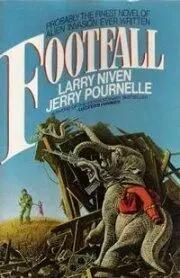
- Название:Footfall
- Автор:
- Издательство:Del Rey Books
- Жанр:
- Год:1985
- ISBN:0-345-32347-5
- Рейтинг книги:3 / 5. Голосов: 1
-
Избранное:Добавить в избранное
- Отзывы:
-
Ваша оценка:
Footfall: краткое содержание, описание и аннотация
Предлагаем к чтению аннотацию, описание, краткое содержание или предисловие (зависит от того, что написал сам автор книги «Footfall»). Если вы не нашли необходимую информацию о книге — напишите в комментариях, мы постараемся отыскать её.
Physically, the Fithp resemble man-sized, quadrupedal elephants with multiple trunks. They possess more advanced technology than humans, but have developed none of it themselves. In the distant past on their planet, another species was dominant, with the Fithp existing as animals, perhaps even as pets. This predecessor species badly damaged the environment, rendering themselves and many other species extinct, but left behind their knowledge inscribed on large stone cubes (called
, plural of
in the Fithp language), from which the Fithp have gained their technology. The study of Thuktun is the only science the Fithp possess. The Fithp are armed with a technology that is superior rather than incomprehensible: laser cannon, projectile rifles, controlled meteorite strikes to bombard surface targets, lightcraft surface-to-orbit shuttles the size of warships, etc.
Nominated for Hugo and Locus awards in 1986.
Footfall — читать онлайн бесплатно полную книгу (весь текст) целиком
Ниже представлен текст книги, разбитый по страницам. Система сохранения места последней прочитанной страницы, позволяет с удобством читать онлайн бесплатно книгу «Footfall», без необходимости каждый раз заново искать на чём Вы остановились. Поставьте закладку, и сможете в любой момент перейти на страницу, на которой закончили чтение.
Интервал:
Закладка:
“Mr. Clybourne,” Admiral Carrell said mildly.
“No,” Jack said firmly. “Before the President goes in there, you get that alien out, or you give me a hell of a lot more gun than this pistol, and that’s final.”
Admiral Carrell sighed.
“Jack …” Jenny stepped forward. How do I get him out of this? “Jack, will you agree if I bring in Sergeant Bonner and two MPs with military rifles?”
“You can’t do that,” Sherry Atkinson protested. “We can’t make Harpanet feel that we don’t trust him!”
“Damn it all. Mr. President!” Wade Curtis said.
“Yes, Mr. Curtis?” the President asked. He sounded as if he was suppressing a chuckle.
“Their top brass travel with armed guards. Harpanet won’t see anything unusual in having the President escorted by soldiers.”
“Do you think I will need them, Mr. Curtis?”
“No. But I see Jack’s point. If Harpanet decided to take on the President, he’d be damned hard to stop. Incidentally, if you’re going to do this, do it right. None of those dinky little Mattel toy rifles. Get a couple of thirty-ought-sixes.”
“And where will we find those?” Jenny asked.
“There’s one in my room. Ransom’s got another,” Curtis said.
“That’s why, Mr. President.” Joe Ransom finished his presentation. The room, filled with writers and engineers and soldiers stood in silence, so that the only sound was the heavy breathing of the alien captive.
“Impressive,” President Coffey said. He looked bewilderedly around the room until his eyes met those of the alien. Harpanet stood thirty feet away, as far as Clybourne could put him, with four armed combat veterans between the alien and the President.
And still too close, Jenny thought.
“What do you call him? Has he a title?” the President asked.
“Just Harpanet, Mr. President,” Robert Anson said. “Any title he might have had from his own people was lost when he surrendered, and we have not yet given him one.”
“Harpanet,” the President said quietly.
“Lead me.”
“Have you understood what was said here?”
“Yes.”
“Is it true? They will drop a large asteroid on the Earth?” The alien spread his digits.
“He says he can’t know,” Sherry interpreted.
“But your ship was to be — mated with a foot?”
“Yes.” The s sound fluttered.
“Is there anyone here who disagrees?” the President demanded. There was only silence.
President Coffey began to pace. “We’ll have to warn as many people as possible. Worldwide. God, I wish they hadn’t made such hash of our communications. Yes, Admiral?”
“I think we don’t dare.”
“Dare what? Warn the world? We’d be condemning millions! Tidal waves, storms, earthquakes, volcanoes, it’ll be like a weeklong disaster movie festival!”
“And if we do issue a warning, we will certainly condemn thousands. Tens of thousands,” Admiral Carrell said. “They will flee from the coasts. All the coasts.”
“But it’s better than doing nothing!”
“Mr. President.” Robert Anson seemed to have aged ten years in months, but his voice was firm and insistent.
“Yes, Mr. Anson?”
“If you issue a warning, people will flee the coastal towns. Bellingham is a coastal town.”
“But …?”
“You dare not have people flee from every town except Bellingham,” Anson said.
“He is certainly correct,” Admiral Carrell said. “If you issue a warning, you will disrupt Project Archangel. Perhaps permanently.”
“And Archangel is the only goddam chance we have,” Curtis said.
The President sat heavily. His fingers drummed against the desk. After a few moments he looked up. “Thor, would you send Mrs. Coffey in, please? I’ll speak with the rest of you later. Thank you for your advice.”
Mrs. Carmichael had told Alice a story once. Later Alice had asked around, and everyone had heard it. The psychiatrists probably thought it did their patients good. Maybe it did.
A motorist finds himself with a flat tire on a back road, late at night. There’s a fence. Someone is peering through it, not doing anything, just watching. The motorist sees a sign in the headlights. He’s parked next to a mental institution.
He takes the flat tire off, putting the five nuts in the hubcap. The stranger watches. He pulls the spare tire out of the trunk. The stranger watches. Motorist is getting nervous. What’s a maniac doing out so late at night? Why is he staring like that? Motorist rolls the tire around from the back and steps on the rim of the hubcap, which flips all of the nuts into tall weeds. Motorist goes after them. He finds one nut.
The mental patient speaks. “Take a nut off each of the other tires. Put them on the fourth wheel. Four nuts each. It’ll get you to a gas station.”
Motorist says, “That’ll work.” Then, “Hey, that’s brilliant! What the hell are you doing here?”
Patient says, “I’m here for being crazy. Not stupid.”
The air pipes were a little more than a yard across. There we no handholds. At first Alice had floundered, lost and nauseated and fighting the fear of falling. It was better now. Jeri and Melissa actually enjoyed the low gravity, and they’d shown Alice how.
Alice had always been thin. Pale face, fiery hair, slender body, vividly pretty, for whatever that was worth. Now she was gaunt. She tried to eat, but there was no appetite, and the horrors tried to foist nauseating alien plants and meat on her. The others accepted such treatment. They ate canned food and alien food, they ate the vitamins and protein powder and brewer’s yeast she had supplied and they thrived.
Living wasn’t worth the effort under these circumstances. Alice had slashed her wrists once, long ago, for reasons that seemed trivial now. Something sharp would presently come her way. Yet she was half sure she wouldn’t use it.
After all, who would care?
The little girl, Melissa, treated her with something between fear and contempt. Jeri was nice, but she spent a lot of time with the Russians. I think she likes the big one. He does things for her. Brings her things. Got the blanket to put around the toilet pool; that was nice.
Nobody does things for me. They resent me. With Wes Dawson it went far beyond resentment. He gave orders. He lectured. He taught the language of the horrors — an expected the women to use it. He was persuasive and smooth and condescending, like that first psychiatrist they had given her, the one who thought using Q-tips was a form of masturbation. She’d gotten along all right with the second one. Mrs. Carmichael had looked a little like Jeri Wilson. A little plumper, and not as scared, Alice thought.
The horrors were worse than Dawson. Anything short of instant obedience puzzled them. They solved the problem by prodding with their trunks or the butts of the twisted-looking guns. They wouldn’t listen to anything she had to say. They treated her like a thing. If Alice McLennon slashed her wrists, it would be one less damn thing for the horrors to worry about.
This cleaning of air pipes: it was make-work, a way of keeping the prisoners busy, like picking tomatoes at Menninger’s. Alice wasn’t fooled. I’m here for being crazy, not stupid. The horrors were too big to fit in the pipes. What had they done before people turned up? Maybe they had Roto-Rooters, or maybe the pipes just never needed cleaning, or — she’d glimpsed something like a steel doughnut just the size of the pipe, with a glittering eye that watched her, from a distance. Robots?
And like the make-work at Menninger’s, it served its purpose. They’d pushed her into the ducts when she balked. Those rubbery split trunks were irresistibly strong. She floundered in there, disoriented and nauseated, and took the great wad of cloth and the plastic bag that were shoved in after her. Then she hadn’t done anything for a while. Then … she started to clean the pipes.
Читать дальшеИнтервал:
Закладка:
Похожие книги на «Footfall»
Представляем Вашему вниманию похожие книги на «Footfall» списком для выбора. Мы отобрали схожую по названию и смыслу литературу в надежде предоставить читателям больше вариантов отыскать новые, интересные, ещё непрочитанные произведения.

Обсуждение, отзывы о книге «Footfall» и просто собственные мнения читателей. Оставьте ваши комментарии, напишите, что Вы думаете о произведении, его смысле или главных героях. Укажите что конкретно понравилось, а что нет, и почему Вы так считаете.