Larry Niven - Footfall
Здесь есть возможность читать онлайн «Larry Niven - Footfall» весь текст электронной книги совершенно бесплатно (целиком полную версию без сокращений). В некоторых случаях можно слушать аудио, скачать через торрент в формате fb2 и присутствует краткое содержание. Год выпуска: 1985, ISBN: 1985, Издательство: Del Rey Books, Жанр: Фантастика и фэнтези, на английском языке. Описание произведения, (предисловие) а так же отзывы посетителей доступны на портале библиотеки ЛибКат.
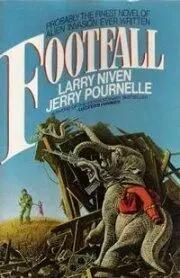
- Название:Footfall
- Автор:
- Издательство:Del Rey Books
- Жанр:
- Год:1985
- ISBN:0-345-32347-5
- Рейтинг книги:3 / 5. Голосов: 1
-
Избранное:Добавить в избранное
- Отзывы:
-
Ваша оценка:
Footfall: краткое содержание, описание и аннотация
Предлагаем к чтению аннотацию, описание, краткое содержание или предисловие (зависит от того, что написал сам автор книги «Footfall»). Если вы не нашли необходимую информацию о книге — напишите в комментариях, мы постараемся отыскать её.
Physically, the Fithp resemble man-sized, quadrupedal elephants with multiple trunks. They possess more advanced technology than humans, but have developed none of it themselves. In the distant past on their planet, another species was dominant, with the Fithp existing as animals, perhaps even as pets. This predecessor species badly damaged the environment, rendering themselves and many other species extinct, but left behind their knowledge inscribed on large stone cubes (called
, plural of
in the Fithp language), from which the Fithp have gained their technology. The study of Thuktun is the only science the Fithp possess. The Fithp are armed with a technology that is superior rather than incomprehensible: laser cannon, projectile rifles, controlled meteorite strikes to bombard surface targets, lightcraft surface-to-orbit shuttles the size of warships, etc.
Nominated for Hugo and Locus awards in 1986.
Footfall — читать онлайн бесплатно полную книгу (весь текст) целиком
Ниже представлен текст книги, разбитый по страницам. Система сохранения места последней прочитанной страницы, позволяет с удобством читать онлайн бесплатно книгу «Footfall», без необходимости каждый раз заново искать на чём Вы остановились. Поставьте закладку, и сможете в любой момент перейти на страницу, на которой закончили чтение.
Интервал:
Закладка:
He tried to remember the map. That part of Kansas was laid out in a grid, roads at section and range boundaries, other roads parallel to them. Few diagonal roads. Farmhouses at regular intervals. Dirt tracks crossed the wheat fields. Those tended to parallel the main roads, too, but they led to farmhouses, not towns.
Logan was several miles ahead Harry gambled that there’d be a farm access mad leading north before he came into sight of the Invaders. He put the pistol into his kidney belt where he could reach it easily, and started off east.
He saw the smoke long before he reached the ruined farmhouse. He came up slowly, ready to leap off the motorcycle and run into the wheat. He stopped several times to listen, but there was nothing to hear. The dirt road led through the wheat fields to the farmhouse. He could go back the way he’d come; or go on. He went on.
The house itself was a wreck, roof sagging, doors torn from their hinges, but it hadn’t burned. The barn was burned to ashes. The bodies of a man and two dogs lay in the dusty yard between the house and the barn. A shotgun lay across the man’s chest.
Another dog whimpered from under the wreckage of the farmhouse.
“Ho! Anyone home?” Harry shouted. There was no answer except the whimpering of the dog. He stopped the motorcycle and got off. Large tracks were visible in the dust. They didn’t really look like the tracks of elephants, because they left claw marks. Nothing on Earth left tracks like that.
He stalked cautiously around the yard, and after a while he went inside the house. There were women’s clothes in the closet with the farmer’s clothes. Another room had been occupied by a boy. Harry guessed he’d been about Melissa’s age, ten or eleven. A model of the starship Enterprise hung from the ceiling and toy guns stood in the corner. Clothing for a small boy was flung onto the floor. Two dresser drawers were empty.
Prisoners? They’re taking women and children, but not men? That doesn’t make sense.
There were letters scattered across the front room floor. John Thomas Kensington, RFD #3… Harry went back outside. Kensington lay on his back, his eyes staring upward to the sky. He’d been torn in two halves by one shot. The bore on those alien guns was as big as a fist. Twenty yards from his body the ground had been torn up by something large thrashing in the dust, and there were dark stains. John Thomas Kensington had sold his farm dearly. Harry saluted and went back into the collapsing house.
They take their dead with them. Dead or wounded. A shotgun ought to do some damage at hat range. Wonder what he was using?
The refrigerator had been wrecked, but the food inside wasn’t spoiled. Harry rooted around until he found bread and cheese and lunch meat and made a sandwich. While he was looking for bread he found a box of shells for the shotgun. It was number six bird shot, suitable for doves and quail. Not much of a load for elephants. He waited until he’d eaten before he went to take the gun from the man’s lifeless fingers.
The dog under the porch continued to whimper.
Bury the dead? Shoot the dog before it turns feral or starves?
Harry had always believed himself tough, but he’d never thought he’d be faced with decisions like this. Dead bodies were matters for the police and the coroner’s office and the undertakers.
There won’t be a coroner. Harry went looking for a shovel.
He made another dozen miles before the sonic boom tore at his ears. Harry braked the motorcycle and looked up. Three contrails led from the west, passing nearly overhead. Harry cheered. “Go get the bastards!” he shouted.
As he watched, one of the contrails broke into a ball of black smoke. Something bright seemed to stab upward from the east, and the second contrail died. The third traced a complex curve; then it, too, ended in a ball of black smoke.
“Damn. Damn and hell.” Harry started the bike again.
The big situation map in the war room changed every few minutes, but no one was sure how current its information was. A vast area of Kansas , stretching northward into Nebraska , was covered with bright red symbols. Someone had finally got stylized parachutes to show where alien units had landed. They covered an area that looked much like an amoeba, with its nucleus at Great Bend . Pseudopods reached east and west.
The Situation Room was the center of the underground North American Air Defense complex. It was located under nearly a mile of granite, separated from the outside world by sealed corridors, water barriers, guard rooms, and more granite. A row of offices overlooked the Situation Room. Jack Clybourne stood outside one of the office doors.
Jenny came up to him and winked. He didn’t respond. “I’m supposed to report to Admiral Carrell,” Jenny said. Her voice held slight irritation.
“Sure.” Jack shook his head. “Sorry, hon. I’m about as useful as a fifth leg here. Where’s the President safer? But I’m the only Presidential Protective Unit agent here, and I have to act like it.”
“Yeah. Look, there’s no such thing as off duty down here, but we have to eat sometimes. Sleep, too…Dinner tonight?”
“I’d love that—”
“I’ll be around.” She grinned. “If they leave the door open, be sure to watch the screens.”
“You’ve got pictures of the aliens?”
“We think so.” Jenny tapped at the door. It wasn’t closed properly, and the door swung open. One wall of the office was glass. It overlooked the big screen displays and control consoles on the floor below. There was one desk. President David Coffey sat there staring at the maps. Admiral Carrell stood next to him. General bland stood grimly on the other side of the desk from Carrell, his lips a tight line.
“Roughly a circle,” Admiral Carrell said.
“But what do they want?” the President asked.
“This is obviously a reconnaissance in force,” Carrell said. He shook his head. “As to what their ultimate aims might be, I don’t know, sir.” He looked up to see Jenny at the door. “Come in, Major. Have your intelligence people got the displays ready?”
“Yes, sir. We have reports from refugees, and some pictures one brought out. The pictures should be up from the lab any minute.”
“Have you seen them?”
“No, sir, they’re color, and you don’t look at color while it’s being developed.”
“But you have descriptions?”
“Yes, sir.”
“Well, tell us!” the President demanded.
“Mr. President-sir, it will only be another minute until the pictures are ready. I’d-sir, I’d rather you saw for yourself.”
“Refugee reports,” General Toland said. “They’re letting people out, then?”
“Yes, sir, if they’re walking. No vehicles allowed out. Anyone who goes out is required to undergo a sort of ceremony.”
“Ceremony?”
“Yes, sir. They-the science-fiction people say it’s reasonable, given the way the aliens look, but—”
“Major, your air of mystery is rapidly becoming tiresome,” Admiral Carrell said.
The phone chirped. Saved.
The Admiral lifted the phone. “Carrell… Yes, put the photographs up on the big screens. Let everyone see what we’re up against.”
There were five screens. One by one they filled with pictures of baby elephants. Some hung from paper airplanes and wore elevator shoes. Others were on foot. All earned weirdly shaped rifles.
Laughter sounded on the floor below, but it soon died away as the screen showed photographs of ruined buildings and wrecked cars, with alien shapes in the foreground. Bodies lay in the background of most of the pictures.
Jenny studied the photographs. They were quite good; the photographer who’d taken them said she’d sold to Sports Illustrated and other major magazines. That’s the enemy.
Читать дальшеИнтервал:
Закладка:
Похожие книги на «Footfall»
Представляем Вашему вниманию похожие книги на «Footfall» списком для выбора. Мы отобрали схожую по названию и смыслу литературу в надежде предоставить читателям больше вариантов отыскать новые, интересные, ещё непрочитанные произведения.
Обсуждение, отзывы о книге «Footfall» и просто собственные мнения читателей. Оставьте ваши комментарии, напишите, что Вы думаете о произведении, его смысле или главных героях. Укажите что конкретно понравилось, а что нет, и почему Вы так считаете.