Bruce Sterling - Distraction
Здесь есть возможность читать онлайн «Bruce Sterling - Distraction» весь текст электронной книги совершенно бесплатно (целиком полную версию без сокращений). В некоторых случаях можно слушать аудио, скачать через торрент в формате fb2 и присутствует краткое содержание. Год выпуска: 1998, ISBN: 1998, Издательство: Spectra, Жанр: Фантастика и фэнтези, на английском языке. Описание произведения, (предисловие) а так же отзывы посетителей доступны на портале библиотеки ЛибКат.
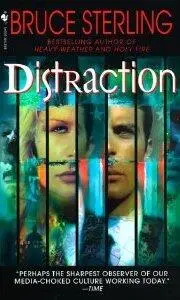
- Название:Distraction
- Автор:
- Издательство:Spectra
- Жанр:
- Год:1998
- ISBN:0-553-10484-5
- Рейтинг книги:4 / 5. Голосов: 1
-
Избранное:Добавить в избранное
- Отзывы:
-
Ваша оценка:
Distraction: краткое содержание, описание и аннотация
Предлагаем к чтению аннотацию, описание, краткое содержание или предисловие (зависит от того, что написал сам автор книги «Distraction»). Если вы не нашли необходимую информацию о книге — напишите в комментариях, мы постараемся отыскать её.
Won Clarke Award in 200.
Nominated for Hugo, Locus, and Nebula awards in 1999.
Distraction — читать онлайн бесплатно полную книгу (весь текст) целиком
Ниже представлен текст книги, разбитый по страницам. Система сохранения места последней прочитанной страницы, позволяет с удобством читать онлайн бесплатно книгу «Distraction», без необходимости каждый раз заново искать на чём Вы остановились. Поставьте закладку, и сможете в любой момент перейти на страницу, на которой закончили чтение.
Интервал:
Закладка:
The Collaboratory’s party of the status quo had been decimated before they could organize any resistance. Years without serious chal-lenge or controversy had made them fat and slow. They’d been crushed before they could even recognize the threat. Greta still held the initiative. She had excellent operational intelligence, thanks to Os-car’s oppositional research and his plethora of demographic profiles. The forced confession of Dr. Skopelitis had also been very useful, since Skopelitis had spilled his guts in a torrent of email and fingered his fellow conspirators.
Behind these vibrant, stage-managed scenes of unleashed popular discontent, the transition of actual day-to-day power had gone re-markably smoothly. Felzian had always run the lab like a high school vice principal; the real power decisions in the Collaboratory had al-ways rested in the distant hands of Dougal and his Senate krewe.
Now Dougal and his cronies were finished. However, the power vacuum was brief Oscar’s own krewe was a group of political opera-tives who could easily have become a Senate staff. With a little bend-ing and jamming, they slotted very nicely into place, and quietly usurped the entire operation.
Oscar himself served as Greta’s (very unofficial) chief of staff. Pelicanos oversaw lab finances. Bob Argow and Audrey Avizienis were handling constituency services and counterintelligence. Lana Rama-chandran dealt with scheduling, office equipment, and press relations. “Corky” Shoeki, formerly in charge of the Bambakias campaign’s road camps and rallies, was handling the scramble for office space in-side the Hot Zone. Kevin Hamilton was doing bravura work on secu-rity.
Greta was acting as her own press spokeswoman. That would have to change eventually, but it made excellent sense during the Strike crisis. Greta became the only official source of Strike news, and her solo public role made her seem to be handling matters all by herself This gave her heroic charisma.
In point of fact, Greta and her zealous idealists had no real idea how to run a modern executive staff They’d never held power before, so they were anxious to have glamorous jobs with titles and prestige, rather than the gruntwork jobs by which the acts of government were actually accomplished. This charade suited Oscar perfectly. He knew now that if he could simply keep the lab alive, solvent, and out of Huey’s hands, he would have accomplished the greatest feat of his career.
So Oscar took a deeply shadowed backseat, well behind the throne. The new year ground on. Many scientists found the Strike to be an ideal opportunity to quietly resign and leave, but that left the remaining hard-core scientists saturated with revolutionary fervor. Like revolutionaries everywhere, they were discovering that every tri-fling matter was a moral and intellectual crisis. Every aspect of their former lives and careers seemed to require a radical reformulation. These formerly downtrodden wretches spent most of their free hours raising one another’s consciousnesses.
And it all suited Oscar very well. His political instincts had never been sharper and his krewe, frenetic neurotics to the last man and woman, always shone in a crisis.
At this particular moment — January 8, 2045-Greta and her kitchen cabinet were engaged in particularly intense debate. The scientists were anxiously weighing new candidates for the board: In-formation Genetics and Biomedicine. Oscar, accompanied by his ever-present bodyguard Kevin, lurked behind a tower of instrumental clutter. He planned to let them talk until they got very tired. Then he would ask a few pointed Socratic questions. After that, they would accept a solution that he had decided a week ago.
While Kevin munched a set of color-coded protein sticks, Oscar was enjoying a catered lunch. Since Oscar’s krewe had taken over the Collaboratory, they’d been forced to hire a new Texan krewe to run their hotel. Given the tepid economy in Buna, finding new staff hadn’t been difficult.
Kevin stopped tinkering with the microchipped innards of a phone, zipped its case shut, and passed the phone to Oscar. Oscar was soon chatting in blissful security to Leon Sosik in Washington.
“I need Russian Constructivist wall posters,” he told Sosik. “Have Alcott’s Boston krewe hit the art museums for me. I need everything they can get from the early Communist Period.”
“Oscar, I’m glad that you’re having fun at the lab, but forget the big glass snow globe. We need you here in DC, right away. Our anti-Huey campaign just crashed and burned.”
“What? Why? I don’t need to go to Washington to feud with Huey. I’ve got Huey on the ropes right here. We’ve fingered all his cronies in the lab. I’ve got people here who are literally picketing them. Give me another week, and we’ll purge all the local cops, too. Once those clowns are out of the picture, I can get to some serious work around here.”
“Oscar, try to stick to the point. That lab is just a local side-show. We have a national-security crisis here. Huey has a radar hole.”
“What is that supposed to mean?”
“It means the North American radar coverage. The Air Force military radar. Part of the Southern U.S. radar boundary was run out of that Louisiana air base. Now that radar’s gone, and there’s a missing overlap between Texas and Georgia. The bayous have gone black. They’ve dropped right out of military surveillance.”
Oscar put his fork down. “What the hell does that have to do with anything? I can’t believe that. How is that even possible? No radar? A ten-year-old child can do radar!” He took a breath. “Look, surely they’ve still got air traffic control radar. New Orleans wouldn’t last two days without air traffic. Can’t the Air Force use the civilian radar?”
“You’d think so, but it just doesn’t work that way. They tell me it’s a programming problem. Civilian radar runs off a thousand decen-tralized cells. It’s distributed radar, on packet networks. That doesn’t work for the Air Force. The military has a hierarchical system archi-tecture. ”
Oscar thought quickly. “Why is that a political problem? That’s a technical issue. Let the Air Force handle that.”
“They can’t handle it. Because those are old federal missile-detection systems, they date back to Cold War One! They’re mil-spec hardware running antique code. That system just isn’t flexible — we’re lucky it still runs at all! But the point is, there’s no federal radar cover-age in Louisiana. And that means that enemy aircraft can invade the United States! Anywhere from Baton Rouge south!”
“Oh, for heaven’s sake, Leon. It can’t possibly be that bad,” Oscar said. “How could the military miss a problem that size? There must be contingency plans. Who the hell was keeping track of all that?”
“No one seems to know,” Sosik said mournfully. “When the Emergency committees took over the base closures, the radar issue got lost in competing jurisdictions.”
Oscar grunted. “Typical.”
“It is typical. It’s totally typical. There’s just too much going on. There’s no clear line of authority. Huge, vital issues just fall through the cracks. We can’t get anywhere at all.”
Oscar was alarmed to hear Sosik sound so despondent. Clearly Sosik had been spending rather too much time at the Senator’s bed-side. Bambakias became ever more fluent and compelling as his grip on reality faded. “All right, Leon. I agree with that diagnosis, I con-cede your point. I am with you all the way there. But let’s face it — nobody’s going to invade the United States. Nobody invades national boundaries anymore. So what if some idiot Emergency committee misplaced some ancient radar? Let’s just ignore the problem.”
“We can’t ignore it. Huey won’t let us. He’s making real hay out of the issue. He says this proves that his Louisiana air base was vital to national security all along. The Louisiana delegation is kicking our ass in Congress. They’re demanding that we build them a whole new air base from the ground up, immediately. But that’ll cost us billions, and we just don’t have the funds. And even if we can swing the funding, we can’t possibly launch a major federal building program inside Louisiana.”
Читать дальшеИнтервал:
Закладка:
Похожие книги на «Distraction»
Представляем Вашему вниманию похожие книги на «Distraction» списком для выбора. Мы отобрали схожую по названию и смыслу литературу в надежде предоставить читателям больше вариантов отыскать новые, интересные, ещё непрочитанные произведения.

Обсуждение, отзывы о книге «Distraction» и просто собственные мнения читателей. Оставьте ваши комментарии, напишите, что Вы думаете о произведении, его смысле или главных героях. Укажите что конкретно понравилось, а что нет, и почему Вы так считаете.