Bruce Sterling - Distraction
Здесь есть возможность читать онлайн «Bruce Sterling - Distraction» весь текст электронной книги совершенно бесплатно (целиком полную версию без сокращений). В некоторых случаях можно слушать аудио, скачать через торрент в формате fb2 и присутствует краткое содержание. Год выпуска: 1998, ISBN: 1998, Издательство: Spectra, Жанр: Фантастика и фэнтези, на английском языке. Описание произведения, (предисловие) а так же отзывы посетителей доступны на портале библиотеки ЛибКат.
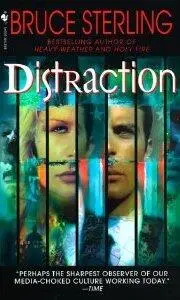
- Название:Distraction
- Автор:
- Издательство:Spectra
- Жанр:
- Год:1998
- ISBN:0-553-10484-5
- Рейтинг книги:4 / 5. Голосов: 1
-
Избранное:Добавить в избранное
- Отзывы:
-
Ваша оценка:
Distraction: краткое содержание, описание и аннотация
Предлагаем к чтению аннотацию, описание, краткое содержание или предисловие (зависит от того, что написал сам автор книги «Distraction»). Если вы не нашли необходимую информацию о книге — напишите в комментариях, мы постараемся отыскать её.
Won Clarke Award in 200.
Nominated for Hugo, Locus, and Nebula awards in 1999.
Distraction — читать онлайн бесплатно полную книгу (весь текст) целиком
Ниже представлен текст книги, разбитый по страницам. Система сохранения места последней прочитанной страницы, позволяет с удобством читать онлайн бесплатно книгу «Distraction», без необходимости каждый раз заново искать на чём Вы остановились. Поставьте закладку, и сможете в любой момент перейти на страницу, на которой закончили чтение.
Интервал:
Закладка:
“Actually, I think she might do very well.”
“No, she’ll do much better where she belongs — back behind her lab bench. We can ease her off the board now, and back to her proper role as a working researcher, and everything will fall neatly into place.”
“So that you can continue having an affair with her, and nobody will bother to notice it.”
Oscar said nothing.
“Whereas, if she became Director, she’d be right in the public spotlight. So your sordid little dalliance becomes impossible.”
Oscar stirred in his seat. “I really didn’t expect this of you. This is truly beneath you. It’s not the act of a gentleman and scholar.”
“You didn’t think I knew anything about that business, did you? Well, I’m not quite the helpless buffoon that you take me for! Pen-ninger is the next Director. You and your scurvy krewe can sneak back to Washington. I’m leaving this office — no, not because you’re forcing me out, but because I’m sick to death if this Job!”
Felzian banged his desk. “It’s very bad here now. Since we lost our support in the Senate, it’s impossible. It’s a farce now, it’s untena-ble! I’m washing my hands of you, and Washington, and everything that you stand for. And keep one thing in mind, young man. With Penninger in office here, if you out me, I can out you. You might embarrass me — even humiliate me. But if you ever try it, I’ll out you and the new Director. I’ll break you both in public, like a pair of matchsticks.”
8
The abrupt departure of Dr. Felzian gave Oscar a vital window of opportunity. With the loss of his patron Bambakias, he had very little to fall back on. He had to seize the initiative. Their numbers were small, their re-sources narrow, their budget nonexistent. The order of the day was sheer audacity.
During Greta’s first day as Director, her followers formed a Strike Committee and physically occupied the Hot Zone. Strikers commandeered the airlocks overnight, overriding all the police-installed safety locks and replacing them with brand-new strikers’ pass-cards. Seizing the Hot Zone made excellent strategic sense, since the giant ce-ramic tower dominated the facility. The Hot Zone was a natural fortress.
Given this physical safe haven, the second order of business in Oscar’s internal coup was to attack and seize the means of information. The Hot Zone’s computers re-ceived a long-postponed security overhaul. This revealed an appalling number of police back doors, unregistered users, and whole forests of snooping crackerware. These freeloaders were all swiftly purged.
The lab’s internal phone system was still under the control of the Collaboratory police. The lab’s tiny corps of police were something of a comic-opera outfit, but they had been suborned by Huey long ago. They represented the greatest local threat to Greta’s fledgling administration. The lab’s phone system was rid-dled with taps, and beyond secure repair.
So, the strikers simply abandoned the phone system entirely, and replaced it with a homemade network of dirt-cheap nomad cellphones. These semi-licit gizmos ran off relay stakes, hammered into walls, ceilings, roofs, and (in a particularly daring midnight ma-neuver) all across the underside of the dome.
Greta’s first official act as Director was to abolish the Public Re-lations department. She accomplished this through the lethally effec-tive tactic of zeroing-out the PR budget. She then returned the funds to Congress. Given the ongoing federal budget crisis, this was a very difficult move to parry politically.
Within the lab itself, abolishing the PR department was a hugely popular decision. At long last, the tedious jabber of the obnoxious pop-science pep squad ceased to irritate the local populace. There was no more chummy propaganda from on high, no more elbow-grabbing official email, no more obligatory training videos, nothing but blissful quiet and time to think and work.
The Collaboratory’s official PR was replaced by Oscar’s revolu-tionary poster campaign. A Strike, of course, needed effective propa-ganda even more than did the dead Establishment, and Oscar was just the man to supply this. The giant cyclopean walls inside the dome were absolutely perfect for political poster work. Oscar had never run a campaign among people with such extremely high levels of literacy. He took real pleasure in the antique handicrafts involved.
Greta’s postindustrial action was a highly unorthodox “strike,” because the strikers were not refusing to do their work. They were refusing to do anything except their work. The general tenor of the Strike strategy was highly public noncooperation, combined with pas-sive-aggressive cost-cutting.
The scientists were continuing their investigations, but they were refusing to fill out the federal paperwork. They refused to ask for grants, refused to pay rent on their barracks rooms, refused to pay for their food, refused to pay their power bills. They were refusing every-thing except for new instrumentation, a deeply embedded vice that simply could not be denied to scientists.
All the Strike Committee’s central members were also refusing their salaries. This was a deeply polarizing maneuver. Reasonable peo-ple simply couldn’t bring themselves to hold their breath and leap into the unknown in this way. Most of the lab’s “reasonable people” had long since made their peace with the Collaboratory’s institutional cor-ruption. Therefore, they were all on the take. It followed that they were personally compromised, at war with themselves, riddled with guilt. Greta’s stalwart core of dissidents were made of sterner stuff.
So, through this swift and unpredictable seizure of the tactical initiative, the Strike won a series of heartening little moral victories. Oscar had arranged this situation deliberately, in order to build com-munity self-confidence. The rent strike seemed very dramatic, but a rent strike was an unbeatable gambit. There was no internal competi-tion for the rents in the Collaboratory. If the strikers were somehow thrown out of their lodgings, the buildings would simply stay empty.
The power strike succeeded in a very similar way, because there was no effective method to shut off the electricity for nonpayment. By its very nature as a sealed environment, the Collaboratory dome al-ways required uninterrupted power, supplied by its own internal gen-erators. There simply wasn’t any way to shut it off. It had never occurred to the original designers that the dome’s inhabitants might someday rebel and refuse to pay.
Each successful step away from the status quo won Greta more adherents. The long-oppressed scientists had always had many galling problems. But since they lacked a political awareness of their plight, they had never had any burning issues — they’d simply endured a bad scene. Now, organization and action had shattered their apathy. Aches and pains they’d long accepted as parts of the natural order were sear-ingly revealed to them as oppression by evil know-nothings. A new power structure was aborning, with new methods, new goals, brave new opportunities for change. The Hot Zone had become a beehive of militant activism.
Within a week, the dome’s internal atmosphere was charged like a Leyden jar; it crackled with political potential. Greta’s unflinching radicalism had whipped the place into a frenzy.
Having built up a manic pressure for change, Greta took action to shore up her official legal situation. The Directorship had never been a strong executive post, but Greta engineered the forced resigna-tions of all her fellow board members. The original board was, of course, deeply unwilling to leave power, but the sudden resignation and departure of Dr. Felzian had left them stunned. Outmaneuvered and discredited, they were soon replaced by Greta’s zealous fellow-travelers, who trusted her implicitly and granted her a free hand.
Читать дальшеИнтервал:
Закладка:
Похожие книги на «Distraction»
Представляем Вашему вниманию похожие книги на «Distraction» списком для выбора. Мы отобрали схожую по названию и смыслу литературу в надежде предоставить читателям больше вариантов отыскать новые, интересные, ещё непрочитанные произведения.


Обсуждение, отзывы о книге «Distraction» и просто собственные мнения читателей. Оставьте ваши комментарии, напишите, что Вы думаете о произведении, его смысле или главных героях. Укажите что конкретно понравилось, а что нет, и почему Вы так считаете.