John Ringo - There Will Be Dragons
Здесь есть возможность читать онлайн «John Ringo - There Will Be Dragons» весь текст электронной книги совершенно бесплатно (целиком полную версию без сокращений). В некоторых случаях можно слушать аудио, скачать через торрент в формате fb2 и присутствует краткое содержание. Год выпуска: 2003, ISBN: 2003, Издательство: Baen Books, Жанр: Фантастика и фэнтези, Боевая фантастика, Фэнтези, на английском языке. Описание произведения, (предисловие) а так же отзывы посетителей доступны на портале библиотеки ЛибКат.
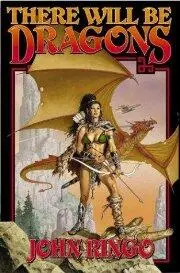
- Название:There Will Be Dragons
- Автор:
- Издательство:Baen Books
- Жанр:
- Год:2003
- ISBN:978-0-7434-7164-0
- Рейтинг книги:3 / 5. Голосов: 1
-
Избранное:Добавить в избранное
- Отзывы:
-
Ваша оценка:
There Will Be Dragons: краткое содержание, описание и аннотация
Предлагаем к чтению аннотацию, описание, краткое содержание или предисловие (зависит от того, что написал сам автор книги «There Will Be Dragons»). Если вы не нашли необходимую информацию о книге — напишите в комментариях, мы постараемся отыскать её.
There Will Be Dragons — читать онлайн бесплатно полную книгу (весь текст) целиком
Ниже представлен текст книги, разбитый по страницам. Система сохранения места последней прочитанной страницы, позволяет с удобством читать онлайн бесплатно книгу «There Will Be Dragons», без необходимости каждый раз заново искать на чём Вы остановились. Поставьте закладку, и сможете в любой момент перейти на страницу, на которой закончили чтение.
Интервал:
Закладка:
To do this required a massive organization. The area that Herzer and Mike had worked on clearing, with the buildings that they had constructed, was intended as a giant slaughtering yard. Fences were being built, and more would be. When the time came groups of beaters would move through the forests pushing the game ahead of them. It was hoped that in this way sufficient farm animals could be gathered for all the farms that were planned. And since the protofarmers themselves would participate in the drive, there would be less of a stink about them getting the animals for “free.”
Two reenactors, a husband and wife from down the valley, had moved most of their herd of horses up the valley to Raven’s Mill. The reason was simple. Shortly after the Net dropped, all the controls on wild beasts had been released. Besides attacks on humans this had resulted in even more attacks on domestic herds. After losing a foal to what was probably a panther and having a horse badly clawed by a tiger, they had decided to relocate.
Horses were material and cost intensive. They needed either fodder or fairly large areas to graze. Although there had been nearly sufficient grazing at their home, it still would have been overgrazed by their large herds in the winter. But Edmund had agreed to cede a large pasture to them in return for using their horses as a base for the still nascent Raven’s Mill cavalry. After thinking about it for quite some time — use as cavalry would mean some of their babies probably would not be coming home — they had agreed.
Before that, though, the horses would play an important part in the roundup. Although they would not be able to move in the trees, the area that the game was going to be pushed into was a recently cleared area across the river from Raven’s Mill. It was hoped that between the horsemen and various half-trained reenactors it would be possible to sort the different species and then hold them in herds for further disposition.
The problem with that was there were not nearly enough trained horsemen.
And thus Herzer’s detailing by Edmund.
As Herzer walked towards the corrals he looked the herd over. There were two distinct “types” of horses and he didn’t know enough about them to know what breeds they were. One type was small and light-boned. When these trotted or reacted to the other horses they tended to trot with their legs held high, their necks and tails up. The trot looked like Bast dancing as the horses seemed to float across the ground.
The other breed was much larger and heavier bodied but it had some of the same grace as the smaller. When these trotted it wasn’t quite as showy, but Herzer noticed that the trot itself looked… smoother. It wasn’t as dancing as the first ones. And these were definitely fast. He saw one of the younger horses, a beautiful red one that he knew was called “chestnut” for some reason, dash from one side of the pasture to the other, apparently from sheer high spirits, and he was very glad he wasn’t on its back.
There were two women and about ten men gathered by the fence to the pasture, looking at the herd and talking in low tones when Herzer walked up. The tallest of the men looked over at him and nodded. The man was wearing an outlandish period costume. From the feathered hat, topping graying brown hair that dropped halfway down his back, through the pointed mustache, and open, lace-front shirt to the thigh-high boots he was clearly a reenactor, but he also seemed to be in charge.
“Good day, sir,” Herzer said, looking out at the horses. “I’m looking for the horse master.”
The man grinned at that and laughed. “Well, I’m the owner of the horses,” he replied. “And for my sins Talbot’s put me in charge of rounding up whatever comes out of the woods. Now, I don’t know if Edmund is aware of this but pigs don’t herd worth a damn. Nor do deer. And I’ve only this dozen riders, none of whom has ever tried to herd with horses. But if you’re looking for the ‘horse master’ I guess that’s me. Kane,” he said, sticking out his hand.
“Herzer Herrick,” Herzer replied, sticking out his.
“This is Alyssa my wife,” he said, touching the shoulder of the blond woman next to him. She was thin and wiry with a friendly, sun-weathered face. She too stuck out her hand.
“What can we do for you?” she asked in a furry voice.
“I’ve ridden before,” Herzer replied. “I was training in reenactor combat before this happened,” he added waving his arm around.
“Virtual reality?” Kane asked dubiously.
“Enhanced,” Herzer corrected.
“Oh, so you know how to ride a horse, ” the man laughed broadly. “Not just think you do.”
“Well, I’ve ridden, ” Herzer corrected. “A bit.”
“Did you fight on horseback?” the horseman asked. “Or just ride a bit?”
“I was starting training in cavalry combat,” Herzer admitted. “But it was… tough.”
“Yeah, that it is,” Alyssa said. “Everybody thinks it’s easy until they try.”
“Well, what’s say we try you out on one of the boys,” Kane said looking at his wife. “One of mine I think?”
“Oh, yes,” the woman replied. “Mine could take him, but he’s more suited to yours.”
“What’s this ‘yours and mine’ thing?” Herzer asked as Kane led him to a nearby shed.
“We brought both our herds down,” the man explained. “Mine are Hanarahs and hers are Arabs. Do you know the difference?”
“I’ve seen them,” Herzer said, gesturing at the herd.
“The Arabs are the little ones and the Hanarahs are the big ones,” Kane said with a nod. “Do you want to know the rest?”
“How much?” Herzer said with a chuckle. “Lately I feel like my brain is getting overloaded!”
“Been in the familiarization program?” Kane asked, opening the door to the shed. Inside, saddles were hanging on boards that thrust out from the walls, and on the back wall was a series of pegs from which hung bridles and reins. Under the reins was a pile of blankets. The room had an odd, musty odor composed of old leather and horse sweat that was not unpleasant but definitely strong.
“Yes,” Herzer said simply, taking the saddle that was thrust at him. He noticed that it had a high back and a low front. He had used similar saddles in his training, but with a higher front. He had no clue what the different parts were named except for the stirrups.
“Well Arabs are a very old breed. They’ve never been genegineered,” Kane explained. “Nobody knows exactly where they came from but they were distinguished by being light of body, very human oriented, extremely fast and with great endurance. They also are missing one vertebrae which gives them less of a tendency to get ‘swaybacked.’ ”
He grabbed a blanket and piled it and reins on Herzer’s arms. “There, all set.”
“Okay.”
“There were originally basically two strains of horses, hotbloods and coldbloods, with me so far?”
“Yep.”
“Hotbloods come down to Arabs. Coldbloods were found in Ropasa and were heavier bodied, relatively slow horses. They got bred up for size in the preindustrial period and worked well as cart horses and the like. But for a good cavalry horse you have to have speed and agility. So at some point, they started breeding Arabs into them and came up with a third strain called ‘warmbloods.’ ”
“Hanarahs?” Herzer guessed as Kane led the way back outside.
“Hanarahs are warmbloods of a sort. But no matter how they worked, some of the qualities of Arabs just never took in warmbloods, notably the lack of that one vertebra. And they’d tend to get horses that were fast or had good stamina. Or if they were fast with good stamina, they were very delicate, had to have the right foods, that sort of thing.”
Читать дальшеИнтервал:
Закладка:
Похожие книги на «There Will Be Dragons»
Представляем Вашему вниманию похожие книги на «There Will Be Dragons» списком для выбора. Мы отобрали схожую по названию и смыслу литературу в надежде предоставить читателям больше вариантов отыскать новые, интересные, ещё непрочитанные произведения.








Обсуждение, отзывы о книге «There Will Be Dragons» и просто собственные мнения читателей. Оставьте ваши комментарии, напишите, что Вы думаете о произведении, его смысле или главных героях. Укажите что конкретно понравилось, а что нет, и почему Вы так считаете.