John Ringo - There Will Be Dragons
Здесь есть возможность читать онлайн «John Ringo - There Will Be Dragons» весь текст электронной книги совершенно бесплатно (целиком полную версию без сокращений). В некоторых случаях можно слушать аудио, скачать через торрент в формате fb2 и присутствует краткое содержание. Год выпуска: 2003, ISBN: 2003, Издательство: Baen Books, Жанр: Фантастика и фэнтези, Боевая фантастика, Фэнтези, на английском языке. Описание произведения, (предисловие) а так же отзывы посетителей доступны на портале библиотеки ЛибКат.
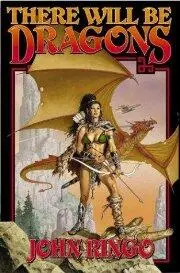
- Название:There Will Be Dragons
- Автор:
- Издательство:Baen Books
- Жанр:
- Год:2003
- ISBN:978-0-7434-7164-0
- Рейтинг книги:3 / 5. Голосов: 1
-
Избранное:Добавить в избранное
- Отзывы:
-
Ваша оценка:
There Will Be Dragons: краткое содержание, описание и аннотация
Предлагаем к чтению аннотацию, описание, краткое содержание или предисловие (зависит от того, что написал сам автор книги «There Will Be Dragons»). Если вы не нашли необходимую информацию о книге — напишите в комментариях, мы постараемся отыскать её.
There Will Be Dragons — читать онлайн бесплатно полную книгу (весь текст) целиком
Ниже представлен текст книги, разбитый по страницам. Система сохранения места последней прочитанной страницы, позволяет с удобством читать онлайн бесплатно книгу «There Will Be Dragons», без необходимости каждый раз заново искать на чём Вы остановились. Поставьте закладку, и сможете в любой момент перейти на страницу, на которой закончили чтение.
Интервал:
Закладка:
“Mallory and Christopher can help with that as well,” Suwisa said with a nod.
“Right now it’s all farm implements,” Edmund warned. “Real blacksmithing. But in time we’re going to need armor and swords. I’m still working on the guard force but the plan is to produce a professional military as well. And there’s a training program starting so you’re going to have to set up an orientation to blacksmithing, basically what the job of an apprentice is and a few tricks for farmers. Most of the people going through the orientation are going to end up farming.”
“All right, and how do I get paid?” Suwisa asked.
“Right now the basis of what currency we have is food chits. You can use them to trade for meals in the chow-halls or you can get raw food to cook yourself. We’ll figure out something equitable for your training time and, of course, you’ll get paid for your finished materials. We haven’t really got an economy beyond that and it’s all based on Myron’s supplies.”
“This is going to be fun,” Phil said. “That’s an inflationary economy if I’ve ever heard of one.”
“Well, yes and no. Most people get three food chits per day. If they starve themselves they have ‘extra’ money. Skilled artisans get four for days spent working on communal projects, and they can try to find materials to trade for more. But there’s not much surplus floating around. So far, by restricting the chits we’re both controlling the food supply, which is really important, and keeping the economy noninflationary. Sooner or later we’ll get large enough we have to come up with a better system, but for right now it’s working. There are too many other problems for me to want to knock it.”
“Such as?” Suwisa said.
“You’ve heard about the bandits?”
“There was a group of five guys who tried to, I don’t know, hold us up?” Phil said. “They had a few sticks and a knife. We pulled out three swords and a crossbow. They lost interest really quick.”
Edmund chuckled for a moment then shook his head. “One of the things I’m worried about is that the small communities have all the food, and other goods but right now food is paramount. Sooner or later the bandit gangs are going to start banding together and attacking the towns. I want to be ready for them before they do.”
“If there’s one thing that reenactors can do it’s swing a sword,” Suwisa said with a gesture in the general direction of the town.
“Not as well as they think they can and that assumes they have them,” Edmund said with a frown. “Most of them started out from wherever they came from with a sword or a bow or a glaive of some sort. And most of them left them somewhere as well. They’re heavy, don’t you know?”
“Damn,” Phil said, shaking his head.
“And, frankly, I’d rather have raw recruits than most reenactors with live blades. We’re going to form a militia and everyone is going to learn at the minimum to defend themselves. But I want a professional military at the core. Two tiered for right now, longbow and line infantry, the line infantry based loosely on Roman legions.”
“Why longbow?” Suwisa asked. “Crossbow is easier to train.”
“Hmmm… a lot of reasons,” Edmund replied. “Both of them have their pros and cons and you have to understand, despite the last week or so I’m talking with Sheida fairly often. I’m starting to get a grasp of what the strategic situation is and how it might fall out. So I’m thinking in terms not of days or weeks but of years of war.”
“Shit,” Phil said. “I’d hoped…”
“You’d hoped this would be over quick and we could go back to our lives. I don’t think that’s what’s going to happen. I’m not too sure we’ll be able to go back to our lives even after the war is over. But we were talking about longbows.”
“Okay.”
“Longbows and crossbows both have their pros and cons. Some of them are universal and some of them were specific to the conditions. Okay, here’s one: what’s the only wood you can use for a longbow that is made in Ropasa?”
“Yew,” Suwisa answered. “Well, okay, yew and ash. But you can use hickory… oh.”
“Right. One of the reasons for longbow rarity in Ropasa was the lack of materials. Which meant a longbow cost a lot. And towards the end the Britons had to import all their yew from the Continent, which was a critical strategic fault in the system. But in Norau hickory makes an excellent longbow and it is widely available. Here, longbows can be made by anyone with a knife and some knowledge.
“Cons of the longbow are rarity of materials, we covered that, difficulty of training and the fact that you have to have very physically able persons to use it. That is, they have to be physically strong and in good shape, not sick.
“Taking the last first, we’re not dealing with medieval peasants. The human of today, even those who are not Changed, are the result of multiple generations of tinkering. Do you know what ‘dysentery’ is?”
“Only from history,” Phil said. ” Diarrhea. ‘Runny guts’ as they used to call it.”
“Right. The most common reason for dysentery was water that was contaminated with the giardia cyst. On the way here, did you drink from streams?”
“Sure, we always have,” Suwisa said. “Why?”
“Did you get diarrhea?”
“No.”
“That’s because you’re immune to the effect of giardia. Also the common flu, typhoid, syphilis and a host of other bacteriological and viral infections. We’re born that way; it’s bred into us. Just as greater strength, both for men and women, is innate. Women of today have the potential to be as strong as the average man was in the thirteen hundreds. And men have the potential to be enormously stronger. Furthermore, the basic… human material we have, now, from the refugees, is so much better than the average medieval peasant it doesn’t bear discussion. Taller, stronger, healthier, everything that you need for the baseline of a decent longbow archer.”
“Most of that relates to crossbows as well,” Phil said, stubbornly.
“Except for height, yes,” Edmund replied. “But the point is, it takes away one of the ‘cons’ of longbows. The next one is training. Well, I’ve seen people train to be competent, not expert but competent bowmen in four to six months. And as they continue to train they get better and better. By next fall I want to have a small but growing longbow corps. And in a few years I want it to be a large and growing longbow corps.”
“But none of that touches on crossbows,” Phil replied.
“Okay, what are the pros of longbows? They have a higher rate of firepower, for the same training, than crossbows. That is, they can put out nearly twice as many arrows in an hour and more for short periods. They are easier to manufacture; a trained bowyer with seasoned wood can turn out a longbow in an hour. And their training is identical to that for compound bows.”
“You mean ‘composite’?” Phil asked. “I’m not sure you want to use those. The glues we’d have to use to make horn-bows are hydroscopic. They’re really only good in very dry conditions.”
“Phil, I’ve been doing this for nigh on three hundred years,” Edmund said, letting the first sign of exasperation through. “Give me the benefit of using the right term. No, I mean compound, the ones with the pulleys. You can use a bow that is nearly twice the ‘standard’ strength of a longbow with compound bows because the archer only takes the full weight of the pull for about ten percent of the draw and the ‘hold’ strength is a fraction of the full strength. But, right now, we don’t have the logistics to produce them in quantity. However, in time we will. And then we’ll have archers who can be easily cross-trained to bows that have five times the potential, in combination of pull and rate of fire, of any reasonable crossbow.”
Читать дальшеИнтервал:
Закладка:
Похожие книги на «There Will Be Dragons»
Представляем Вашему вниманию похожие книги на «There Will Be Dragons» списком для выбора. Мы отобрали схожую по названию и смыслу литературу в надежде предоставить читателям больше вариантов отыскать новые, интересные, ещё непрочитанные произведения.





Обсуждение, отзывы о книге «There Will Be Dragons» и просто собственные мнения читателей. Оставьте ваши комментарии, напишите, что Вы думаете о произведении, его смысле или главных героях. Укажите что конкретно понравилось, а что нет, и почему Вы так считаете.