John Ringo - There Will Be Dragons
Здесь есть возможность читать онлайн «John Ringo - There Will Be Dragons» весь текст электронной книги совершенно бесплатно (целиком полную версию без сокращений). В некоторых случаях можно слушать аудио, скачать через торрент в формате fb2 и присутствует краткое содержание. Год выпуска: 2003, ISBN: 2003, Издательство: Baen Books, Жанр: Фантастика и фэнтези, Боевая фантастика, Фэнтези, на английском языке. Описание произведения, (предисловие) а так же отзывы посетителей доступны на портале библиотеки ЛибКат.
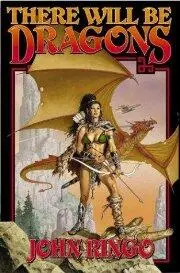
- Название:There Will Be Dragons
- Автор:
- Издательство:Baen Books
- Жанр:
- Год:2003
- ISBN:978-0-7434-7164-0
- Рейтинг книги:3 / 5. Голосов: 1
-
Избранное:Добавить в избранное
- Отзывы:
-
Ваша оценка:
There Will Be Dragons: краткое содержание, описание и аннотация
Предлагаем к чтению аннотацию, описание, краткое содержание или предисловие (зависит от того, что написал сам автор книги «There Will Be Dragons»). Если вы не нашли необходимую информацию о книге — напишите в комментариях, мы постараемся отыскать её.
There Will Be Dragons — читать онлайн бесплатно полную книгу (весь текст) целиком
Ниже представлен текст книги, разбитый по страницам. Система сохранения места последней прочитанной страницы, позволяет с удобством читать онлайн бесплатно книгу «There Will Be Dragons», без необходимости каждый раз заново искать на чём Вы остановились. Поставьте закладку, и сможете в любой момент перейти на страницу, на которой закончили чтение.
Интервал:
Закладка:
He stepped back and wiped at his face as the fledgling smith tried to get the recalcitrant metal to do his will, trying not to shake his head. With the scraps and bars that Angus had brought in, they had enough material for the beginnings of a community, but they’d soon need more. He had sent a wagon load of mixed foodstuffs up the road to Angus but the distance was far enough that the oxen would eat a good bit of the load on the way. And it would be three or four weeks before any response could come.
“What about weapons?” the apprentice asked, finally getting the hoe to form. He had got the rhythm of the hammer, and sparks struck a brilliant white in the dim forge.
“You’re a long way from making a weapon, son, other than a spear blade, which is naught more than a hoe shaped a bit differently. But swords and such, or armor, they take a tad more work. Once we have the wire puller going in the water forge we’ll get some of you to work on mail. But for the time being it’s more important to learn how to make farming utensils.” He looked out the door of the shed again, then peered more carefully.
“You all start working on hoes from this stock, I’ll be back in a bit.”
Stepping out of the heat of the forge he shielded his eyes against the sun. As if in expiation for the unending rains the skies had cleared and turned bright for the last few days as the sodden ground steamed. The temperature hadn’t gone up much but the humidity was still high, giving the area a damp chill that sapped energy and made everyone hungry for fats and carbohydrates that were in short supply. But the bright sun and haze made seeing anything at a distance difficult, which was why Edmund had to look long and hard to be sure of what he saw. Then he let out a whoop and headed down to town.
“Class dismissed for the next hour or so,” he called over his shoulder. “Try not to burn down the forge while I’m gone!”
He thought about grabbing a horse but decided that it would take more time and trouble than just walking down the hill.
As he entered the town of Raven’s Mill, which was growing in all four directions, he could see a large crowd gathered around the three wagons that had come from the east, and he pushed his way through to the center without thought until he approached the first wagon, which had stalled for lack of room to move.
“Suwisa, you’re a sight for God-damned sore eyes!” he shouted, clambering up the side of the wagon and enfolding the muscular driver in his arms.
“Why Edmund,” the woman laughed, giving him a hug in return. “I didn’t know you cared!”
“I’ve been trying to run this madhouse and simultaneously teach newbies who are as hardheaded as the metal they can’t shape,” he laughed. “So I’ll admit it’s a purely selfish reaction.”
“I should have guessed,” she replied with a grin.
“Hola Phil,” he called to the man driving the second wagon. “Still selling the condemned mead?”
“Aye, enough to drown you in if you don’t quit manhandling my wife!” the man called back.
“Let me get this cluster out of the way and get the wagons up to the forge. I assume you brought all your tools with you?”
“And spare anvils and a small forge,” Suwisa replied. “And all of Phil’s beekeeping supplies.”
“Forges and anvils we have, tools we’re lacking. And hives for that matter. We’re going to have to have a long talk.”
As he and a group of the newly forming guard force opened a path for the wagons, Edmund considered the priceless asset that had arrived.
He had known Suwisa for at least seventy-five years and had occasionally considered asking her to become his “apprentice.” The problem with that was that by the time they became friends she was a master smith in her own right. He knew things about forming metal that she did not, but the reverse was also true and the level of his “mastery” over hers was an incremental thing. Just as an example, he mostly worked in “hot” forging with metal heated to brightness whereas she generally used preformed plates for “cold forging.” He was undeniably superior at the first while she had a slight edge on him in the latter. She also concentrated on plate armor and decorative works while he specialized in blades. So it was more a matter of complementary styles than superior/inferior.
In the end he decided that if no appropriate apprentice made an appearance by the time he was getting too old to work the forge, he would probably “gift” it to her, along with Carborundum. He was pretty sure that they would get along, and judicious soundings had indicated that she had very few reservations about AI’s.
But with the Fall and his increasing responsibilities, he had despaired of having anyone come along who could take over the training of the new smiths. Smithing was nearly as vital as farming in a preindustrial economy and the number of tools that they were going to need prior to the beginning of the planting season was staggering.
Furthermore, he knew that his personality was not at the best teaching raw newcomers to the trade, especially ones he hadn’t carefully chosen. Suwisa was much more patient with the sort of hamhandedness he had been despairing of this morning.
He got the wagons up to the back side of town, just short of his house, left them with a couple of the guards and one of the pair’s grown children, and led the couple up to the house. Suwisa looked at the expanded sheds and whistled.
“How many smiths do you have in this place now?”
“One,” Edmund replied bitterly. “I’m the only one who has made it in yet, except you. I know that there were more in walking distance of the Mill, but some of the other communities are forming up as well and I guess they made it to them. Or they were on the other side of the world when the Fall hit.”
“Who all has made it here?” Phil asked.
“If you mean of ‘our’ crowd, quite a few. But… well… you know most reenactors. They don’t, actually, know diddly-shit about period life. Or, for that matter, preindustrial technology. And they’re all happy to swing swords for a bit but then they want their meals served on silver platters.”
“I won’t disagree on that, but this is tough, ” Suwisa said. “Taking a few weeks to travel by wagon and sleep on the ground for fun is one thing. Having to do it for survival is another.”
“I know,” Edmund said, leading the way into his house. He waved them into chairs around the fire then poked it back to life and pulled out a jug of cider that had been warming by the coals. When he had them comfortable he continued.
“I know that things are tough,” he continued. “But until one faction or the other of the Council wins, this is what life is going to be. And we have to make it as ‘good’ as we can within these parameters.”
“Or until one side gives up,” Suwisa said, taking a sip of the cider.
“I don’t think that’s going to happen,” Edmund replied. “Paul is in too deep and is too… fanatical I guess is the best word. And Sheida thinks the world, even as devastated as it has become, would be worse off under Paul’s unrestricted control.”
“I don’t know that I fault her there,” Phil agreed. “We heard some really weird rumors on the way over here.”
“You mean about Paul Changing people to fit the conditions of the Fall better?” Edmund asked. “We’ve heard the same. But it’s always somebody’s brother who heard it from somebody else.”
“Doesn’t Sheida know?” Suwisa asked.
“I haven’t talked to her in two weeks, so I don’t know if she does or not.”
“So what do you want us to do?” Phil asked.
“Well, in Suwisa’s case I want her to take over training all the apprentices and turning out metalwork,” Edmund admitted. “I’m up to my ass in alligators every day and I have neither the time nor the patience to handle a gaggle of apprentices.”
Читать дальшеИнтервал:
Закладка:
Похожие книги на «There Will Be Dragons»
Представляем Вашему вниманию похожие книги на «There Will Be Dragons» списком для выбора. Мы отобрали схожую по названию и смыслу литературу в надежде предоставить читателям больше вариантов отыскать новые, интересные, ещё непрочитанные произведения.




Обсуждение, отзывы о книге «There Will Be Dragons» и просто собственные мнения читателей. Оставьте ваши комментарии, напишите, что Вы думаете о произведении, его смысле или главных героях. Укажите что конкретно понравилось, а что нет, и почему Вы так считаете.