Chris Moriarty - Spin Control
Здесь есть возможность читать онлайн «Chris Moriarty - Spin Control» весь текст электронной книги совершенно бесплатно (целиком полную версию без сокращений). В некоторых случаях можно слушать аудио, скачать через торрент в формате fb2 и присутствует краткое содержание. Год выпуска: 2006, ISBN: 2006, Издательство: Bantam Spectra, Жанр: Фантастика и фэнтези, на английском языке. Описание произведения, (предисловие) а так же отзывы посетителей доступны на портале библиотеки ЛибКат.
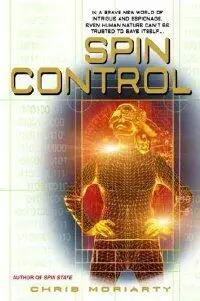
- Название:Spin Control
- Автор:
- Издательство:Bantam Spectra
- Жанр:
- Год:2006
- ISBN:978-0-553-58625-1
- Рейтинг книги:5 / 5. Голосов: 1
-
Избранное:Добавить в избранное
- Отзывы:
-
Ваша оценка:
Spin Control: краткое содержание, описание и аннотация
Предлагаем к чтению аннотацию, описание, краткое содержание или предисловие (зависит от того, что написал сам автор книги «Spin Control»). Если вы не нашли необходимую информацию о книге — напишите в комментариях, мы постараемся отыскать её.
As the auction heats up, the Artificial Life Emancipation Front sends in Major Catherine Li. Drummed out of the Peacekeepers for executing Syndicate prisoners, Li has now literally hooked up with an AI who has lived many lifetimes and shunted through many bodies. But while they have their own conflicting loyalties to contend with, together they’re just one player in a mysterious high-stakes game…
Spin Control — читать онлайн бесплатно полную книгу (весь текст) целиком
Ниже представлен текст книги, разбитый по страницам. Система сохранения места последней прочитанной страницы, позволяет с удобством читать онлайн бесплатно книгу «Spin Control», без необходимости каждый раз заново искать на чём Вы остановились. Поставьте закладку, и сможете в любой момент перейти на страницу, на которой закончили чтение.
Интервал:
Закладка:
“You don’t want to put it up? No? Well, can I at least get you something to drink?”
“Fine on all counts.” He peered at Cohen, who seemed even more opaquely unreadable than usual. “Are you all right? You’re doing that freezing thing again.”
“It’s nothing.”
A nothing named Catherine Li, if Gavi guessed right.
“So tell me about this golem of yours,” Cohen said. “I need a little comedy in my life.”
Gavi told him, walking him through the pieces of code he’d painfully stitched together over the past several years, explaining the places where he couldn’t make things work, or couldn’t decide which of several possible imperfect solutions to settle for. He presented it as a programming problem, one that he was submitting to higher authority. Which was perfectly valid, since Cohen’s abilities in that area would put any human to shame. He didn’t mention what the AI must have seen the minute he began looking at the source code: that the glue that would tie it all together and make the impossible, jerry-built kludge of databases and interfaces work was Cohen.
“You know how crazy this is, don’t you?” Cohen said at last. On the surface he was only pointing out a technical problem, but both of them saw the attached moral problem: How could an AI designer create a sentient being only to sentence it to a life dominated by memories that had driven so many humans to despair and suicide? The goal might be idealistically selfless, but for the newborn Emergent trying to come to terms with those memories the reality would be every bit as brutal as what EMET faced on the Green Line.
“Always so encouraging!” Gavi said, choosing to dodge the nontechnical question. “Don’t you know when your kid brings his little crayon scribbles home from school you’re supposed to hang them on the refrigerator, not give him an art history lesson?”
“I’ve never had kids. Strange, isn’t it? Well, I guess not that strange. The people who marry me aren’t exactly the settle down and have three point two children type.” He looked at the source code again. “Actually, Gavi, I don’t think it’s all that far from working. Which should be encouraging, considering the fact that it must be three centuries since an unaugmented human actually tried to write nontrivial source code. Where did you even find the SCHEME manuals?”
“The dump.”
“Seriously?”
“Seriously.”
“Well, that explains the smell, I guess.”
They talked around the problem for a few minutes, skimming over Gavi’s various false starts, and what he’d learned from them, and the current state of his work on what Cohen was now jokingly calling Gavi’s Golem.
“Can I ask you something?” Gavi said finally. “About your visit last week, not this.”
“Sure.”
“What’s ALEF after? What’s your endgame?”
“Mine personally, or ALEF’s?”
“Both. Either.”
“ALEF’s actually interested in the tech, insofar as they’re ever interested in anything in any organized fashion.”
“And you?”
The AI sighed. He’d never gotten sighing quite right, Gavi thought. Even his most sincere sighs rang false. Funny how a little thing like that could elude the best wetware. Or maybe the wet wasn’t where the problem was. “I’m after Absalom.”
“I’m sorry to hear that, Cohen. I’m very sorry that Didi’s dragged you into this.”
“And what about you, Gavi? What’s your endgame? Why are you still here when there’s a whole universe up there that doesn’t know you’re a traitor to Israel? You could probably even get a real leg if you went Ring-side.”
“Not anymore. They would have had to ship me Ring-side within the first seventy-two hours in order for viral surgery to be any good. And anyway, I wouldn’t have been able to bring my new leg home, would I?”
“That’s my point, in case you missed it.”
“I spent six months Ring-side.” Gavi wrinkled his nose, remembering the curved, antiseptic, artificially bright expanses of plastic that Ring-siders called “outdoors.” “You can take the boy out of the country, but…”
“Well, there are always other planets if you don’t like life in the orbitals.”
“Other planets smell funny.”
It was a joke, at least partly. But Cohen gave no evidence of realizing that. In fact, he’d fallen oddly silent. And when Gavi looked up, the AI was staring intently at him.
“Are you still looking for Joseph?” Cohen asked.
“Of course I am. But it’s not the same now. When he was seven, eight, ten, I was desperate to find him. Now he’d be a young man, if he…well, I just have this nagging feeling that maybe I would be finding him for me now, not for him. And while that doesn’t make me want to find him any less, it does make it less urgent somehow.”
“Is Didi still helping you look?”
Gavi looked up to find Roland’s soft hazel eyes fixed on him. Talking to Cohen always brought home to him how much he, like all humans, confused the mind with the body. He knew as a technical and intellectual matter that only young and superbly healthy bodies could stand up to the stress of what any programmer would recognize as a biological version of overclocking. But he still couldn’t repress the shiver that ran through him when he looked into some shunt’s wide young eyes and saw the face of the swarm. And he was still eternally surprised that Cohen could take the same five feeble senses most humans got by on and damn near read your mind with them.
“If you want to know what Didi’s doing or not doing,” Gavi said, “you’d better ask Didi.”
Cohen appeared to accept this answer. “The thing is,” the AI said, “somehow I can’t help thinking that maybe your obsession with preserving the archives is just a little bit about Leila and Joseph.”
“Sometimes a cigar is just a cigar, Cohen.”
“Oh for God’s sake! Are humans still quoting Freud at each other? Grow up, will you?”
But Gavi wasn’t in the mood for jokes. “Have you ever read any of the testimonies, Cohen?”
“I’ve read enough to know I don’t want to read any more.”
“It’s a funny thing, those testimonies. You start to get numb after a while, from the sheer numbers, from the awfulness of it all. And then there’ll be one that gets under your skin and makes it all real again. There was one guy who went into Theresienstadt with his entire family: mother, father, two brothers. The whole family got sequential numbers. The boy’s father was number something something something five hundred and twenty. He was five hundred and twenty-one, the next brother was five hundred and twenty-two, the next brother was five hundred and twenty-three. But his mother was pregnant, so they pulled her out of the line and sent her straight to the gas chamber without even giving her a number.
The oldest son is the only one who survives. He goes to America. He makes a life for himself, a good life. But as he gets to be around the age his parents were when they died, he starts to have nightmares about his mother. He becomes obsessed by the fact that the Germans didn’t give her a number, that there’s no record of her death, no proof. It’s not that he thinks she’s alive, you understand. He saw her get sent into the nonworkers line, and he doesn’t have any illusions about what that meant. But he can’t process the idea that she just…vanished.
So he saves up his money. He goes back to Poland. He advertises in the newspapers, literally for years, offering a reward to anyone who can give him a photograph of his mother, anyone who even remembers his mother. No one ever answers. This woman had grown up, gone to university, taught grade school, been a daughter and a wife and a mother. But it was like she’d never existed. The Germans had simply wiped her from the face of history.
Читать дальшеИнтервал:
Закладка:
Похожие книги на «Spin Control»
Представляем Вашему вниманию похожие книги на «Spin Control» списком для выбора. Мы отобрали схожую по названию и смыслу литературу в надежде предоставить читателям больше вариантов отыскать новые, интересные, ещё непрочитанные произведения.









Обсуждение, отзывы о книге «Spin Control» и просто собственные мнения читателей. Оставьте ваши комментарии, напишите, что Вы думаете о произведении, его смысле или главных героях. Укажите что конкретно понравилось, а что нет, и почему Вы так считаете.