Chris Moriarty - Spin Control
Здесь есть возможность читать онлайн «Chris Moriarty - Spin Control» весь текст электронной книги совершенно бесплатно (целиком полную версию без сокращений). В некоторых случаях можно слушать аудио, скачать через торрент в формате fb2 и присутствует краткое содержание. Год выпуска: 2006, ISBN: 2006, Издательство: Bantam Spectra, Жанр: Фантастика и фэнтези, на английском языке. Описание произведения, (предисловие) а так же отзывы посетителей доступны на портале библиотеки ЛибКат.
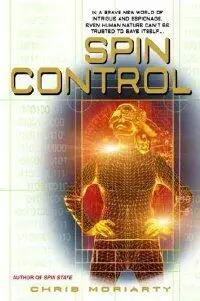
- Название:Spin Control
- Автор:
- Издательство:Bantam Spectra
- Жанр:
- Год:2006
- ISBN:978-0-553-58625-1
- Рейтинг книги:5 / 5. Голосов: 1
-
Избранное:Добавить в избранное
- Отзывы:
-
Ваша оценка:
Spin Control: краткое содержание, описание и аннотация
Предлагаем к чтению аннотацию, описание, краткое содержание или предисловие (зависит от того, что написал сам автор книги «Spin Control»). Если вы не нашли необходимую информацию о книге — напишите в комментариях, мы постараемся отыскать её.
As the auction heats up, the Artificial Life Emancipation Front sends in Major Catherine Li. Drummed out of the Peacekeepers for executing Syndicate prisoners, Li has now literally hooked up with an AI who has lived many lifetimes and shunted through many bodies. But while they have their own conflicting loyalties to contend with, together they’re just one player in a mysterious high-stakes game…
Spin Control — читать онлайн бесплатно полную книгу (весь текст) целиком
Ниже представлен текст книги, разбитый по страницам. Система сохранения места последней прочитанной страницы, позволяет с удобством читать онлайн бесплатно книгу «Spin Control», без необходимости каждый раз заново искать на чём Вы остановились. Поставьте закладку, и сможете в любой момент перейти на страницу, на которой закончили чтение.
Интервал:
Закладка:
He stepped off the bridge, waited until the door had fully closed behind him, and then let out the trembling breath he’d been holding.
Three people were missing, not one. Laid-back Ahmed and Shy Bella, who could be damn sure of landing on the euth ward if they ever made it home and the truth came out. And Arkasha, who had said he would die before he went through renorming again…and then taken the bullet for Ahmed in a quixotic attempt to keep the mission from falling apart.
Arkady hurried back to the lab, forcing himself to walk instead of run, freezing his face into an expression that he hoped didn’t reflect the rising panic inside him.
Arkasha’s work space was as gleamingly immaculate as ever. Not a notebook or a pencil or a slide plate out of place. Except for an all-but-imperceptible sag in the precisely arranged bookshelf that betrayed the hurried removal of several notebooks. Back in their quarters, a complete set of Arkasha’s clothes was missing as near as Arkady could make out…but there was no note there either. He wished he could check Ahmed’s and Bella’s personal things, but of course that was impossible.
There had to be a note, he told himself. They wouldn’t have left without giving him a chance to follow. Unless they hadn’t thought they could trust him. Or unless Arkasha had insisted on keeping him out of it. And of course Arkasha had insisted. Arkasha the reserved. Arkasha the cautious. Arkasha who would never risk dragging Arkady into danger—and who would never understand that Arkady would gladly have risked a stint on the euth ward for a last note from him.
He went back to the lab, forcing himself not to run down the corridor by an act of sheer will. But it was true. There really was no note. They were gone. And he would never know what decision he would have made, because he’d never have the chance to make it.
Then he looked over to his side of the lab and saw something that drove everything else from his mind.
He had forgotten to pack the arena where he’d been running his milling experiment. Worse, he’d forgotten to stop the experiment. It was still running, though the word running could only be applied to it with grisly irony. The pinwheel shape of the circular column remained. But the fleet-legged swarm of yesterday was now only a trail of crumpled corpses.
Arkady would never be able to explain what happened next, even to himself. He looked at the carnage in the arena. He looked at his field kit, lying forlornly in an open packing crate. He opened the rucksack and rummaged through it until he was sure that the first-aid gear and emergency rations were in their usual place. He told himself he was just going to stroll over to the airlock to see if he could see anything from there. No need to make his mind up about anything. And who cared if someone saw him? He had nothing to hide. But he noticed with a kind of bemused detachment that he rolled the kit up inside a clean lab coat before stepping into the corridor.
He could see nothing from the airlock, of course, only the impenetrable wall of the Big Wood. The air was heavy with some coming storm, and the cicadas were shrieking so wildly that he could hear them even through the lander’s sealed hull.
He wavered like a diver hanging over icy water. Then he hit the airlock, put his head down against the rising wind, and forged across the beaten ring of grass that separated the grounded ship from the forest. Ten strides took him under the shadow of the trees. Ten more strides and the wind had faded to the faint roar of surf on a distant reef.
He found Ahmed’s tracks first; Bella’s and Arkasha’s were fainter but still visible when you knew what you were looking for. When he was sure he had read them right he followed, erasing his own tracks as he went along and hoping against all reasonable hope that what little he knew of woodcraft was more than the tacticals knew.
PRINCIPLES OF THE SELF-ORGANIZING SYSTEM
I am prepared to assert that there is not a single mental faculty ascribed to Man that is good in the absolute sense. If any particular faculty is usually good, this is solely because our terrestrial environment is so lacking in variety that its usual form makes that faculty usually good. But change the environment, go to really different conditions, and possession of that faculty may be harmful. And “bad,” by implication, is the brain organization that produces it.
—W. ROSS ASHBY (1962)“So you mutinied,” li said when Gavi had gathered them all together and made Arkady repeat his story from beginning to end.
“You couldn’t even call it a mutiny, we were so incompetent. We never stood a chance against the tacticals. It’s a miracle we got out of there alive.”
“Oh,” Li murmured, “I doubt miracles had much to do with it.”
Osnat was staring at him, her expression intense but unreadable. Gavi, when Arkady dared to glance at him, was tracing the wood grain of the table with one long finger, up and down, over and over. The AI, in contrast, seemed so absent that if Arkady hadn’t known better he would have thought he was off-shunt.
Osnat was the first to break the silence. “What happened to Bella?” she asked.
Li stirred impatiently. “The more important question is why Arkady’s telling us this? What’s in it for him?”
“He’s doing it for Arkasha,” Gavi said. “Isn’t that clear enough?”
“Not to me it isn’t. It doesn’t explain why Arkady agreed to come here, why he lied about being sent by Korchow, and then changed his mind about lying. How do we know he isn’t still following Korchow’s orders, just like the two of them planned it back on Gilead?”
“We don’t actually need to know those things,” Gavi pointed out. “All we need to know now is what to do next. And it’s quite possible our next move will be the same regardless of whether or not you believe Arkady. In which case…”
“…in which case we’re wasting our breath arguing about it.”
“That’s how it seems to me.” Gavi’s dark eyes flickered toward Arkady for an instant, then turned away without quite making contact. “For now, at least. By the way, would anyone else find a flowchart useful?”
Cohen leapt to his feet and snatched at one of the scattered pencils. “I’ll be Vanna.”
“What?” Osnat and Gavi asked at the same moment.
“Never mind,” he said, looking crestfallen. “Obsolete joke.”
Li, already working on her second cigarette, raised an eyebrow and blew a shivering smoke ring.
“Rule three,” Gavi said. “When you want to know what a piece of information means, look at where it’s been. Let me take a first stab at it, just to get my thoughts straight. Then we’ll see if the rest of you think I’m whistling into the wind. I think we’re all rude enough that we don’t have to worry about succumbing to groupthink just because we show each other our homework.
“So. We start with Novalis.” He drew a circle near the top of the page and wrote the word Novalis in it. “From Novalis news of the virus—one that most of Arkady’s crewmates assumed, rightly or wrongly, was a UN-designed genetic weapon—went to Korchow. And then it went to GolaniTech. And that’s when things get interesting…”
Quickly, he drew circles labeled KORCHOW and GOLANITECH. Then three sharp lines dropping down from GolaniTech to the names of the various bidders. Then, off by itself in the left margin, he drew a circle with the name DIDI in it.
“Didi has a copious flow of information from ALEF, at least judging from what Cohen’s told me.” He drew an arrow from ALEF to DIDI, wrote the name Cohen above it—and below it, in parentheses, Li.
Читать дальшеИнтервал:
Закладка:
Похожие книги на «Spin Control»
Представляем Вашему вниманию похожие книги на «Spin Control» списком для выбора. Мы отобрали схожую по названию и смыслу литературу в надежде предоставить читателям больше вариантов отыскать новые, интересные, ещё непрочитанные произведения.









Обсуждение, отзывы о книге «Spin Control» и просто собственные мнения читателей. Оставьте ваши комментарии, напишите, что Вы думаете о произведении, его смысле или главных героях. Укажите что конкретно понравилось, а что нет, и почему Вы так считаете.