Chris Moriarty - Spin Control
Здесь есть возможность читать онлайн «Chris Moriarty - Spin Control» весь текст электронной книги совершенно бесплатно (целиком полную версию без сокращений). В некоторых случаях можно слушать аудио, скачать через торрент в формате fb2 и присутствует краткое содержание. Год выпуска: 2006, ISBN: 2006, Издательство: Bantam Spectra, Жанр: Фантастика и фэнтези, на английском языке. Описание произведения, (предисловие) а так же отзывы посетителей доступны на портале библиотеки ЛибКат.
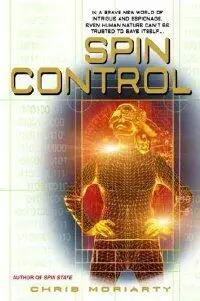
- Название:Spin Control
- Автор:
- Издательство:Bantam Spectra
- Жанр:
- Год:2006
- ISBN:978-0-553-58625-1
- Рейтинг книги:5 / 5. Голосов: 1
-
Избранное:Добавить в избранное
- Отзывы:
-
Ваша оценка:
Spin Control: краткое содержание, описание и аннотация
Предлагаем к чтению аннотацию, описание, краткое содержание или предисловие (зависит от того, что написал сам автор книги «Spin Control»). Если вы не нашли необходимую информацию о книге — напишите в комментариях, мы постараемся отыскать её.
As the auction heats up, the Artificial Life Emancipation Front sends in Major Catherine Li. Drummed out of the Peacekeepers for executing Syndicate prisoners, Li has now literally hooked up with an AI who has lived many lifetimes and shunted through many bodies. But while they have their own conflicting loyalties to contend with, together they’re just one player in a mysterious high-stakes game…
Spin Control — читать онлайн бесплатно полную книгу (весь текст) целиком
Ниже представлен текст книги, разбитый по страницам. Система сохранения места последней прочитанной страницы, позволяет с удобством читать онлайн бесплатно книгу «Spin Control», без необходимости каждый раз заново искать на чём Вы остановились. Поставьте закладку, и сможете в любой момент перейти на страницу, на которой закончили чтение.
Интервал:
Закладка:
“Those Syndicate spins. I got dragged to one a few months ago, never mind how. The Time of Cruel Miracles. ”
“You saw The Time of Cruel Miracles ? Where—”
“At the Castro. They always show Syndicate flicks there. ’Cause you people are all…well, never mind, that’s not the point. My question is this: Is that spin considered art ?”
“Uh…well, not the spin necessarily. But it was based on a famous novel by Rumi.”
Osnat’s brows knit in confusion. “Rumi with an R? I’ve never heard of R’s. How many series do you have, anyway?”
“No, no. It’s a pen name. Rumi was a KnowlesSyndicate A. From the same series as Andrej Korchow, actually. That whole series can be…um…odd. Anyway, he was mostly a poet, but he wrote one famous novel. And the spin you saw is a very sensationalistic and simplistic version of that novel.”
“Commercial, you mean.”
“I’m sorry, I don’t know that term.”
“Popular.”
“Well, it certainly was popular.”
“So. At the end of the spin the hero and his lover kill themselves, right?”
“Right.”
“And the friend I went to see it with said that always happens in Syndicate spins. The heroes start out fighting with each other, and then they fall in love, and then they have a lovers’ suicide pact and kill themselves.”
That was selling Rumi’s novel a bit short, Arkady thought. But he had to admit that it sounded like a pretty fair rendering of the average run of Syndicate movies.
“So my question,” Osnat said, “is why? Why do they always kill themselves? Why do you people like watching that stuff?”
“Well, it sounds like some humans like watching it too,” he countered. “Why don’t you ask them why?”
She gave him an impatient glare. “They like it because you’d have to be either blind or dead not to enjoy watching that Ahmed Aziz fellow take his clothes off.”
“I wouldn’t know,” Arkady said wryly. “He’s not my type.”
Osnat forged on, missing the joke entirely. “My question is why do you watch it? Do you people get off on watching snuff flicks? Or is it some kind of government propaganda designed to convince you that”—her voice dropped into a really quite respectable imitation of the Ahmeds’ masculine tones—“the collective good is a more beautiful ideal than the futile search for selfish individual happiness?”
“There are plenty of human love stories that end that way,” Arkady protested. “Just think of Romeo and Juliet. ”
“Yeah, but the point of Romeo and Juliet was that their families’ vendetta was stupid and pointless and they should have just let the young people be happy.”
“Was it? I don’t recall Shakespeare ever saying that.”
“Don’t be a smartass. It doesn’t change the point that if you ever do get back to your precious Arkasha, the best you can hope for is another twenty years of separation before—assuming you’re good and neither of you pisses anyone off and you both get citizenship—your steering committee might maybe, just maybe, give you permission to be together.”
“You make it sound so…bleak.”
“Do I?” She smirked. “I don’t recall my ever saying that.”
“Thirty-year contracts and temporary workpairings aren’t about some family squabble over the means of genetic production, Osnat. We’re not fighting for a bigger share of the genomic pie. We’re fighting for survival as a species. You people are always complaining about living in the ruins of a broken planet. Well, we don’t even have ruins. We’re out in space without a lifeboat. Every crèche run, every piece of genetic design, every terraforming mission—and yes, even culling and renormalization—is dictated by the cold equations of survival and extinction. And one moment of carelessness or selfishness could be all it takes to tip the balance toward extinction. You can make a face if you want to, but that’s the reality. And, frankly, what does humanity have to put against it? Chaos. Bickering, rutting, selfish, maladaptive cha—”
“Whoa, Arkady!” Osnat interrupted. At first he thought she was angry, but then he realized she was trying not to laugh. “I think we’re going to have to agree to disagree on this.”
“Come on, Arkady. I got clearance to take you for a little walk. Told Moshe you were going to die of vitamin D deficiency if he didn’t let you out in the sun sooner or later.”
Arkady, spliced for survival in space, was perfectly capable of synthesizing his own vitamin D; but he thought about Osnat’s peculiarly human prudishness about genetic engineering and decided that an unnecessary walk would probably hurt him less than another argument with the only sentient being currently on speaking terms with him.
Osnat’s “little walk” turned out to be a bit more than he’d bargained for.
Arkady had always enjoyed being planetside until then—a notable, though highly adaptive, deviation from the stationer’s agoraphobia that was becoming increasingly widespread among the younger cohorts of most Syndicates’ crèches. But the deep, dense undergrowth of the temperate zones of Gilead and Novalis had done nothing to prepare him for the environment into which Osnat introduced him.
He was amazed by the cold, first of all. He’d known, of course, about the ice age; but somehow he’d still imagined that a desert would be hot. He certainly hadn’t expected the dusting of snow that chilled his feet and clotted in the treads of his boot soles.
Nor had he expected the inhabitedness of the landscape. Nothing on Earth was pristine, it turned out; what he took for granted on Gilead or any of the other new and still-empty planets he’d worked on was long gone even in this desolate place. At every dip and turn of the land they would stumble on some artifact of the desert’s former population. Junked cars. Rusting water tanks. Coils of barbed wire still draped between the leftover bones of old fences. An entire apartment complex, built of rebar-reinforced concrete and sheathed in now-peeling white stucco, abandoned so abruptly that there were still faded shreds of laundry hanging from the windows like flags put out to celebrate a victory that had never, in the end, come to pass.
“Is this Israeli or Palestinian?” Arkady asked.
“Could be either. They’ve changed the lines so often that settlements are always getting stranded on the wrong side.”
“And no one moves in after the settlers leave?”
Osnat shrugged. “Israelis don’t want to live in Arab houses. Palestinians don’t want to live in Jewish houses. And anyway, it’s cheaper to build new.”
“It always comes back to money with humans, doesn’t it?”
Osnat laughed bitterly. “If only it did! Money’s nice and clean and simple compared to most of what goes on down here.”
They saw only one sign among the wreckage of present human occupation: a vast dusty herd of sheep swirling in the bottom of a wadi like a spring flood. To Arkady, station-raised, the sight was inconceivable. How much biomass did these creatures consume? What kind of organic load did they place on the ecosystem that supported them? What king’s ransom of water did they consume every day? How many accumulated tons of grass, insects, and annelids were necessary to allow for the extravagance of a single sheep? And for what? A scrap of wool? A bit of meat that could be produced more quickly and cheaply in the most primitive viral manufacturing tanks? It was enough to make him long for the elegant economy of a worm.
Long after he’d stopped wondering if there was any purpose to the forced march Osnat was leading him on, they topped a steep mesa and looked out over a flat valley that contained what appeared, at first glance, to be a remote desert town. It was empty, however. And as they dropped off the ridge and moved down the single silent street, Arkady began to understand that it had never really been a town at all. The buildings were all made of whitewashed cement block, and their walls were massively scarred with bullet holes. But there were no shards of broken glass anywhere—because none of the buildings had ever had windows. And the yellow dust of the desert and the khamsin had drifted through the open doors and windows to pile up in the corners of dark, warrenlike rooms that had clearly never been finished for human habitation.
Читать дальшеИнтервал:
Закладка:
Похожие книги на «Spin Control»
Представляем Вашему вниманию похожие книги на «Spin Control» списком для выбора. Мы отобрали схожую по названию и смыслу литературу в надежде предоставить читателям больше вариантов отыскать новые, интересные, ещё непрочитанные произведения.






Обсуждение, отзывы о книге «Spin Control» и просто собственные мнения читателей. Оставьте ваши комментарии, напишите, что Вы думаете о произведении, его смысле или главных героях. Укажите что конкретно понравилось, а что нет, и почему Вы так считаете.