Brian Aldiss - White Mars
Здесь есть возможность читать онлайн «Brian Aldiss - White Mars» весь текст электронной книги совершенно бесплатно (целиком полную версию без сокращений). В некоторых случаях можно слушать аудио, скачать через торрент в формате fb2 и присутствует краткое содержание. Год выпуска: 1999, ISBN: 1999, Издательство: Little, Brown UK, Жанр: Фантастика и фэнтези, на английском языке. Описание произведения, (предисловие) а так же отзывы посетителей доступны на портале библиотеки ЛибКат.
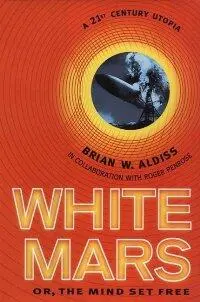
- Название:White Mars
- Автор:
- Издательство:Little, Brown UK
- Жанр:
- Год:1999
- ISBN:0-316-85243-0
- Рейтинг книги:5 / 5. Голосов: 1
-
Избранное:Добавить в избранное
- Отзывы:
-
Ваша оценка:
White Mars: краткое содержание, описание и аннотация
Предлагаем к чтению аннотацию, описание, краткое содержание или предисловие (зависит от того, что написал сам автор книги «White Mars»). Если вы не нашли необходимую информацию о книге — напишите в комментариях, мы постараемся отыскать её.
White Mars — читать онлайн бесплатно полную книгу (весь текст) целиком
Ниже представлен текст книги, разбитый по страницам. Система сохранения места последней прочитанной страницы, позволяет с удобством читать онлайн бесплатно книгу «White Mars», без необходимости каждый раз заново искать на чём Вы остановились. Поставьте закладку, и сможете в любой момент перейти на страницу, на которой закончили чтение.
Интервал:
Закладка:
The action group set about refuelling the ferry. In a nearby heated prefab shed stood a Zubrin Reactor, still in working order despite the taxing variations in Martian temperatures. It soon began operating at 400° Celsius. Atmospheric carbon dioxide plus the stolen hydrogen began to generate methane and oxygen. The RWGS reaction kicked in. Carbon dioxide and hydrogen, plus catalyst, yielded carbon monoxide and water, this part of the operation being maintained by the excess energy of the operation. The water was immediately electrolysed to produce more oxygen, which would burn the methane in a rocket engine.
The group connected hoses from the Zubrin to the ferry. The refuelling process began.
As the group of six men sheltered in the buggy, waiting for the tanks to fill, an argument broke out between the Feneloni brothers, in which the other men became involved. Each man had a pack of food with him. The plan was that when they reached the interplanetary vessel orbiting overhead, all except Abel would climb into cryogenic lockers and sleep out the journey home. Abel would fly the craft for a week, lock it into an elliptical course for Earth, allow the automatics to take over, and then go cryogenic himself. He would be the first to awaken when the craft was a week’s flight away from Earth, and would take over from the guidance systems.
Abel had shown great confidence during the planning stage, carrying the others with him. Now his younger brother asked, hesitantly, if Abel had taken into account the fact that methane had a lower propellant force than conventional fuel.
“We’ll compute that once we’re aboard the fridge wagon,” Abel said. “You’re not getting chicken, are you?”
That’s not an answer, Abel,” said one of the other men, Dick Harrison. “You’ve set yourself up as the man with the answers regarding the flight home. So why not answer your brother straight?”
“Don’t start bitching, Dick. We’ve got to be up in that fridge wagon before they come and get us. The on-board computer will do the necessary calculations.” He drummed his fingers on the dash, sighing heavily.
They sat there, glaring at each other, in the faint shadow of the ferry.
“You’re getting jumpy, not me,” said Jarvis.
“Shut your face, kid.”
“I’ll ask you another elementary question,” said Dick. “Are Mars and Earth at present in opposition or conjunction? Best time to do the trip is when they’re in conjunction, isn’t it?”
“Will you please shut the fuck up and prepare to board the ferry?”
“You mean you don’t bloody know?” Jarvis said. “You told us the timing had to be right, and you don’t bloody know?”
A quarrel developed. Abel invited his brother to stay bottled up on Mars if he was so jittery. Jarvis said he would not trust his brother to navigate a fridge wagon if he could not answer a simple question.
“You’re a titox—always were!” Abel roared. “Always were! Get out and stay out! We don’t need you.”
Without another word, Jarvis climbed from the buggy and stood there helplessly, breathing heavily in his atmosphere suit. After a minute, Dick Harrison climbed down and joined him.
“It’s all going wrong,” was all he said. The two men stood there. They watched as Abel and the others left the buggy and went towards the now refuelled ferry. As the men climbed aboard, Jarvis ran over and thrust his food pack into his brother’s hands.
“You’ll need this, Abel. Good luck! My love to our family!”
His brother scowled. “You rotten little titox,” was all •he said. He swung the pack on to his free shoulder and disappeared into the ferry. The hatch closed behind him.
Jarvis Feneloni and Dick Harrison climbed into the shelter of the buggy. They waited until the ferry lifted off into the drab skies before starting the engine and heading back to the domes. Neither of them said a word.
Abel Feneloni’s exploit and the departure of the fridge wagon from its parking orbit caused a stir for a day or two. Jarvis put the best gloss he could on the escape, claiming that his brother would present their case to the UN, and rescue for all of them would soon be at hand.
Time went by. Nothing more was heard of the rocket. No one knew if it reached Earth. The matter was eventually forgotten. As patients in hospital become so involved in the activities of their ward that they wish to hear no news of the outside world, so the new Martians were preoccupied with their own affairs. If that’s a fair parallel!
Lotteries for this and that took place all the time. I was fortunate enough to win a trip out to the science unit. Ten of us travelled out in a buggybus. The sun was comparatively bright, and the PIRs shone like a diamond necklace in the throat of the sky.
Talk died away as we headed northwards and the settlement of domes was lost below the near horizon. We drove along a dried gulch that served as a road. There was something about the unyielding rock, something about the absence of the most meagre sign of any living thing, that was awesome. Nothing stirred, except the dust we churned up as we passed. It was slow to settle, as if it too was under a spell.
This broken place lay defenceless under its thin atmosphere. It was cold and fragile, open to bombardment by meteors and any other space debris. All about us, fragments of primordial exploded stars lay strewn.
“Mars resembles a tomb, a museum,” said the woman I was travelling next to. “With every day that passes, I long to get back to Earth, don’t you?”
“Perhaps.” I didn’t want to disappoint her. But I realised I had almost forgotten what living on Earth was like. I did remember what a struggle it had been.
I thought again, as I looked out of my window, that even this progerial areoscape held—in Tom’s startling phrase—that “divine aspect of things” which was like a secret little melody, perhaps heard differently by everyone susceptible to it.
I managed to terrify myself by wondering what it would be like to be deaf to that little tune. How bearable would Mars be then?
I was grateful to him for naming, and so bringing to my conscious mind, that powerful mediator of all experience. All the same, I disliked the drab pink of the low-ceilinged sky.
The tall antennae and the high-perching solar panels of the Smudge laboratory and offices showed ahead. It was only a five-minute drive from Mars City (as we sometimes laughingly called our congregation of domes). We drew nearer. The people in the front seats of the bus started to point excitedly.
At first I thought paper had been strewn near the unit. It crossed my mind that these white tongues were plants—something perhaps like the first snowdrops of a new spring. Then I remembered that Tom and I had seen these inexplicable things on our visit to Dreiser Hawkwood. As we drew close to them they slicked out of sight and disappeared into the parched crusts of regolith.
“Life? It must be a form of life…” So the buzz went round.
A garage door opened in the side of the building. We drove in. The door closed and atmosphere hissed into the place. When a gong chimed, it was safe to leave the buggy. The air tasted chill and metallic.
We passed into a small reception hall, where we were briefly greeted by Arnold Poulsen. As chief computer technician, Poulsen was an important man, answerable only to Hawkwood and seldom appearing in public. I studied him, since Tom had spoken highly of him. He stood before us in a wispy way, uttering conventional words of greeting, looking pleasant enough, but forgetting to smile. Then he disappeared with evident relief, his social moment finished.
We were served a coffdrink while one of the particle physicists, a Scandinavian called Jon Thorgeson, youthful but with a deeply lined face, spoke to us. He was more communicative than Poulsen, whom he vaguely resembled, being ectomorphic and seemingly of no particular age.
Читать дальшеИнтервал:
Закладка:
Похожие книги на «White Mars»
Представляем Вашему вниманию похожие книги на «White Mars» списком для выбора. Мы отобрали схожую по названию и смыслу литературу в надежде предоставить читателям больше вариантов отыскать новые, интересные, ещё непрочитанные произведения.








Обсуждение, отзывы о книге «White Mars» и просто собственные мнения читателей. Оставьте ваши комментарии, напишите, что Вы думаете о произведении, его смысле или главных героях. Укажите что конкретно понравилось, а что нет, и почему Вы так считаете.