Donald Moffitt - Second Genesis
Здесь есть возможность читать онлайн «Donald Moffitt - Second Genesis» весь текст электронной книги совершенно бесплатно (целиком полную версию без сокращений). В некоторых случаях можно слушать аудио, скачать через торрент в формате fb2 и присутствует краткое содержание. Год выпуска: 1986, ISBN: 1986, Издательство: Del Rey / Ballantine, Жанр: Фантастика и фэнтези, на английском языке. Описание произведения, (предисловие) а так же отзывы посетителей доступны на портале библиотеки ЛибКат.
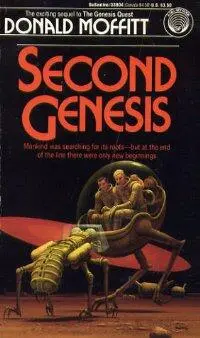
- Название:Second Genesis
- Автор:
- Издательство:Del Rey / Ballantine
- Жанр:
- Год:1986
- ISBN:0-345-33804-9
- Рейтинг книги:4 / 5. Голосов: 1
-
Избранное:Добавить в избранное
- Отзывы:
-
Ваша оценка:
Second Genesis: краткое содержание, описание и аннотация
Предлагаем к чтению аннотацию, описание, краткое содержание или предисловие (зависит от того, что написал сам автор книги «Second Genesis»). Если вы не нашли необходимую информацию о книге — напишите в комментариях, мы постараемся отыскать её.
Second Genesis — читать онлайн бесплатно полную книгу (весь текст) целиком
Ниже представлен текст книги, разбитый по страницам. Система сохранения места последней прочитанной страницы, позволяет с удобством читать онлайн бесплатно книгу «Second Genesis», без необходимости каждый раз заново искать на чём Вы остановились. Поставьте закладку, и сможете в любой момент перейти на страницу, на которой закончили чтение.
Интервал:
Закладка:
“Oh, that! There are spare space suits in the ship, and one of them is bound to fit me—it isn’t as if they had to be custom fitted. I’ve ridden with Lydis lots of times before—on trips to other branches and even to the probe. And when it comes to that, I’ve spent as much time in vacuum as anybody. If I can climb around the branches under spin, I ought to be able to manage on one of those nice flat things out there.”
Bram refrained from bringing up Jao’s speculations on the nature of disk gravity gradients. “Are you sure you want to leave the twins alone for that long?”
“Smeth will take care of them. They adore him. He spoils them like mad. They’re two years old now—they don’t need to have me around constantly.”
Bram sighed. “Everybody and their gene sibling wanted to be included on this trip. I almost had a riot. I had to promise that if there are no problems, everyone who wants to will get a turn while we’re parked in this orbit. And here I am, giving preference to a descendant. They’ll have my hide for nepotism.”
“I can go, then?”
He gave in. “Your great-great-grandmother is the pilot. It’s her decision. If she says you can go, then you’re on. Otherwise you promise to leave quietly, all right?”
“I promise.”
Above, Jao stuck his head out of the hatch. “What’s holding you up? Lydis’s already lost a turn while you’ve been palavering.”
Ame scrambled up the landing leg ladder, with Bram behind her carrying the sack of equipment. It was bulky; he felt the handle of a digging tool through the fabric as it swung against his hip.
At the top, Bram twisted around and caught sight of Mim waving to him from the other side of the barrier. He waved back and squeezed through the hatch after Ame.
Jao filled the air lock, huge and grinning. “Stay here a minute with her,” Bram said, “while I—”
“Lydis says it’s okay,” Jao said. “Let’s get going.”
A great rumbling sound filled the bay as the curtain rolled around its track and sealed off the cylindrical launch chamber. The crowd on the other side would be streaming toward holo monitors to watch the drop as relayed by the exterior pickups.
Bram turned sternly to Ame. “You had it all arranged with her in advance, didn’t you?”
She wrinkled her nose at him. “She said you’d only be stuffy about it, and she was right.”
Bram shrugged and sealed the outside hatch, then, after herding Jao and Ame through the air lock, screwed the inner lid into place.
He looked around the dome-shaped cabin. The landing vehicle was basically a squat hemisphere supported on five arched legs. It had started out as a Nar design with the pilot’s seat in the middle, but like the rest of the considerable fleet the tree had been stocked with, its interior had been rearranged during the intergalactic crossing to give it something resembling front-back orientation, and the controls had been shifted to conform to human morphology. Lydis and her copilot sat facing one of the five bulging ports—the one that had been designated “forward.” The rear of the cabin contained passenger couches—more than the current mission profile called for—storage, equipment, and minimum amenities.
“You have exactly ten minutes to tie yourselves down,” Lydis said. “I don’t intend to sit here for another go-round.”
“Sorry,” Bram said.
He nodded to his daughter’s co-pilot, a wiry, nonchalant fellow named Zef, then helped Enry and Jao stow their gear. Ame went to a locker and helped herself to a spare vacuum suit. While she struggled to get into it, Bram hefted the clanking sack she had given him and, after a moment’s reflection, shoved it into a padded locker. “I hope there’s nothing breakable in there,” he said.
“Nothing very breakable,” she said.
They climbed onto their couches and fastened the armpits-to-hips webbing in place. Jao cranked his couch to a sitting position.
“I want all you treelubbers to lie prone for the drop,” Lydis said. “And while you’re at it, put your helmets on.”
She herself was sitting upright, as was Zef. Jao pointed that out.
“You do everything by the list when you ride with me,” Lydis said. “Otherwise, you can get out and walk.”
Grumbling, Jao complied.
“It’s surprising, the number of things that can go wrong,” Zef said cheerfully. “Why, I saw a fellow explode once because he forgot to screw his helmet on all the way and nobody’d told him the cabin wasn’t going to be pressurized that trip.”
“Oh, stow it,” Jao said. “I’m not falling for any more of your stories.”
Zef laughed. “It’s not that we care about the safety of our passengers. We just don’t want a lot of helmets floating around and bumping into things.”
Jao started to reply, but his voice was cut off as Lydis watched the passengers off the Talk circuit. Abruptly Zef dropped his smile and became all business. Bram found himself gripping the armrests of his couch. Drop must be imminent.
He was still plugged into the Listen circuit, though. He could hear Lydis talking to Jun Davd back in the observatory.
“I have your readout,” she said. “Please confirm.”
“Three minutes more and you’ll be in optimum drop position. As tangent as you can get. Do you want the computer to open the trapdoor for you?”
“No, I’d rather do it by feel. The computer doesn’t have nerves in its bottom, and it has too much faith in the invariance of mechanical systems. I’m going to have to make a lot of small burn corrections, anyway, once we’re out there. Just keep feeding me the figures.”
It was a point of pride with Lydis to be in fingertip control. She believed piloting was an art, not a science.
“A computer with nerves in its bottom!” Jun Davd chuckled. “My goodness. We’ll work on it.”
By craning his neck, Bram could see one of the duplicate screens left over from the original Nar installation, next to the observation blister closest to him. In a simplified computer cartoon it showed a great dull-red disk, slightly angled to give a sense of perspective, and a jolly little green representation of Yggdrasil, much out of scale, floating above and to one side of it. Discreetly flashing and dotted lines showed the direction of rotation of both bodies and their intersecting orbits around the rice-grain sun shining through a cluster of red lobes at the center of the system.
It obviously hadn’t been very practical to put Yggdrasil into orbit around the rim of a disk-shaped body with a circumference of two hundred seventy million miles. And parking Yggdrasil sixty degrees ahead of the disk—at the stable point which in this crazy system neatly coincided with the point of equilibrium with the disk ahead of it in orbit—would still have placed them an inconvenient forty-five million miles away from the forward edge of the disk and all of one hundred million miles away from the present “top” of the disk, which they had chosen as their likeliest base of operations.
So instead, with Jun Davd’s help, Bram had put Yggdrasil into a solar orbit that intersected the disk’s orbit at a tilted angle. It started above and behind the disk at a distance of only a few million miles, slanted down at a tangent that almost grazed their target point on the rim, and continued on past to a point ahead of the disk in orbit that would place Yggdrasil directly “above” the spot where the disk’s own slow rotation would have brought the explorers’ base of operations by that time.
Thus, for at least the first half year, travel time between Yggdrasil and the main landing site would be measured in days rather than months. At that point, Yggdrasil’s solar orbit could be converted into a powered orbit around the rim, which would take it back to its starting point for another such orbital stern chase.
Читать дальшеИнтервал:
Закладка:
Похожие книги на «Second Genesis»
Представляем Вашему вниманию похожие книги на «Second Genesis» списком для выбора. Мы отобрали схожую по названию и смыслу литературу в надежде предоставить читателям больше вариантов отыскать новые, интересные, ещё непрочитанные произведения.








Обсуждение, отзывы о книге «Second Genesis» и просто собственные мнения читателей. Оставьте ваши комментарии, напишите, что Вы думаете о произведении, его смысле или главных героях. Укажите что конкретно понравилось, а что нет, и почему Вы так считаете.