Donald Moffitt - Second Genesis
Здесь есть возможность читать онлайн «Donald Moffitt - Second Genesis» весь текст электронной книги совершенно бесплатно (целиком полную версию без сокращений). В некоторых случаях можно слушать аудио, скачать через торрент в формате fb2 и присутствует краткое содержание. Год выпуска: 1986, ISBN: 1986, Издательство: Del Rey / Ballantine, Жанр: Фантастика и фэнтези, на английском языке. Описание произведения, (предисловие) а так же отзывы посетителей доступны на портале библиотеки ЛибКат.
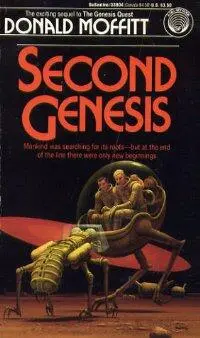
- Название:Second Genesis
- Автор:
- Издательство:Del Rey / Ballantine
- Жанр:
- Год:1986
- ISBN:0-345-33804-9
- Рейтинг книги:4 / 5. Голосов: 1
-
Избранное:Добавить в избранное
- Отзывы:
-
Ваша оценка:
Second Genesis: краткое содержание, описание и аннотация
Предлагаем к чтению аннотацию, описание, краткое содержание или предисловие (зависит от того, что написал сам автор книги «Second Genesis»). Если вы не нашли необходимую информацию о книге — напишите в комментариях, мы постараемся отыскать её.
Second Genesis — читать онлайн бесплатно полную книгу (весь текст) целиком
Ниже представлен текст книги, разбитый по страницам. Система сохранения места последней прочитанной страницы, позволяет с удобством читать онлайн бесплатно книгу «Second Genesis», без необходимости каждый раз заново искать на чём Вы остановились. Поставьте закладку, и сможете в любой момент перейти на страницу, на которой закончили чтение.
Интервал:
Закладка:
“By using littler disks?”
He nodded. “Almost all the mass of the energy trap is in the three big ninety-million-mile disks. The next shell inward—the one that orbits at thirty-six million miles—contains only about a sixth as much mass. Call it four twenty-fifths. And the ratio holds as you keep diminishing—so that all of the inner disks put together add up to less than the mass of one more big disk. Original Man was very clever. He made his fence out of geometry instead of mass.”
“It’s a fence with a lot of gaps, though, isn’t it?” said a smart aleck who looked as if he were the boyfriend of the girl or aspired to be.
“Not as much as you think,” Jao said indulgently. “Let’s figure it out. Hey, Smeth, what’s the formula for a hypocycloid—never mind, I’ll graph it.”
He grabbed for the touch pad he had dangling from a chain around his neck and poked at it with thick fingers. An electric-blue circle grew on its photoplastic surface, followed by a horizontal line that bisected it, then two curves with the same radius as the original circle that sprouted from the ends of the line and met at the top. Little boxes began to subdivide the resulting figures, getting smaller and smaller until the eye could no longer separate them. The negatively curved triangle in the center differentiated itself with a change of color. Jao’s fingers asked the touch pad a couple of questions, and he read off the answer.
“Yah,” he said. “The equatorial fence intercepts about seventy percent of the solar energy that comes its way. So does the polar shell. Together they cover somewhat more than one-fifth of the surface of an imaginary sphere enclosing the sun at any radius. I guess that was good enough to do the job.”
“What ever happened to Jao’s Bubble?” his opponent asked maliciously.
Jao was totally bland. “Oh, yah, the idea of enclosing a star inside some kind of a continuous shell. It wouldn’t work.”
“I can’t stand it!” Smeth groaned. “Now he’s going to disown the whole idea.”
“He has no shame.” Bram laughed. “Jao throws off ideas, but. he isn’t attached to them.”
Jao was lecturing the young man earnestly. “In the first place, there’s no way to keep it from drifting off center,” he said. “You might start with the star perfectly centered, but once the slightest drift started, it would keep getting worse, because the attraction from all other directions would keep decreasing…”
“That’s exactly what I told him,” Smeth complained to Bram.
“…and can you imagine the centrifugal force at the equator if the thing rotated at all? Your sphere would suffer from slump. Everything would tend to collect at the equatorial plane. No, my friend, your sphere’s a picturesque idea, but you can’t have it.”
“How does he do it?” Smeth grumbled.
“And who needs it, anyway?” Jao said before his young antagonist could open his mouth to protest. “Let’s figure out how much energy Original Man had at his disposal for his intergalactic beacon.”
He reached for his pendant touch pad again and began tapping at it one-handed without looking.
“Look at him showing off,” Smeth said in disgust. “He hits wrong numbers all the time that way, but that doesn’t stop him.”
“Each one of those big disks has a surface area of … hmm … call it six point three six quadrillion square miles. A six followed by fifteen digits. On each side. If you’re trying to make sense of a number like that, it means that—” He punched numbers again. “—one side of a disk has thirty-two million times the surface area of an ordinary planetary body like the Father World.”
“Why one side?” his admirer queried.
“We’re only concerned with the side that’s soaking up energy.”
“Oh.”
Jao continued. “We’ve already got a value for the solar constant at the distance of the cometary halo, a light-year out. Now let’s crank it back according to the inverse-square law, and we’ve got—” His fingers busied themselves again. “At ninety million miles, it works out to … hmm … one point four kilowatts per square meter … times sixteen times ten to the nineteen square meters—”
“Oh, for pity’s sake!” Smeth burst out. “All that rigamarole! He wants to say that each of the three large diskworlds receives twenty-three times ten to the twenty-first kilowatts of energy!”
“Thank you, Smeth,” Jao said equably. “Twenty-three sextillion kilowatts. And we’re not through yet. We multiply by six, and—”
“Multiply by three something, you mean,” interrupted his rival for the young woman’s attention.
“No. Don’t forget the three disks of the inner equatorial shell may be a lot smaller, but they’re closer to the star, and they intercept exactly as much solar radiation as if they were big disks in the outer orbit.”
“But—”
Jao sailed on serenely. “Which means that in the equatorial fence alone, Original Man had one hundred and thirty-eight sextillion kilowatts at his disposal to turn into radio waves.” He paused for effect. “That is ten trillion times as much power as Nar civilization produced on the Father World.”
Bram caught his breath. The figure was staggering. He had never bothered to work it out himself, though he had known it must be very high.
“They thought big, those people,” he said to Smeth. “By now the human genetic code will have reached the Virgo cluster. I always assumed that was the target. But with that kind of power, I wonder if they were aiming beyond.”
Smeth snorted. “Huh, don’t let Jao’s raving impress you too much. We don’t know how efficient those … constructions were at converting energy into the longer radio wavelengths and modulating them.”
“It hardly matters, does it?” Bram responded. “The waves will keep spreading through the universe. If they were meant to reach Virgo, the limit of their detectability must lie many times beyond it.”
Over by the view wall, Jao was unleashing one of his terrifying smiles on the girl. Though he was utterly faithful to Ang, he didn’t mind going through the motions.
Jao’s young competitor glowered and made another try at impressing the girl. “If most of the mass of the system is in the big disks,” he said belligerently, “how come the sun hasn’t drifted toward one or another of them over a period of time—just as it would toward one side of a ‘Jao’s Bubble’? Excuse me—‘Jao’s shell.’ The same thing would apply—the attraction of the other two disks would decrease with distance, and it would keep getting worse!”
He must have been a physics, apprentice. He stole a glance at the girl and went on in a classroom voice. “In a synthetic system like this one, which is essentially three big masses mutually revolving at the points of an equilaterial triangle, a mass occupying the center can’t move above or below the equatorial plane because of the combined pull of the three major components.” He stared a challenge. “But it can and will move within the plane!”
“I didn’t say most of the mass of the system was in the big disks,” Jao said kindly. “I said the big disks contain most of the planetary mass. Actually, they only mass about the same as a good-size gas giant—maybe a few tenths of one percent of the mass of the G-type star in the middle. So they’re in orbit around it in the normal way.”
“But that would mean—”
“Right. We know they’re very thin—maybe as little as fifty miles across the rim. But even so, with a diameter measured in orbital distances, that would give them a volume of maybe four thousand times the volume of your run-of-the-mill gas giant. So they’re lighter than they have any right to be.”
Читать дальшеИнтервал:
Закладка:
Похожие книги на «Second Genesis»
Представляем Вашему вниманию похожие книги на «Second Genesis» списком для выбора. Мы отобрали схожую по названию и смыслу литературу в надежде предоставить читателям больше вариантов отыскать новые, интересные, ещё непрочитанные произведения.






Обсуждение, отзывы о книге «Second Genesis» и просто собственные мнения читателей. Оставьте ваши комментарии, напишите, что Вы думаете о произведении, его смысле или главных героях. Укажите что конкретно понравилось, а что нет, и почему Вы так считаете.