Donald Moffitt - Second Genesis
Здесь есть возможность читать онлайн «Donald Moffitt - Second Genesis» весь текст электронной книги совершенно бесплатно (целиком полную версию без сокращений). В некоторых случаях можно слушать аудио, скачать через торрент в формате fb2 и присутствует краткое содержание. Год выпуска: 1986, ISBN: 1986, Издательство: Del Rey / Ballantine, Жанр: Фантастика и фэнтези, на английском языке. Описание произведения, (предисловие) а так же отзывы посетителей доступны на портале библиотеки ЛибКат.
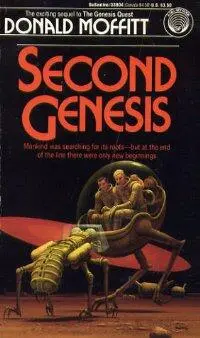
- Название:Second Genesis
- Автор:
- Издательство:Del Rey / Ballantine
- Жанр:
- Год:1986
- ISBN:0-345-33804-9
- Рейтинг книги:4 / 5. Голосов: 1
-
Избранное:Добавить в избранное
- Отзывы:
-
Ваша оценка:
Second Genesis: краткое содержание, описание и аннотация
Предлагаем к чтению аннотацию, описание, краткое содержание или предисловие (зависит от того, что написал сам автор книги «Second Genesis»). Если вы не нашли необходимую информацию о книге — напишите в комментариях, мы постараемся отыскать её.
Second Genesis — читать онлайн бесплатно полную книгу (весь текст) целиком
Ниже представлен текст книги, разбитый по страницам. Система сохранения места последней прочитанной страницы, позволяет с удобством читать онлайн бесплатно книгу «Second Genesis», без необходимости каждый раз заново искать на чём Вы остановились. Поставьте закладку, и сможете в любой момент перейти на страницу, на которой закончили чтение.
Интервал:
Закладка:
With one exception. There was a curiously flat, squashed area on the part of the sphere directly opposite the bead representing the infrared star, which hung just outside the boundary of winking stars.
“I don’t think that part of the sphere is actually flattened,” Jun Davd said. “That’s about forty light-years away—at the furthest distance from us. I think any emissions originating there have started fairly recently and simply haven’t reached us yet.”
Trist nodded in agreement. “Yes, we intersected a small chord of this … spherical volume of space on our way here, and when we crank back the data we find that we’ve witnessed several discrete jumps in the size of the globe. It seems to be growing quite uniformly, at about one-tenth of the speed of light.”
Jun Davd’s fingers flicked buttons, and a star at the surface of the shell sent a spray of three dotted lines toward the line embedded within the sphere that represented Yggdrasil’s route, making an equilateral triangle bisected at the vertex. He added three little green Yggdrasils where the dotted lines met the route.
“No reception,” Jun Davd said, tapping the first Yggdrasil at the earliest position on the route. He went on to tap the second Yggdrasil, where the bisecting line showed the shortest distance to the star. “First reception,” he said. Then he pointed to the third little tree symbol. “And we’re still receiving at the same radial distance as the previous no-reception zone, so knowing our speed and the distance covered, and throwing in a little Doppler anaylsis of about a dozen similar cases, we get a pretty good value for the rate of growth of the shell.”
“And virtually every single star within the shell is giving off radio clicks,” Trist said.
The other three looked at one another. The thought was inescapable. “Original Man?” Bram said.
“No, impossible!” Jao said.
Smeth was getting excited. Too excited. “Why are we wasting time here?” he said. “Whatever this phenomenon is, it’s growing from a center.” He squinted at the pinch of stars in the middle of the representation—a couple of yellow dwarfs, one with a smaller orange star and a red dwarf for companions; a solitary red dwarf; a blue-white giant attended by a burnt-out cinder. “Let’s investigate the center of the sphere and see if we can find out what’s causing it!”
Jao bellowed in outrage. He could see his lovely enclosed star slipping away from him. “What? That’s twenty light-years away! You’re talking seven, eight years of ship time by the time we build up enough gamma at one g! We’re here now! We can be at the center of this system in less than two years!”
Jun Davd was no help. He stood there smiling. Bram turned to Trist. “How fast did you say that sphere of clicking stars is growing? At about one-tenth the speed of light?”
“That’s right,” Trist said.
Bram exercised his prerogatives as year-captain. “In that case we can stay here and wait for it. This star is due to give off clicks any time now.”
CHAPTER 6
The sky was full of disks.
The nearest one, only a hundred million miles away, turned half the sky blind. It stood almost edge-on—seen only as a paper-thin rim faintly traced by light, sketching the partial outline of a tall ellipse whose shape could be inferred from the stars it blotted out.
It was immense. Unbelievably so. A planet would have been imperceptible against it, a sun a mere pinprick. Its diameter was, in fact, that of a planetary orbit.
Another disk, equally huge, bracketed the other side of the sky, showing as a somewhat fuller ellipse. But this one presented its inner face and was visible as a pale wash of refracted light.
Between them hung a whole collection of similar shapes, like paper cutouts all dangling at the same level from invisible threads. Directly ahead was a great illuminated circle on what must have been the opposite side of the hidden sun. A smaller circle was a black silhouette trying unsuccessfully to eclipse it. On either side of the smaller circle were attendant disks, canted inward to make narrow ovals. Their inner faces, closer to the unseen sun than the gigantic disk opposite, made brighter daubs against its inferior illumination. A bite had been taken out of the edge of one of them by the eclipsing circle.
Through the spaces between them could be seen a whole swarm of still smaller disks—if objects that were millions of miles in diameter could be called small. The glimpsed shapes were in a different plane than the outer disks; the ellipses they presented were horizontal, not vertical.
The tiny dot of a sun in the center of that bewildering arrangement had never peeped forth again in all the two years they had been traveling toward it. In view of the complicated schedule of eclipses, its brief emergence must have been an exceedingly rare event.
Bram stared over the heads of the crowd at the flat, queer shapes floating in the darkness. He swallowed hard. Reason said they could not exist. But they did.
“There can be no stranger sight in the universe,” Jun Davd said to no one in particular.
People jostled and crowded around him at the safety rail in front of the long, curving observation wall. This was a real view, not a holo. Naked space was on the other side of the transparent polycarbonate sheet, and people had been gravitating here even though Yggdrasil’s slow rotation periodically turned the scenery on its head. The holo still ran at the opposite end of the lounge, but even though it showed close-ups, there was no added detail to make it worth watching.
“It works out to an ingeniously timed energy trap,” Jao was burbling to anyone who would listen. His burly form was at the center of a knot of people, the nearer ones in danger of getting clipped by his waving hands.
“Listen to him,” Smeth grumbled to Bram. “You’d think he was taking credit for it himself. It’s nothing like the continuous bubble he theorized about.”
“…though the timing’s decayed somewhat after seventy-four million years,” Jao went on. “Otherwise, we wouldn’t be seeing the disks by so much leaked light, and we never would have seen the star itself.”
A pretty admirer who must have stretched Jao’s uxoriousness to the limit spoke up. “I know you explained it before, Jao, but it’s awfully confusing. It gives me a headache just to think about it.”
“It’s beautiful, beautiful!” Jao boomed. “Look, there are four shells of disks—an outer and inner shell in equatorial orbit, and an outer and inner shell in polar orbit. The polar shells are the itsy ones on the inside, and their main job is simply to reflect all radiation into the equatorial plane.”
“I understand that, but…”
“Each shell consists of three disks whose diameters are equal to the radii of their distance from the sun. Actually, it’s their centers of gravity that’re in that orbit. But they don’t swivel. Each one of them has exactly enough spin to make its day equal to its year, so that the flat side always faces sunward.” He frowned. “Except that one of the inner ones once got a nudge from something that messed up its synchronization—probably a solar flare. That’s why the sun was able to pop out in the equatorial plane when we were in the cometary belt.”
“But why don’t they all just crash into one another?” his admirer wailed.
“Look—each set of three consists of disks whose centers of gravity are at the points of an equilateral triangle, thus occupying the same orbit in a state of equilibrium. It’s a very stable arrangement. And the fact—now, get this—the fact that the diameter of each disk is equal to the radius of its orbit means that the zone of interception of the inner set is equal to the zone of interception of the outer set—so that when you project that cone, it’s like having a solid fence of six disks, all tangent to each other.” He smiled benignly. “Except that you don’t have to worry about them crashing together. To say nothing of all the mass you save.”
Читать дальшеИнтервал:
Закладка:
Похожие книги на «Second Genesis»
Представляем Вашему вниманию похожие книги на «Second Genesis» списком для выбора. Мы отобрали схожую по названию и смыслу литературу в надежде предоставить читателям больше вариантов отыскать новые, интересные, ещё непрочитанные произведения.









Обсуждение, отзывы о книге «Second Genesis» и просто собственные мнения читателей. Оставьте ваши комментарии, напишите, что Вы думаете о произведении, его смысле или главных героях. Укажите что конкретно понравилось, а что нет, и почему Вы так считаете.