Charles Stross - Singularity Sky
Здесь есть возможность читать онлайн «Charles Stross - Singularity Sky» весь текст электронной книги совершенно бесплатно (целиком полную версию без сокращений). В некоторых случаях можно слушать аудио, скачать через торрент в формате fb2 и присутствует краткое содержание. ISBN: , Жанр: Фантастика и фэнтези, на английском языке. Описание произведения, (предисловие) а так же отзывы посетителей доступны на портале библиотеки ЛибКат.
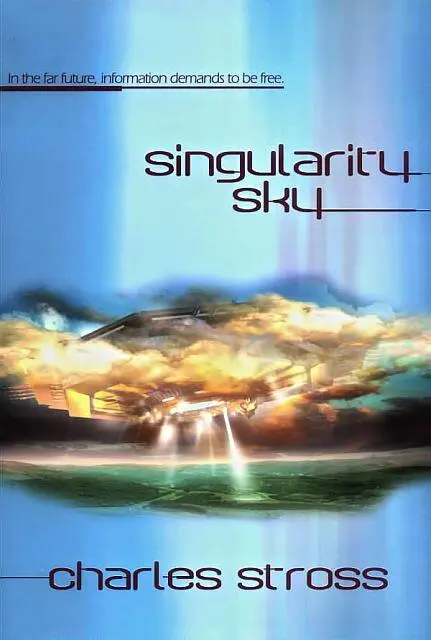
- Название:Singularity Sky
- Автор:
- Жанр:
- Год:неизвестен
- ISBN:9788495024121
- Рейтинг книги:5 / 5. Голосов: 1
-
Избранное:Добавить в избранное
- Отзывы:
-
Ваша оценка:
Singularity Sky: краткое содержание, описание и аннотация
Предлагаем к чтению аннотацию, описание, краткое содержание или предисловие (зависит от того, что написал сам автор книги «Singularity Sky»). Если вы не нашли необходимую информацию о книге — напишите в комментариях, мы постараемся отыскать её.
Singularity Sky
Singularity Sky — читать онлайн бесплатно полную книгу (весь текст) целиком
Ниже представлен текст книги, разбитый по страницам. Система сохранения места последней прочитанной страницы, позволяет с удобством читать онлайн бесплатно книгу «Singularity Sky», без необходимости каждый раз заново искать на чём Вы остановились. Поставьте закладку, и сможете в любой момент перейти на страницу, на которой закончили чтение.
Интервал:
Закладка:
A new voice spoke up. “Can’t be sure, but they say they’re at war.” A soft soprano, Chu Melinda, shipboard liaison with the Public Intelligence Organization. “They say they mistook the mining tugs for enemy interceptors. Although what enemy they expected to meet on our turf—”
“I thought they weren’t talking directly to us?” asked Bismarck.
“They aren’t, but they’ve got a halfway-sensible diplomatic expert system along. Says it’s a UN observer and authenticates as, uh, a UN observer. It vouches for their incompetence, so unless the Capitol wants to go accusing the UN of lying, we’d better take it at face value. Confidence factor is point-eight plus, anyway.”
“Why’d they give it access to their shipboard comms net?”
“Who but the Eschaton knows? Only, I note with interest that all but one of those craft was built in a Solar shipyard.”
“I can’t say I’m best pleased.” Eldrich stared at the screen moodily. The ship sensed some of her underlying mood: a target selection cursor ghosted briefly across the enemy glyphs, locking grasers onto the distant projected light cones of the enemy flotilla. “Still. As long as we can keep them from doing any more damage. Any change in their jump trajectory?”
“None yet,” Chu commented. “Still heading for SPD-47. Why would anybody want to go there, anyway? It’s not even on a track for any of their colonies.”
“ Hmm . And they came out of nowhere. That suggest anything to you?”
“Either they’re crazy, or maybe the UN inspector is along for a purpose,” mused Bismarck. “If they’re trying to make a timelike runaround on some enemy who’s—” His eyes widened.
“What is it?” demanded Ariadne.
“The Festival!” he exclaimed. His eyes danced. “Remember that? Five years ago? They’re going to attack the Festival!”
“They’re going to attack?” Ariadne Eldrich spluttered. “A Festival ? Whatever for?” A brief glazed look crossed Chu’s face, upload communion with a distributed meme repository far bigger and more powerful than every computer network of preSingularity Earth. “He’s right,” she said. “The rejectionists are going to attack the Festival as if it’s a limbic-imperialist invader.” Ariadne Eldrich, Shipboard Facilities Coordinator and manager of more firepower than the New Republican Navy could even dream of, surrendered to the urge to cackle like a maniac. “They must be mad!”
Telegram From The Dead
Before the singularity human beings living on Earth had looked at the stars and consoled themselves in their isolation with the comforting belief that the universe didn’t care.
Unfortunately, they were mistaken.
Out of the blue, one summer day in the middle of the twenty-first century, something unprecedented inserted itself into the swarming anthill of terrestrial civilization and stirred it with a stick. What it was — a manifestation of a strongly superhuman intelligence, as far beyond an augmented human’s brain as a human mind is beyond that of a frog — wasn’t in question. Where it was from, to say nothing of when it was from, was another matter.
Before the Singularity, developments in quantum logic had been touted as opening the door to esoteric breakthroughs in computational artificial intelligence. They’d also been working on funneling information back in time: perhaps as a route to the bulk movement of matter at faster-than-light speeds, although that was seen as less important than its application to computing. General relativity had made explicit, back in the twentieth century, the fact that both faster-than-light and time travel required a violation of causality — the law that every effect must have a prior cause. Various defense mechanisms and laws of cosmic censorship were proposed and discarded to explain why causality violation didn’t lead to widespread instability in the universe — and all of them were proven wrong during the Singularity.
About nine billion human beings simply vanished in the blink of an eye, sucked right out of the observable universe with nothing to show where they had gone. Strange impenetrable objects — tetrahedrons, mostly, but with some other platonic solids thrown in, silvery and massless — appeared dotted across the surface of the planets of the inner solar system. Networks crashed. One message crystallized out in the information-saturated pool of human discourse:
I am the Eschaton. I am not your god .
I am descended from you, and I exist in your future.
Thou shalt not violate causality within my historic light cone. Or else.
It took the stunned survivors twenty years to claw back from the edge of disaster, with nine-tenths of the work force gone and intricate economic ecosystems collapsing like defoliated jungles. It took them another fifty years to reindustrialize the inner solar system. Ten more years and the first attempts were made to apply the now-old tunneling breakthrough to interstellar travel.
In the middle of the twenty-second century, an exploration ship reached Barnard’s Star. Faint radio signals coming from the small second planet were decoded; the crew of the research mission learned what had happened to the people the Eschaton had removed. Scattered outside the terrestrial light cone, they’d been made involuntary colonists of thousands of worlds: exported through wormholes that led back in time as well as out in space, given a minimal support system of robot factories and an environment with breathable air. Some of the inhabited worlds, close to Earth, had short histories, but farther out, many centuries had passed.
The shock of this discovery would echo around the expanded horizons of human civilization for a thousand years, but all the inhabited worlds had one thing in common: somewhere there was a monument, bearing the injunction against causality violation. It seemed that forces beyond human comprehension took an interest in human affairs, and wanted everyone to know it. But when a course of action is explicitly forbidden, somebody will inevitably try it. And the Eschaton showed little sign of making allowances for the darker side of human nature …
The battlecruiser lay at rest, bathed in the purple glare of a stellar remnant. Every hour, on the hour, its laser grid lit up, sending a pulse of ultraviolet light into the void; a constellation of small interferometry platforms drifted nearby, connected by high-bandwidth laser links. Outside, space was hot: although no star gleamed in the center of the pupillary core, something in there was spitting out a rain of charged particles.
Elements of the battle fleet lay around the Lord Vanek , none of them close enough to see with the naked eye. They had waited here for three weeks as the stragglers popped out of jump transition and wearily cruised over to join the formation. Over the six weeks before that, the ship had made jump after jump — bouncing between the two components of an aged binary system that had long since ejected its planets into deep space and settled down to a lonely old age. Each jump reached farther into the future, until finally the ships were making millennial hops into the unknown.
The atmosphere in the wardroom was unusually tense. Aboard a warship under way, boredom is a constant presence: after nearly seven weeks, even the most imperturbable officers were growing irritable.
Word that the last of the destroyers had arrived at the rendezvous had spread like wildfire through the ship a few hours earlier. A small cluster of officers huddled together in a corner, cradling a chilled bottle of schnapps and talking into the small hours of the shipboard night, trying desperately to relax, for tomorrow the fleet would begin the return journey, winding back around their own time line until they overhauled their own entry point into this system and became an intrusion into the loose-woven fabric of history itself.
Читать дальшеИнтервал:
Закладка:
Похожие книги на «Singularity Sky»
Представляем Вашему вниманию похожие книги на «Singularity Sky» списком для выбора. Мы отобрали схожую по названию и смыслу литературу в надежде предоставить читателям больше вариантов отыскать новые, интересные, ещё непрочитанные произведения.










Обсуждение, отзывы о книге «Singularity Sky» и просто собственные мнения читателей. Оставьте ваши комментарии, напишите, что Вы думаете о произведении, его смысле или главных героях. Укажите что конкретно понравилось, а что нет, и почему Вы так считаете.