Charles Stross - Singularity Sky
Здесь есть возможность читать онлайн «Charles Stross - Singularity Sky» весь текст электронной книги совершенно бесплатно (целиком полную версию без сокращений). В некоторых случаях можно слушать аудио, скачать через торрент в формате fb2 и присутствует краткое содержание. ISBN: , Жанр: Фантастика и фэнтези, на английском языке. Описание произведения, (предисловие) а так же отзывы посетителей доступны на портале библиотеки ЛибКат.
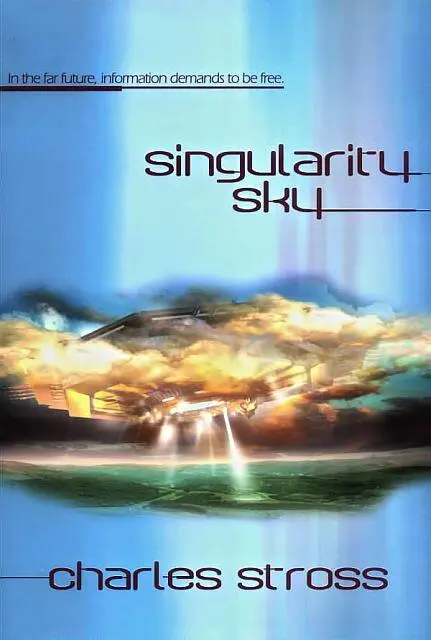
- Название:Singularity Sky
- Автор:
- Жанр:
- Год:неизвестен
- ISBN:9788495024121
- Рейтинг книги:5 / 5. Голосов: 1
-
Избранное:Добавить в избранное
- Отзывы:
-
Ваша оценка:
Singularity Sky: краткое содержание, описание и аннотация
Предлагаем к чтению аннотацию, описание, краткое содержание или предисловие (зависит от того, что написал сам автор книги «Singularity Sky»). Если вы не нашли необходимую информацию о книге — напишите в комментариях, мы постараемся отыскать её.
Singularity Sky
Singularity Sky — читать онлайн бесплатно полную книгу (весь текст) целиком
Ниже представлен текст книги, разбитый по страницам. Система сохранения места последней прочитанной страницы, позволяет с удобством читать онлайн бесплатно книгу «Singularity Sky», без необходимости каждый раз заново искать на чём Вы остановились. Поставьте закладку, и сможете в любой момент перейти на страницу, на которой закончили чтение.
Интервал:
Закладка:
At least, that was what theory dictated. Get there implausibly fast, with more firepower than any attacker could possibly expect, and with advance warning of the attacker’s order of battle and defensive intentions. What could go wrong?
The operations room was a hive of concentration as the gold team officers — the crew shift who would be on duty at the time of the forthcoming first jump, the one that would take the fleet into the future, as well as out into deep space — ran through their set-up checklists.
Captain Mirsky stood at the rear of the room, next to the heavy airtight door, watching his officers at their posts: a running display of telemetry from the ship’s battle management systems ran up the main wall-screen. The atmosphere was tense enough to cut with a knife. It was the first time any warship of the New Republic had engaged a high-technology foe; and no one, to the best knowledge of Commodore Bauer’s staff, had ever tried to pull off this tactical procedure before. Anything could be waiting for them.
Five years into the future was as far as they dared probe in one jump; in theory, there should be a navigation beacon awaiting them, but if something went awry, the enemy might be there instead. Mirsky smiled thinly. All the more reason to get it right , he reasoned. If we mess it up, there won’t be a second time .
The military attache from Earth had invited herself in to rubberneck at the proceedings and presumably report back to her masters in due course. Not that it made any difference at this point, but it annoyed Mirsky’s sense of order to have a tourist along, let alone one whose loyalty was questionable. He resolved to ignore her — or, if that became impossible, to eject her immediately.
“First breakpoint in five-zero seconds,” called the flight engineer. “Slaved to preferential-frame compensation buffers. Range to jump initiation point, six-zero seconds.” More jargon followed, in a clipped, tense voice; the routine stockin-trade of a warship, every phrase was defined by some procedural manual.
Gunnery one: “Acknowledged. Standing by to power up laser grid.” A mass of lasers — more than a million tiny cells scattered across the skin of the ship, able to operate as a single phased array — cycled through their power-up routines and reported their status. The ship was nearing the jump point; as it did so, it sucked energy out of the energized, unstable vacuum ahead of it and stored it by spinning up its drive kernel, the tiny, electrically charged black hole that nestled at the heart of the engine room containment sphere.
Engineering: “Main inertial propulsion holding at minus two seconds. Three-zero seconds to jump.” The ship drifted closer to the lightspeed transition point. The rippled space ahead of it began to flatten, bleeding energy into the underlying vacuum state. Six more huge warships followed behind at five-minute intervals; Squadron Two, the light screen of fast-movers who had set off behind the Lord Vanek , had overhauled them the day before and jumped through six hours ago.
Comms: “Telegram from the flag deck, sir.”
“Read it,” called Mirsky.
‘Telegram from Admiral Kurtz, open, all ears. Begins: Assume enemy warships ahead, break. Initiate fire on contact with hostiles, break. For the glory of the empire. Ends. Sent via causal channel to all sister ships.“ The causal channels between the ships would die, their contents hopelessly scrambled, as soon as the ships made their first jump between equipotential points: quantum entanglement was a fragile phenomenon and couldn’t survive faster-than-light transitions.
Mirsky nodded. “Acknowledge it. Exec, bring us battle stations.” Alarms began to honk mournfully throughout the ship.
“Reference frame trap executed.” Relativistics. “Jump field engaged. We have a white box in group B, repeat, white box in B.” A captive reference frame meant the ship had mapped the precise space-time location of its origin perfectly. Using the newly installed drive controllers, the Lord Vanek could return to that point in time from some future location, flying a closed timelike loop.
Mirsky cleared his throat. “Jump at your convenience.”
No lights dimmed, there was no sense of motion, and virtually nothing happened — except for a burst of exotic particles injected into the ergosphere of the quantum black hole in the ship’s drive module.
Nevertheless, without any fuss, the star patterns outside the ship’s hull changed.
“Jump confirmed.” Almost everybody breathed a slight sight of relief.
“Survey, let’s see where we are.” Mirsky showed no sign of stress, even though his ship had just jumped five years into its own future, as well as a parsec and a half out into the unknown.
“Yes, sir: laser grid coming up.” About two gigawatts of power — enough to run a large city — surged into the laser cells in the ship’s skin: if there was one thing a starship like the Lord Vanek had, it was electricity to burn. The ship lit up like a pulsar, pumping out a blast of coherent ultraviolet light powerful enough to fry anyone within a dozen kilometers. It stabilized, scanning rapidly in a tight beam, quartering the space ahead of the ship. After a minute it shut down again.
Radar: “No obstructions. We’re well clear.” Which was to be expected. Out here, fifteen to fifty astronomical units away from the primary, you could travel for 100 million kilometers in any direction without meeting anything much larger than a snowball. The intense UV lidar pulse would propagate for minutes, then hours, before returning the faint trace of a skin signature.
“Very good. Conn, take us forward. One gee, total delta of one-zero k.p.s.” Mirsky stood back and waited as the helm officer punched in the maneuver. Ten k.p.s. wasn’t much speed, but it would take the Lord Vanek comfortably away from its point of emergence without emitting too much drive noise, leaving room for the rest of the flotilla behind them. A lidar pulse in the depths of the halo could only signify a warship on the prowl, and it would be extremely unhealthy to stay too close to its point of origin.
In the Oort cloud of an industrialized system, even the snowballs could bite.
“Ping at nine-two-six-four!” crowed Radar Two. “Range four-point-nine M-klicks, bearing one by seven-five by three-three-two. Lots of hot one-point-four MeV gammas — they’re cooking on antimatter!”
“Acceleration?” asked Mirsky.
‘Tracking … one-point-three gees, confirmed. No change. Uh, wait—“
“Comms bulletin from the Kamchatka , sir.”
“Comms, call it.”
“Message reads, quote, under attack by enemy missile layers break. Situation serious break. Where are the BBs, break. All units please respond, ends.”
Mirsky blinked. Enemy warships? This soon ? Wolf Depository was right on the New Republic’s doorstep, a mining system owned and exploited by the rich, heavily industrialized Septagon Central.
What on earth were they doing allowing alien warships—
“Second burst at nine-two-six-four,” called Radar One. “Same emission profile. Looks like we scared up a swarm!”
“Wait,” grated Mirsky. He shook himself, visibly surprised by the news. “Wait, dammit! I want to see what else is out there. Comms, do not, under any circumstances, respond to signals from the Kamchatka , or anybody who came through ahead of us without clearing it with me first. If there are enemy ships out here, we’ve got no way of knowing whether our signals have been compromised.”
“Aye aye, sir. Signal silence on all screening elements.”
“Now.” He bent his head, pondering the screen ahead. “If it is an ambush …” The gamma-ray traces lit up on the main screen, labeled icons indicating their position and vector relative to the system ahead. One-point-three gees wasn’t particularly fast, but it was enough to send cold shudders up Mirsky’s spine: it meant serious high-delta-vee propulsion systems, fusion or antimatter or quantum gravity induction, not the feeble ion drive of a robot tug. That could mean a number of things: sublight relativistic bombers, missile buses, intrasystem interceptors, whatever. The Lord Vanek would have to skim past them to get to the next jump zone. Which could give them a passing shot at over 1000 k.p.s … a speed at which it took very little, maybe a sand grain, to total a ship. If it was an ambush, it had probably nailed the entire task force cold.
Читать дальшеИнтервал:
Закладка:
Похожие книги на «Singularity Sky»
Представляем Вашему вниманию похожие книги на «Singularity Sky» списком для выбора. Мы отобрали схожую по названию и смыслу литературу в надежде предоставить читателям больше вариантов отыскать новые, интересные, ещё непрочитанные произведения.








Обсуждение, отзывы о книге «Singularity Sky» и просто собственные мнения читателей. Оставьте ваши комментарии, напишите, что Вы думаете о произведении, его смысле или главных героях. Укажите что конкретно понравилось, а что нет, и почему Вы так считаете.