David Brin - Existence
Здесь есть возможность читать онлайн «David Brin - Existence» весь текст электронной книги совершенно бесплатно (целиком полную версию без сокращений). В некоторых случаях можно слушать аудио, скачать через торрент в формате fb2 и присутствует краткое содержание. Жанр: Фантастика и фэнтези, на английском языке. Описание произведения, (предисловие) а так же отзывы посетителей доступны на портале библиотеки ЛибКат.
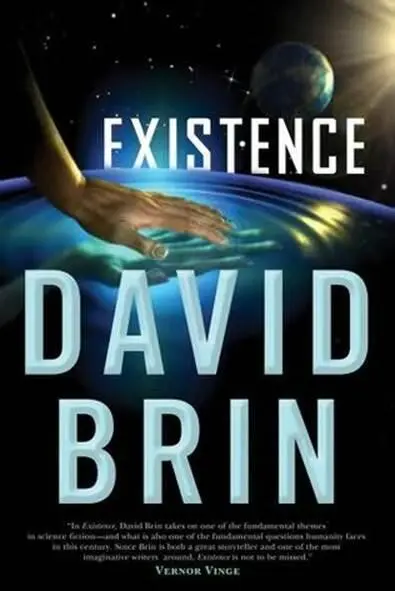
- Название:Existence
- Автор:
- Жанр:
- Год:неизвестен
- ISBN:нет данных
- Рейтинг книги:4 / 5. Голосов: 1
-
Избранное:Добавить в избранное
- Отзывы:
-
Ваша оценка:
Existence: краткое содержание, описание и аннотация
Предлагаем к чтению аннотацию, описание, краткое содержание или предисловие (зависит от того, что написал сам автор книги «Existence»). Если вы не нашли необходимую информацию о книге — напишите в комментариях, мы постараемся отыскать её.
Astronaut Gerald Livingstone grabs a crystal lump of floating space debris. Little does he suspect it's an alien artifact, sent across the vast, interstellar gulf, bearing a message.
"Join us!" – it proclaims. What does the enticing invitation mean? To enroll in a great federation of free races?
Only then, what of rumors that this starry messenger may not be the first? Have other crystals fallen from the sky, across 9,000 years? Some have offered welcome. Others… a warning!
This masterwork of science fiction combines hard-science speculation and fast-paced action with the deeply thoughtful ideas and haunting imagery that David Brin (best-selling author of Earth and The Postman) is known for in more than twenty languages.
Existence — читать онлайн бесплатно полную книгу (весь текст) целиком
Ниже представлен текст книги, разбитый по страницам. Система сохранения места последней прочитанной страницы, позволяет с удобством читать онлайн бесплатно книгу «Existence», без необходимости каждый раз заново искать на чём Вы остановились. Поставьте закладку, и сможете в любой момент перейти на страницу, на которой закончили чтение.
Интервал:
Закладка:
Once, a few days ago, he had heard one of the dolphins voice a similar thought in their simple but expressive click-language, as far as he could dimly interpret.
# If you’re good at diving-chase fish!
# If you have a fine voice-sing!
# If you’re great at leaping-bite the sun!
Hacker knew he should clamber up the nearby beach now, to borrow a phone and call people-his partners and brokers, mother and brother, friends and lovers.
Tell them he was alive.
Get back to business.
Instead, he swiveled in the water and kicked hard at a downward slant, following his new friends to the habitat dome.
Maybe I’ll learn what’s been done to them, he thought.
And why.
Why haven’t we overpopulated the planet?
That may seem an odd question, while refugee riots wrack overcrowded cities that incubate new diseases weekly. Forests topple for desperate farmland, even as drought bakes former farms into desert. Starvation lurks beyond each year’s harvest and human waste is now the world economy’s biggest product by sheer mass. One can understand why some view nine billion humans as a curse, shredding and consuming Earth to the bone.
Yet, it could have been worse. A generation ago, scholars forecast we’d be past fourteen or fifteen billion by now and still climbing toward the limit prophesied by Malthus-a great die-off. It happens to every species that out breeds its habitat capacity.
Trouble is, any die-off won’t just dip our population to sustainable levels. Humans don’t go quietly. We tend to claw and drag others down with us. Out of blame, or for company. Given today’s varied tools of ready wrought destruction, any such event would affect everyone. So, aren’t we lucky that population growth rates are way down? With the total even tapering a bit? Maybe enough to squeak by? Sure, that means old folks will outnumber kids for a while. Well, no one promised survival would be free of consequences.
But how did it happen? Why did we escape (even barely) the Malthusian Trap? Some credit the fact that humans can separate the recreational and procreative aspects of sex.
Animals feel a compulsive drive to mate and exchange genes. Some scatter their offspring in great numbers. Others care intensively for just a few. But animals who finish this cycle and are healthy enough, routinely return to the driver of it all-sex-starting the process over again. Its power is rooted in one simple fact. Those who felt its urgency had more descendants.
This applied to us, too, of course, till technology gave us birth control.
Then suddenly, the sex compulsion could be satisfied without procreation, with amazing effects. Everywhere that women were empowered with both prosperity and rights, most of them chose to limit childbearing, to concentrate on raising a few privileged offspring instead of brooding at max capacity. We became a non-Malthusian species, able to limit our population by choice, in the nick of time.
Too bad it can’t last. Today, some humans do overbreed. These tend not to be the rich, or those with enough food or who have sex a lot. They are having lots of kids because they choose to. And so, whatever inner drives provoked that choice get passed down to more offspring, then more. Over time, this extra-strong desire will appear in rising portions of the population.
It’s evolution in action. As time passes, the locus of compulsion will shift from sex to a genetically-driven, iron willed determination to have more kids…
… and then we’ll be a Malthusian species again-like the “motie” beings in that novel The Mote in God’s Eye, unable to stop. Unable to say “enough.” A fate that may commonly entrap a great many other species, across the cosmos.
Before that happens to us, we had better finish the job of growing up.
– from The Movement Revealed, by Thormace Anubis-Fejel
33.
As he changed into formal dinner clothes in the luxurious guest bedroom, one furnishing caught the attention of Hamish Brookeman-a modernized, antique chamber pot.
Not the Second Empire armoire, or the Sforzese chest of drawers, nor even the Raj era rug from Baluchistan. (He needed a Mesh-consult to identify that one, with Wriggles whispering a description in his ear.) Hamish had an eye for detail-he needed one, while moving in circles like these. The mega wealthy had grown judgmental, of late. They expected you to know about such things, to better understand your place.
Hamish was a rich man, ranking five percentile nines-enough to classify him as a member of the First Estate, if he weren’t already a legend in the arts. Nevertheless, there was nothing in this room that he could afford. Not one blessed thing.
And I’m far from the most important guest who has come to this gathering in the Alps. I can only imagine what kind of digs they’re giving Tenskwatawa and his aides, or the aristocrats flying in from Shanghai and Yangon, Moscow and Mumbai.
Of course, Hamish had another reason for scanning, hungrily, everything in sight. Always at the back of his mind was the question: Can I use this in a novel?
Even when storytelling ceased to be what it had been for three centuries, an author’s hermetic craft, transforming into a hybrid, multimedia team effort, with eye-clickable hyperlinks that required a whole staff to provide… even so, he still had the solitary habit of mind, envisioning the narrative in paragraphs, punctuation and all.
That Heian era tea table would be worth a three-sentence aside, revealing something about the character of the one who owns it.
Or-
I could go on for a couple of pages about this Bohemian Renaissance four-poster bed, with snakes twisting insidiously, perhaps voluptuously, or else biblically, among the deeply carved curly vines. Maybe even write it into the plot as a haunted soul-reliquary… or high-tech life-extension device… or a disguised scanner, meant to read the minds of houseguests while they sleep.
Each of the scenarios was about Science Gone Terribly Wrong in Unforeseen Ways, of course. There were always far more potential stories about the penalties of human technological hubris than even he could put down.
But no, the particular item he found squatting by the foot of the damask coverlet was especially interesting. Decorated in Georgian style, the chamber pot was either an excellent reproduction (unlikely in this mansion) or else the genuine eighteenth century article-a late Whieldon or an early Josiah Wedgwood design. And yet, evidently, it was also meant to be in service-the modern, hermetically sealed lid made that plain, along with a soft green night-light, designed to prevent fumbling in the dark. No doubt, when he opened the pot for use, he would also find another light within, to improve nocturnal aim.
Can’t have guests pissing on the rug, Hamish mused. A functional combination of old and new. And also-just as explicitly-not to be sat on. Not for women, then, or for defecation. Men only. And just old Number One. Any modern person would understand the narrow purpose-for collecting the contemporary equivalent of gold.
But why here, by the bed? Why not simply walk to the loo?
Just fifteen steps took him through an ornate doorway to the elaborately tiled private bath, with heated floor and seven nozzle shower, where nanofiber towels awaited their chance to massage his pores while wicking moisture and applying expensive lotion, all at the same time. The facilities were sumptuous and up-to-date, except…
Well I’ll be hog-tied. There’s no phos-urinal.
Читать дальшеИнтервал:
Закладка:
Похожие книги на «Existence»
Представляем Вашему вниманию похожие книги на «Existence» списком для выбора. Мы отобрали схожую по названию и смыслу литературу в надежде предоставить читателям больше вариантов отыскать новые, интересные, ещё непрочитанные произведения.


Обсуждение, отзывы о книге «Existence» и просто собственные мнения читателей. Оставьте ваши комментарии, напишите, что Вы думаете о произведении, его смысле или главных героях. Укажите что конкретно понравилось, а что нет, и почему Вы так считаете.