David Brin - Existence
Здесь есть возможность читать онлайн «David Brin - Existence» весь текст электронной книги совершенно бесплатно (целиком полную версию без сокращений). В некоторых случаях можно слушать аудио, скачать через торрент в формате fb2 и присутствует краткое содержание. Жанр: Фантастика и фэнтези, на английском языке. Описание произведения, (предисловие) а так же отзывы посетителей доступны на портале библиотеки ЛибКат.
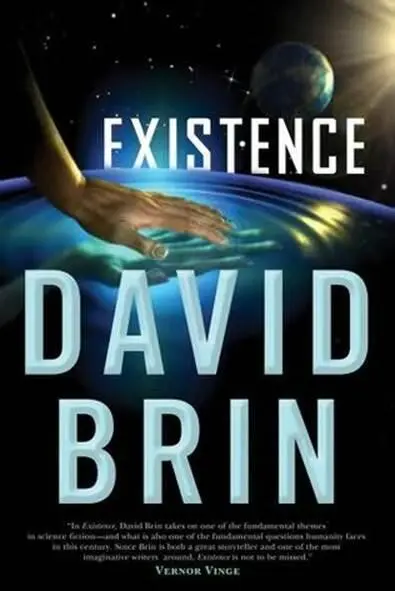
- Название:Existence
- Автор:
- Жанр:
- Год:неизвестен
- ISBN:нет данных
- Рейтинг книги:4 / 5. Голосов: 1
-
Избранное:Добавить в избранное
- Отзывы:
-
Ваша оценка:
Existence: краткое содержание, описание и аннотация
Предлагаем к чтению аннотацию, описание, краткое содержание или предисловие (зависит от того, что написал сам автор книги «Existence»). Если вы не нашли необходимую информацию о книге — напишите в комментариях, мы постараемся отыскать её.
Astronaut Gerald Livingstone grabs a crystal lump of floating space debris. Little does he suspect it's an alien artifact, sent across the vast, interstellar gulf, bearing a message.
"Join us!" – it proclaims. What does the enticing invitation mean? To enroll in a great federation of free races?
Only then, what of rumors that this starry messenger may not be the first? Have other crystals fallen from the sky, across 9,000 years? Some have offered welcome. Others… a warning!
This masterwork of science fiction combines hard-science speculation and fast-paced action with the deeply thoughtful ideas and haunting imagery that David Brin (best-selling author of Earth and The Postman) is known for in more than twenty languages.
Existence — читать онлайн бесплатно полную книгу (весь текст) целиком
Ниже представлен текст книги, разбитый по страницам. Система сохранения места последней прочитанной страницы, позволяет с удобством читать онлайн бесплатно книгу «Existence», без необходимости каждый раз заново искать на чём Вы остановились. Поставьте закладку, и сможете в любой момент перейти на страницу, на которой закончили чтение.
Интервал:
Закладка:
Gloria spilled all of that so rapidly Lacey had trouble keeping up, grasping at the meaning, until it was repeated several times.
“Mark is on the scene right now. He asked me to pass on the good news, and promises that he will call you personally within the hour.”
Lacey, nodded, trying hard to see this as good news. She swallowed a few times before subvocalizing a question.
“So, what happens next?”
“The search will continue, madam. Please understand, the location is quite some distance away from his expected landing point, which is why things took so long. Also, we had been counting on finding radar and sonar reflections from the shell. Now it’s clear why that didn’t happen.
“But we’re dialed in at last! He can have only gone a few dozen kilometers, max, swimming under his own power or drifting with the local currents. So we’ll just draw in all our resources to that small patch of sea. There should be results almost any time now.”
It took a great effort to speak at all, let alone maintain a lifetime habit of civility.
“Thank you, Gloria. Please thank ever… everyone.”
It was no use. There were no further words. She pinched the earring to end the call, then pinched again, as it tried to hurriedly report on waiting messages from important people-like the head of the Naderite coalition and the director of her Chilean planet-hunter observatory, and…
No. Prioritize. First sign Ortega’s petition, so the honor-driven but pesty little man would go away… then focus… focus on some important matter, such as the report from her spy in the Alps. Or else immerse yourself in the brilliantly entertaining blather being spewed by your hired genius. Profnoo would appreciate a little attention.
One thing Lacey would not do was dwell overmuch on the news. On hope.
Anyway, what lurked in her mind below the surface was something beyond hope. Perhaps even insultingly so. She could not shake an intense feeling-perhaps rising out of wishful thinking, or even hysterical denial-that Hacker was not only alive, but safe somehow.
Perhaps even having fun.
Wouldn’t that be just like him?
The suspicion had some basis in experience.
He would always get in touch with me whenever there was trouble. On the other hand, Hacker generally ignored his mother when things were interesting or going well, neglecting to call if he was having the time of his life.
Suppose we manage to avoid the worst calamities. The world-wreckers, extinction-makers, and civilization-destroyers. And let’s say no black holes gobble the Earth. No big wars pound us back to the dark ages. Eco-collapse is averted and the economic system is kept alive.
Let’s further imagine that we’re not alone in achieving this miraculous endurance. That many other intelligent life forms also manage to escape the worst pitfalls and survive their awkward adolescence. Well, there are still plenty of ways that some promising sapient species might rise up, looking skyward with high hopes, and yet-even so-fail to achieve its potential. What traps might await us because we are smart?
Take one of the earliest and greatest human innovations- specialization . Even way back when we lived in caves and huts, there was division of effort. Top hunters hunted, expert gatherers gathered, and skilled technicians spent long hours by the riverbank, fashioning intricate baskets and stone blades. When farming created a surplus that could be stored, markets arose, along with kings and priests, who allocated extra food to subsidize carpenters and masons, scribes and calendar-keeping astronomers. Of course, the priests and kings kept the best share. Isn’t administration also a specialty? And so, a few soon dominated many, across 99 percent of history.
Eventually though, skill and knowledge spread, increasing that precious surplus, letting more people read, write, invent… which created more wealth, allowing more specialization and so on, until only a few remained on the land, and those farmers were mostly well-educated specialists, too.
In the West, one trend spanned the whole twentieth century: a steady professionalization of everything . By the end of the millennium, almost everything a husband and wife used to do for their family had been packaged as a product or service, provided by either the market or the state. And in return? A pilot had merely to pilot and a firefighter just fought fires. The professor simply professed and a dentist had only to dent. Benefits abounded. Productivity skyrocketed. Cheap goods flowed across the globe. Middle-class citizens ate strawberries in winter, flown from the other hemisphere. Science burgeoned, as the amount that people knew expanded even faster than the pile of things they owned.
And that is where-to some of us-things started to look worrisome.
Let me take you back quite a ways, to the other end of a long lifetime, before the explosive expansion of cybernetics, before the Mesh and Web and Net, all the way back to the 1970s, when I first studied at Caltech. Often, late at night, my classmates and I pondered the dour logic of specialization. After reaping the benefits for many generations, it seemed clear that a crisis loomed.
You see, science kept making discoveries at an accelerating clip. Already, a researcher had to keep learning ever-increasing amounts, in order to discover more. It seemed that just keeping up would force each of us to focus on ever narrower fields of study, forsaking the forest in order to zero in on tiny portions of a single tree. Eventually, new generations of students might spend half a lifetime learning enough to start a thesis. And even then, how to tell if someone else was duplicating your effort, across the world or down the hall?
That prospect-having to know more and more about less and less-seemed daunting. Unavoidable. There seemed to be no way out…
… until, almost overnight, we veered in a new direction! Our civ evaded that crisis with a technological side step that seemed so obvious, so easy and graceful that few even noticed or commented. There were so many exciting aspects to the Internet Age, after all. The old fear of narrow overspecialization suddenly seemed quaint, as biologists started collaborating with physicists and cross-disciplinary partnerships abounded. Instead of being vexed by overspecialized terminology, experts conversed excitedly, more than ever!
Today, hardly anybody speaks of the danger that fretted us so. It’s been replaced by the opposite concern -one that we’ll get to next time.
Only first consider this.
Sure, we may have escaped the specialization trap, for now, but will everyone else manage the same trick, out there across the stars? Our solution now seems obvious-to surf the tsunami! To meet the flood of knowledge with eager, eclectic agility. Refusing to be constrained by official classifications, we let knowledge bounce and jostle into new forms, supplementing professional skill with tides of zealous amateurism.
But don’t take it for granted! The approach may not be repeated elsewhere. Not if it emerged out of some rare quality of our smartmonkey natures. Or pure luck.
Nor would it have been allowed in most human cultures! Which of our past military or commercial or hereditary empires would have unleashed something as powerful as the Internet, letting it spread-unfettered and free-to every tower and hovel? Or allow so many skilled tasks to be performed by the unlicensed?
One can imagine countless other species-and our own fragile renaissance-faltering back into the dour scenario that we students mulled, those gloomy nights. Slipping into an endless, grinding cycle, where specialization-once a friend-becomes the worst enemy of wisdom.
Читать дальшеИнтервал:
Закладка:
Похожие книги на «Existence»
Представляем Вашему вниманию похожие книги на «Existence» списком для выбора. Мы отобрали схожую по названию и смыслу литературу в надежде предоставить читателям больше вариантов отыскать новые, интересные, ещё непрочитанные произведения.

Обсуждение, отзывы о книге «Existence» и просто собственные мнения читателей. Оставьте ваши комментарии, напишите, что Вы думаете о произведении, его смысле или главных героях. Укажите что конкретно понравилось, а что нет, и почему Вы так считаете.