David Brin - Existence
Здесь есть возможность читать онлайн «David Brin - Existence» весь текст электронной книги совершенно бесплатно (целиком полную версию без сокращений). В некоторых случаях можно слушать аудио, скачать через торрент в формате fb2 и присутствует краткое содержание. Жанр: Фантастика и фэнтези, на английском языке. Описание произведения, (предисловие) а так же отзывы посетителей доступны на портале библиотеки ЛибКат.
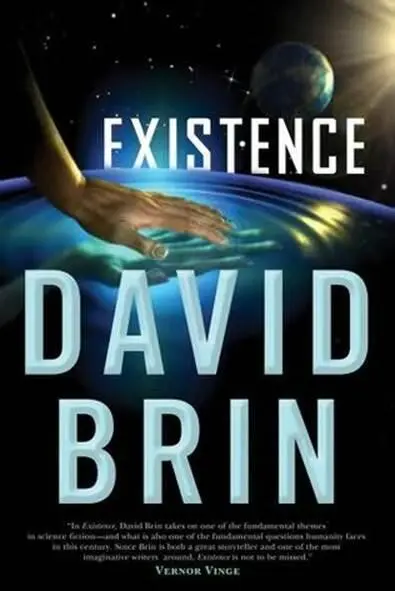
- Название:Existence
- Автор:
- Жанр:
- Год:неизвестен
- ISBN:нет данных
- Рейтинг книги:4 / 5. Голосов: 1
-
Избранное:Добавить в избранное
- Отзывы:
-
Ваша оценка:
Existence: краткое содержание, описание и аннотация
Предлагаем к чтению аннотацию, описание, краткое содержание или предисловие (зависит от того, что написал сам автор книги «Existence»). Если вы не нашли необходимую информацию о книге — напишите в комментариях, мы постараемся отыскать её.
Astronaut Gerald Livingstone grabs a crystal lump of floating space debris. Little does he suspect it's an alien artifact, sent across the vast, interstellar gulf, bearing a message.
"Join us!" – it proclaims. What does the enticing invitation mean? To enroll in a great federation of free races?
Only then, what of rumors that this starry messenger may not be the first? Have other crystals fallen from the sky, across 9,000 years? Some have offered welcome. Others… a warning!
This masterwork of science fiction combines hard-science speculation and fast-paced action with the deeply thoughtful ideas and haunting imagery that David Brin (best-selling author of Earth and The Postman) is known for in more than twenty languages.
Existence — читать онлайн бесплатно полную книгу (весь текст) целиком
Ниже представлен текст книги, разбитый по страницам. Система сохранения места последней прочитанной страницы, позволяет с удобством читать онлайн бесплатно книгу «Existence», без необходимости каждый раз заново искать на чём Вы остановились. Поставьте закладку, и сможете в любой момент перейти на страницу, на которой закончили чтение.
Интервал:
Закладка:
Not trivial! After his urinal-epiphany, Hamish had a new appreciation of how delicate it might be. These oligarchs wouldn’t trust populist agitators, even with shared goals. They’d demand assurances, a measure of control…
… and yet, of course, Tenskwatawa was the smartest person Hamish had ever met, so what was there to worry about?
“Why don’t you see if Dr. Betsby can be brought aboard somehow?” Tenskwatawa was so tall that he almost met Hamish eye to eye. “Our passionate young physician must have some want or need that would supersede his current agenda. Money? Help for a cause? Perhaps a taste of jail time, on some lesser charge, would create incentive for him to be reasonable.
“Still,” the Prophet added. “If Betsby won’t budge, do try to see if the senator can be saved.”
“Whatever it takes, sir?”
The Prophet raised an eyebrow, paused, and then shook his head.
“No. Strong isn’t that important. Not anymore. Not with the world in turmoil over this damned Alien Artifact doohickey.
“Anyway, remember Hamish, we’re not pushing to become tyrants. Dirty tricks and Stazi tactics need to be kept to a minimum. Our movement aims only to put a harness on science and technology, instead of leaving them in charge of human destiny. We use populism and mob-mobilization methods, but in order to calm and tame the masses, and thus save the world, so that a better democracy can return later on.”
“Hmm.” Hamish pondered, glancing at their surroundings “Our new allies may not agree with the very last part of that.”
In truth, Hamish wasn’t sure that he did. Plato despised democracy and wasn’t he the wisest philosopher of all?
“I know.” Tenskwatawa briefly squeezed Hamish’s arm above the elbow, conveying a sense of power, jovially restrained, but coiled and always ready, like some force of physics. “The aristos think they can use us… and they do have both history and human nature on their side of the ledger. Perhaps they’ll succeed! We may wind up like so many other populist movements across time-tricked into aiding the rise of oligarchy.
“On the other hand, we have a few new things on our side of the scale.” The Prophet smiled, conveying confidence that shone like the sun.
“Such as Truth.”
Last time, we talked about one more way that civilizations might fail to achieve their dreams-not because of calamity, or war, or ecological collapse, but something mundane, even banal.
Overspecialization. Failure to keep climbing the near-vertical mountain of their accumulated learning. Pondered logically, it seems unavoidable. The greater your pile of information, the steeper the chore of discovering more! Concentrating on a narrower subject will only work up to a point, because even if you live long enough to master your cramped field, you’ll never know how much of your work is being duplicated, wastefully, across the world or down the hall, by people using a slightly different vocabulary for the same problem. Humanity’s greatest trick for making progress-subsidizing ever larger numbers of specialist-professionals-seemed destined to become a trap.
Indeed, this failure mode may trip up countless civilizations out there, across the galaxy.
But not us. Not on twenty-first century Earth. That danger was overcome, at least for now, by stunning achievements in human mental agility. By Internet connections and search-correlation services that sift the vast sea of knowledge faster than thought. By quest-programs that present you with anything germane to your current interest. By analytic tools that weigh any two concepts for mutual relevance. And above all, by our new ability to flit-like gods of legend-all over the e-linked globe, meeting others, ignoring guild boundaries and sharing ideas.
The printing press multiplied what average humans could know, while glass lenses magnified what we could see-and every century since expanded that range, till the Multitasking Generation can zip hither and yon, touching lightly upon almost any fact, concept or work of art, exchanging blips, nods, twits, and pips with anyone alive… and some entities that aren’t.
Ah, but therein lies the rub. “Touching lightly.”
Much has been written about the problems that accompany Continuously Divided Attention. Loss of focus. A susceptibility for simplistic/viral notions. An anchorless tendency to drift or lose concentration. And these are just the mildest symptoms. At the extreme are dozens of newly named mental illnesses, like Noakes’s Syndrome and Leninger’s Disease, many of them blamed on the vast freedom we have won-to skitter our minds across any topic with utter abandon.
Have we evaded one dismal failure mode-the trap of narrow overspecialization -only to stumble into the opposite extreme? Broadly-spread shallow-mindedness? Pondering thoughts that span the farthest horizons, but only finger-deep?
Listen to those dour curmudgeons out there, decrying the faults of our current “Age of Amateurs.” They call for a restoration of expertise, for a return to credentialed knowledge-tending, for restoring order and disciplined focus to our professions and arts and academe. Is this just self-interested guild-tending? Or are they prescribing another badly needed course correction, to stave off disaster?
Will the new AI systems help us deal with this plague of shallowness… or make it worse?
One thing is clear. It isn’t easy to be smart, in this galaxy of ours. We keep barely evading a myriad pitfalls along our way to… whatever we hope to become.
When you add it all up, are you really surprised that we seem so alone?
– Pandora’s Cornucopia
34.
Ocean stretched in every direction.
Peng Xiang Bin had come to think of himself as a man of the sea, who spent most of his time in water-amid the scummy, sandy tidal surges that swept up and down the Huangpu Estuary. He thought nothing of holding his breath while diving a dozen meters for crab, or prying salvage from the junk-strewn bottom, feeling more akin to the fish, or even drifting jellies, than to the landlubber he once had been. In a world of rising seas and drowning shorelines, it seemed a good way to adapt.
Only now he realized. I always counted on the nearness of dry land.
Ahead of him lay nothing but gray ocean, daunting and endless, flecked with wind-driven froth and merging imperceptibly with a faraway, turbid skyline. Except where he now stood, on a balcony projecting outward from a man-made island-a high-tech village on stilts-clinging to a reef that used to be a nation.
That was now a nation once again.
Looking carefully, he could follow the curve of breakers smashing over stumps that had once been buildings-homes and schools, shops and wharves. Here had been no massive seawalls. No effort to preserve doomed properties. All toppled under powerful typhoons long ago. Soon after most of the natives moved away, explosives finished off the messy remnants of Old Pulupau, a one-time tropical paradise. The new inhabitants didn’t want unpleasant remnants spoiling their view.
Of course there was a lot more hidden from the eye, just beyond the reef. A vista of underwater industry had been visible from the small submarine that brought Bin here three days ago. Wave machines for generating electricity and siphons that sucked bottom mud to spread into the currents, fertilizing plankton to enhance nearby fishing grounds and earn carbon credits at the same time. Pressing his face against the sub’s tiny window, Bin had stared at huge globes, shaped like gigantic soccer balls, bobbing against anchor-tethers-pens where schools of tuna spent their entire lives, fed and fattened for market. A real industrial and economic infrastructure… all of it kept below the surface, out of sight, in order not to perturb rich residents who lived above.
Читать дальшеИнтервал:
Закладка:
Похожие книги на «Existence»
Представляем Вашему вниманию похожие книги на «Existence» списком для выбора. Мы отобрали схожую по названию и смыслу литературу в надежде предоставить читателям больше вариантов отыскать новые, интересные, ещё непрочитанные произведения.



Обсуждение, отзывы о книге «Existence» и просто собственные мнения читателей. Оставьте ваши комментарии, напишите, что Вы думаете о произведении, его смысле или главных героях. Укажите что конкретно понравилось, а что нет, и почему Вы так считаете.