Walter Tevis - Mockingbird
Здесь есть возможность читать онлайн «Walter Tevis - Mockingbird» весь текст электронной книги совершенно бесплатно (целиком полную версию без сокращений). В некоторых случаях можно слушать аудио, скачать через торрент в формате fb2 и присутствует краткое содержание. Город: London, Год выпуска: 2007, ISBN: 2007, Издательство: Gollancz, Жанр: Фантастика и фэнтези, на английском языке. Описание произведения, (предисловие) а так же отзывы посетителей доступны на портале библиотеки ЛибКат.
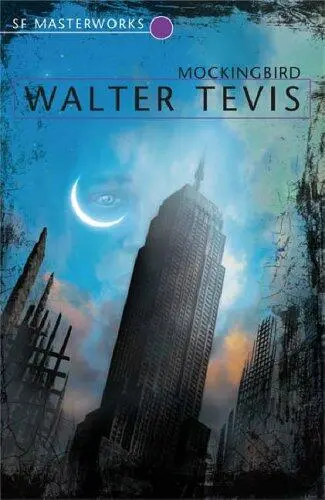
- Название:Mockingbird
- Автор:
- Издательство:Gollancz
- Жанр:
- Год:2007
- Город:London
- ISBN:978-0575079151
- Рейтинг книги:5 / 5. Голосов: 1
-
Избранное:Добавить в избранное
- Отзывы:
-
Ваша оценка:
Mockingbird: краткое содержание, описание и аннотация
Предлагаем к чтению аннотацию, описание, краткое содержание или предисловие (зависит от того, что написал сам автор книги «Mockingbird»). Если вы не нашли необходимую информацию о книге — напишите в комментариях, мы постараемся отыскать её.
Mockingbird
Review
From the Inside Flap “A moral tale that has elements of Aldous Huxley’s
,
, and
.”
—
“Set in a far future in which robots run a world with a small and declining human population, this novel could be considered an unofficial sequel to
, for its central event and symbol is the rediscovery of reading.”
—
“Because of its affirmation of such persistent human values as curiosity, courage, and compassion, along with its undeniable narrative power,
will become one of those books that coming generations will periodically rediscover with wonder and delight.”
—
“I’ve read other novels extrapolating the dangers of computerization but Mockingbird stings me, the writer, the hardest. The notion, the possibility, that people might indeed lose the ability, and worse, the desire to read, is made acutely probable.”
—
bestselling author ANNE MCCAFFREY “Walter Tevis is science fiction’s great neglected master, one of the definitive bridges between sf and literature. For those who know his work only through the movies, the lucid prose and literary vision of
and
will come as a revelation.”
—AL SARRANTONIO, Author of
saga
Mockingbird — читать онлайн бесплатно полную книгу (весь текст) целиком
Ниже представлен текст книги, разбитый по страницам. Система сохранения места последней прочитанной страницы, позволяет с удобством читать онлайн бесплатно книгу «Mockingbird», без необходимости каждый раз заново искать на чём Вы остановились. Поставьте закладку, и сможете в любой момент перейти на страницу, на которой закончили чтение.
Интервал:
Закладка:
Then Mary Lou came out of the House of Reptiles with her arms full. She shut the door smartly behind her with her elbow. She was dressed in the blue jeans and a white T-shirt and sandals and was carrying the baby expertly, cradled in one arm. Over the other arm were the rest of her new clothes and on top of them a pile of diapers. The clothes she was wearing fit her perfectly. Her hair was combed neatly and her face was radiant as she came toward me and the light from the fountain fell on it. The baby had stopped crying and just lay in her arms looking comfortable, pleased. Looking at them both I could hardly breathe for a moment.
Then I let my breath out and said softly, “I can make a baby bed out of one of the bus seats. And we can go away together.”
She looked up at me. “Do you want to leave New York?”
“I want to go to California,” I said. “I want to go as far from New York as we can go. I want to be away from robots, and drugs, and other people. I have my books and my music and you and Jane. That’s enough. I don’t want New York anymore.”
She looked at me a long time before she answered. Then she said, “All right.” She paused. “But there’s something I have to do…”
“For Spofforth?” I said.
Her eyes widened. “Yes,” she said. “It’s for Spofforth. He wants to die. I made a… a bargain with him. To help him.”
“To help him die?”
“Yes. It frightens me.”
I looked at her. “I’ll help you,” I said.
She looked at me, relieved. “I’ll get Jane’s things. I guess it is time to leave New York. Can this bus take us to California?”
“Yes. And I can find food. We’ll get there.”
She looked toward the bus, toward its sturdy, solid shape, and then back toward me. She seemed to study my face for a long time, carefully and with a hint of surprise. Then she said, “I love you, Paul. I really do.”
“I know,” I said. “Let’s get going.”
Spofforth
It looks, by itself, as it did in 1932—an essentially stupid, non-human building, its architecture concerned merely with height and with bravado. It has now, on the third of June, 2467, the same number of stories, one hundred two, that it had then; but now they are all empty even of the furniture of offices. It is one thousand two hundred fifty feet tall. Nearly a quarter mile. And there is no use for it now. It is only a marker, a mute testimony to the human ability to make things that are too big.
The context over which it stands has come to magnify it more than the New York of the twentieth century ever could. There are no other tall buildings in New York; it truly towers above Manhattan in singleness of form and intent in the way that it must have first sprung to the hopeful minds of its architects. New York is nearly a grave. The Empire State Building is its gravestone.
Spofforth stands as near to the edge of the platform as he can come. He is alone, waiting for Bentley and Mary Lou to finish the climb. He has carried Mary Lou’s baby for her, and he holds it now, sheltering it from the wind. The baby is asleep in his arms.
The sky will lighten soon on Spofforth’s right, over the East River and Brooklyn; but it is dark now. The lights of thought buses are visible below. They move slowly up and down Fifth and Third and Lexington and Madison and Broadway, and up further through Central Park. There is a light in a building at Fifty-first Street, but no lights at Tunes Square. Spofforth watches the lights, holds the baby protectively, and waits.
And then he hears the heavy door behind him open, and hears their footsteps. Almost immediately, Mary Lou’s voice, nearly out of breath, speaks. “The baby, Bob. I’ll take it back now.” The climb has taken them over three hours.
He turns and sees their shadows and holds the baby out. Mary Lou’s dark form takes it and she says, “Tell me when you’re ready, Bob. I’ll have to set the baby down.”
“We’ll wait until daylight,” he says. “I want to be able to see.”
The two human beings sit, and Spofforth, facing them now, sees a yellow flame flicker brightly in the wind as Bentley lights a cigarette. In sudden chiaroscuro he sees Mary Lou’s strong body hunched over her child’s, her hair blown sideways.
He stands there looking at what is now only her shadow again, with Paul Bentley’s shadow next to hers, touching: the old, old archetype of a human family, here atop this grotesque building over a numb and aimless city, a city of drugged sleep for its people and of an obscene mock-life for its robots, with its only brightness the small and pleasant minds of its buses, complacent and at ease, patrolling the empty streets. His robot mind can sense the telepathic thought bus buzz, but it does not affect his state of consciousness. Something is coming into his mind slowly, gently. His spirit is hushed, letting it come in. He turns and faces north.
And then from nowhere and darkness there is a fluttering in the wind, and a small dark presence settles on Spofforth’s motionless right forearm and becomes, in abruptly frozen silhouette, a bird. Perched on his arm, a sparrow, a city sparrow—tough and anxious and far too high. And it stays there with him, waiting for dawn.
And the dawn begins, low over Brooklyn, spreading to Upper Manhattan, over Harlem and White Plains and what was once Columbia University, a gray light over land where Indians had slept on filthy skins and where, later, white men had focused their fretful intensity of power and money and yearning, pushing up buildings in hubris, in mad cockiness, filling streets with taxis and anxious people and, finally, dying into drugs and inwardness. The dawn spreads and the sun appears, bulging up red over the East River. Then the sparrow flicks its head and flies away from Spofforth’s bare arm, holding its tiny life to itself.
And the thing that has been coming slowly into Spofforth’s mind now seizes it: joy. He is joyful as he had been joyful one hundred seventy years before, in Cleveland, when he had first experienced consciousness, gagging to life in a dying factory, when he had not yet known that he was alone in the world and would always be alone.
He feels the hard surface beneath his bare feet with pleasure, feels the strong wind on his face and the sure pumping of his heart, senses his youth and strength and loves them, for a moment, for themselves.
And aloud he says, “I’m ready now.” He does not look behind him.
He hears the baby squall as Mary Lou sets it down in the doorway. He feels hands on the small of his back.and knows they are hers. A moment later he feels larger hands above them. He hears breathing. His eyes are straight ahead, looking now toward the upper tip of Manhattan Island.
Then on his bare back he feels her hair and then, feeling his upper body beginning to topple forward, he feels her mouth pressed against his back, kissing him gently—feels her soft, warm woman’s breath. He throws his arms out wide. And falls.
And oh, continues to fall. Finally then, with his face serene, blown coldly by the furious upward wind, his chest naked and exposed, his powerful legs straight out, toes down, khaki trousers flapping above the backs of his legs, his metallic brain joyful in its rush toward what it has so long ached for, Robert Spofforth, mankind’s most beautiful toy, bellows into the Manhattan dawn and with mighty arms outspread takes Fifth Avenue into his shuddering embrace.
ABOUT THE AUTHOR
Tevis was born in San Francisco, California and grew up in the Sunset District, near the Pacific Ocean and Golden Gate Park. When he was ten years old, his parents placed him in the Stanford Children’s Convalescent home for a year while they returned to Kentucky, where the family had been given a grant of land in Madison County. At the age of 11, Tevis traveled across country alone on a train to rejoin his family.
Читать дальшеИнтервал:
Закладка:
Похожие книги на «Mockingbird»
Представляем Вашему вниманию похожие книги на «Mockingbird» списком для выбора. Мы отобрали схожую по названию и смыслу литературу в надежде предоставить читателям больше вариантов отыскать новые, интересные, ещё непрочитанные произведения.







Обсуждение, отзывы о книге «Mockingbird» и просто собственные мнения читателей. Оставьте ваши комментарии, напишите, что Вы думаете о произведении, его смысле или главных героях. Укажите что конкретно понравилось, а что нет, и почему Вы так считаете.