Sam Weller - Shadow Show
Здесь есть возможность читать онлайн «Sam Weller - Shadow Show» весь текст электронной книги совершенно бесплатно (целиком полную версию без сокращений). В некоторых случаях можно слушать аудио, скачать через торрент в формате fb2 и присутствует краткое содержание. Город: New York, Год выпуска: 2012, ISBN: 2012, Издательство: William Morrow, Жанр: Фантастика и фэнтези, Ужасы и Мистика, Фэнтези, на английском языке. Описание произведения, (предисловие) а так же отзывы посетителей доступны на портале библиотеки ЛибКат.
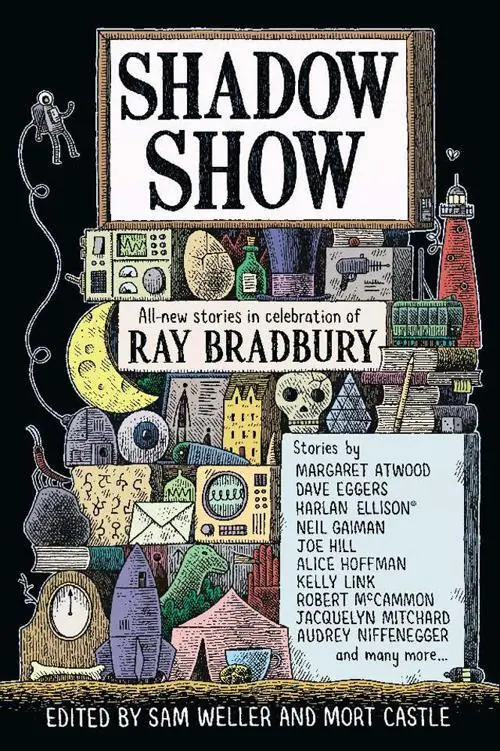
- Название:Shadow Show
- Автор:
- Издательство:William Morrow
- Жанр:
- Год:2012
- Город:New York
- ISBN:978-0-06-2122681
- Рейтинг книги:5 / 5. Голосов: 1
-
Избранное:Добавить в избранное
- Отзывы:
-
Ваша оценка:
Shadow Show: краткое содержание, описание и аннотация
Предлагаем к чтению аннотацию, описание, краткое содержание или предисловие (зависит от того, что написал сам автор книги «Shadow Show»). Если вы не нашли необходимую информацию о книге — напишите в комментариях, мы постараемся отыскать её.
.
Ray Bradbury—peerless storyteller, poet of the impossible, and one of America's most beloved authors—is a literary giant whose remarkable career has spanned seven decades. Now twenty-six of today's most diverse and celebrated authors offer new short works in honor of the master; stories of heart, intelligence, and dark wonder from a remarkable range of creative artists.
Shadow Show — читать онлайн бесплатно полную книгу (весь текст) целиком
Ниже представлен текст книги, разбитый по страницам. Система сохранения места последней прочитанной страницы, позволяет с удобством читать онлайн бесплатно книгу «Shadow Show», без необходимости каждый раз заново искать на чём Вы остановились. Поставьте закладку, и сможете в любой момент перейти на страницу, на которой закончили чтение.
Интервал:
Закладка:
“Yeah,” Ali said over his shoulder. “You’re cleaning this mess, Joe. It’s on you.”
“By myself? Not if we’re going by a fair rotation.”
“Fair?” Ali growled. “Who promised—”
“We agreed, when we started working Reagan.”
“That was back before… ,” Marta blurted again. Harold’s and Ali’s unblinking stares stopped her.
Joseph walked the ramp’s incline, dragging a machine cord at his front. When he reached the trailer, he looked out on the center’s western arc of buildings. Glimmering steel temples of outgoing capital & commerce, energy & oversight, responsible for looming over the dwelling’s entirety and employing some 80 percent of the compound’s quarter million residents in one way or another. A bank of digital-projector screens reached from the pinnacle of each skyscraper, featuring permed and tanned bobble-head voices humming updates as to the happenings in the Old World beyond compound walls. Joseph turned to the Rocky Mountain sky above, then to the square’s crawling matinee and its repeated script. The day, time, and temperature according to the International Mercantile Bank Tower ticker blinked first and last against his eyelids as Marta and Harold jumped down from the trailer, escaping the father of the one whom the IM ticker had called an “anarchist” just two days prior.
2-July—60, 5:13P, 68 degrees-
He looked down at his coworkers. “I was out here Sunday—gets so quiet after eleven—begs you to think about things. Used to be when we were kids, remember, we all still carried the Old World’s ways on our shoulders. Still used the words we know better than to speak. My father hated the man in the unit next to ours, only because he was a foreigner, and that guy, I think his name was Arturo—Pops called him el chico próximo —his family hated us because they blamed bitter blackness for all that had gone wrong back in the Old World, said we’d ruined it for those who appreciated life bottom-up.”
“That’s what we used to say about los negros , too,” Marta recalled, glancing shiftily at Ali and Joseph. “Bitter. Not me, mind you, my family said so. No slight intended.”
“Slight?” Ali bristled. “Slight at what? Why’re you looking at me for? I look like los negro s to you? You blind or something?”
Ali raised a hand to his eyes, turned the limb palm to back in careful assessment. His coworkers took him in, too, from the flared beige jumpsuit bottoms tucked into rugged work boots to the nest of wiry black wool combed skyward atop his head.
“What do los negros supposed to look like?” redheaded Harold asked between clearing his throat. “I don’t remember.”
“Who remembers?” Joseph agreed. He rubbed callous hands together hungrily, then cupped the dome of his bald head as he recalled his point. “That’s what I was thinking about here the other night, too. You take away everything they said was true in the Old World: God and tongues and skin, and who you’re fucking. The only thing left to make sense of up and down is generations. Between us and our children.”
The protest sounded three blocks west of the electric truck, a murmur to the workers. “And our fathers, too. Maybe they knew nothing for no n words.” Harold looked toward the center square, or at Ali, as he spoke. “But they sure’d still call you ‘boy’ and get away with it.”
“What’re you talking about?” Ali spit and sneered, yet never glanced toward the trailer. “Did you say ‘age’ or ‘Aids’? Jeez… do you hear them out there? What kind of way to commemorate is this? What has it come to? You’re cleaning up for sure, Joe.”
“Who would’ve thunk it could’ve been your own child? Writing such vicious muck. Your son?” Marta spoke into her chest, and Joseph was the only one of the team to hear her. “Shame, you never imagine such a thing.”
“No shame to it. They know no better. The boy is nineteen, by God. Barely started university. Never had anything like a chance,” Joseph heard himself defending. Ali lifted the truck’s steel ramp from First Street. Marta looked up from herself as the metal jammed against narrow storage slits, and Joseph leapt down to street level. “Isn’t any such thing as ‘Post-Age,’ is there? Can’t even pretend it—what would it look like? Our years is the only difference we have.”
“What do they want?” Ali’s tantrum continued. “To go back out there? What do they know?”
The echo of bobble-head words streamed along the ticker between street cleaners and protesters: Compound Police Still Seek Terrorist in Plot to Detonate Explosives Along High-Speed Muni-Train Route as Reagan Square Disturbance Heightens.
The nearest flank of protesters read the ticker, too, and they cheered. Joseph heard some small portion of the crowd chant his son’s name with clear and vigorous tongues above the murmur, just as the skateboarding boy had claimed.
He climbed into the municipal truck’s passenger seat, wondering at the connection the screens drew between plot and disturbance. He saw Chevy behind his eyelids, and he asked the specter: If a bunch of learn-ed university students went about rejecting all else the compound has told them, why were the very same ninnies so willing to cheer its most ridiculous link about you?
Ali cleared his throat behind the electric truck’s steering wheel, and Joseph caught the fake street-cleaning supervisor staring past Marta and Harold, watching him in the cab’s side-view mirror. He nodded.
“All right,” he said, and pointed to his municipal badge. “I’ll clock in to clean Reagan tonight.”
“Alone?”
Joseph nodded his acceptance again. The electric municipal truck veered to U-turn away from the compound protest. He told himself that he would decide whether some difference existed between anarchy and terror once midnight quiet fell over Reagan Square.
Their family had been among the compound’s first settlers. Joseph was five when they’d come, and he remembered only dim blinks, a few clipped and fading blurbs from the Old World. The tales of substance he’d passed on to his only son regarding the place of his birth were those given him by his elders.
They’d spoken of the end of water back home—decrepit fronts, shores, lines, and beaches where most of them had lived. They described the Old World as no different from those new compounds, except for the girded walls towering from the compound’s limits. Borders obstructing the horde’s glimpse into the world before them; blocking old privileged lenses, too, from gazing into lives led by those freed behind steel.
Otherwise, the Fed had promised Joseph’s elders—and they’d passed word on to the children—that the developments were but redesigned inner cities. A series of “Just Compounds,” they’d called the dwellings, concentrated east to west along the U.S. mountain and river chains, walled-off replicas with the red lining and crumbled rust of the belted Mid-Atlantic Mecca scoured clean. Leaving the neon, blinking amenities of civilization at the ready access of the poorest qualified souls who agreed to migrate.
Not until Joseph approached his teenage years did the few wayward teachers begin telling him and his first-generation peers unfiltered tales of nighttime torture in the Old World’s facilities, incarcerated dark men screaming at blue eclipse, pain often wrought by their own possessed hands. How the mystery of eleven shackled and mutilated brown youths washed up on waterfront sands on one bloody night spurred protests first, and then the Riots of 2015. “Willful Fury,” the teachers had called the events. No one established responsibility for what appeared mass imprisonment and murder, but it did not much matter. The appearance of the brutalized corpses afforded teeming hordes ninety summer days to set fire to the last remains of those wards and woods dark souls had called their corners of the American cities. Their flames burned even blight to embers, smoldering with a bitter black smoke that would have consumed the old cities whole had the Great Society not foreseen those urban margins emblazoned fifty years earlier and girded their towers accordingly.
Читать дальшеИнтервал:
Закладка:
Похожие книги на «Shadow Show»
Представляем Вашему вниманию похожие книги на «Shadow Show» списком для выбора. Мы отобрали схожую по названию и смыслу литературу в надежде предоставить читателям больше вариантов отыскать новые, интересные, ещё непрочитанные произведения.
![Lord Weller - Ритера или опасная любовь [СИ]](/books/421202/lord-weller-ritera-ili-opasnaya-lyubov-si-thumb.webp)





Обсуждение, отзывы о книге «Shadow Show» и просто собственные мнения читателей. Оставьте ваши комментарии, напишите, что Вы думаете о произведении, его смысле или главных героях. Укажите что конкретно понравилось, а что нет, и почему Вы так считаете.