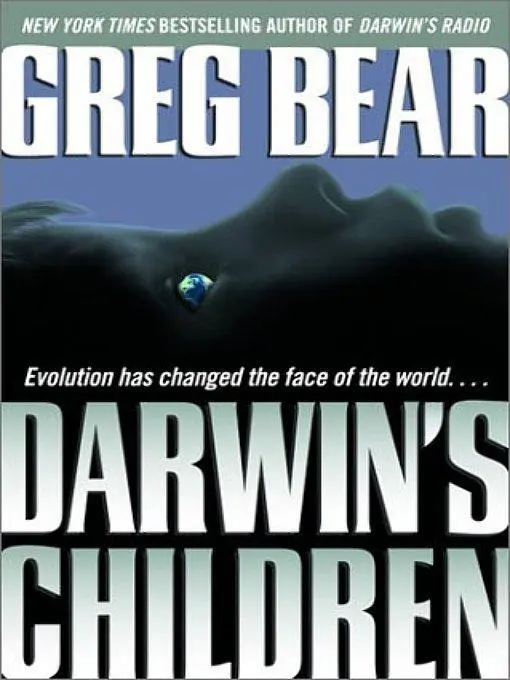
Greg Bear - Darwin's Children
Здесь есть возможность читать онлайн «Greg Bear - Darwin's Children» — ознакомительный отрывок электронной книги совершенно бесплатно, а после прочтения отрывка купить полную версию. В некоторых случаях можно слушать аудио, скачать через торрент в формате fb2 и присутствует краткое содержание. Город: New York, Год выпуска: 2010, ISBN: 2010, Издательство: Del Rey Books, Жанр: Фантастика и фэнтези, на английском языке. Описание произведения, (предисловие) а так же отзывы посетителей доступны на портале библиотеки ЛибКат.
- Название:Darwin's Children
- Автор:
- Издательство:Del Rey Books
- Жанр:
- Год:2010
- Город:New York
- ISBN:9780345448361
- Рейтинг книги:3 / 5. Голосов: 1
-
Избранное:Добавить в избранное
- Отзывы:
-
Ваша оценка:
Darwin's Children: краткое содержание, описание и аннотация
Предлагаем к чтению аннотацию, описание, краткое содержание или предисловие (зависит от того, что написал сам автор книги «Darwin's Children»). Если вы не нашли необходимую информацию о книге — напишите в комментариях, мы постараемся отыскать её.
, painted a chilling portrait of humankind on the threshold of a radical leap in evolution—one that would alter our species forever. Now Bear continues his provocative tale of the human race confronted by an uncertain future, where “survival of the fittest” takes on astonishing and controversial new dimensions.
Eleven years have passed since SHEVA, an ancient retrovirus, was discovered in human DNA—a retrovirus that caused mutations in the human genome and heralded the arrival of a new wave of genetically enhanced humans. Now these changed children have reached adolescence… and face a world that is outraged about their very existence. For these special youths, possessed of remarkable, advanced traits that mark a major turning point in human development, are also ticking time bombs harboring hosts of viruses that could exterminate the “old” human race.
Fear and hatred of the virus children have made them a persecuted underclass, quarantined by the government in special “schools,” targeted by federally sanctioned bounty hunters, and demonized by hysterical segments of the population. But pockets of resistance have sprung up among those opposed to treating the children like dangerous diseases—and who fear the worst if the government’s draconian measures are carried to their extreme.
Scientists Kaye Lang and Mitch Rafelson are part of this small but determined minority. Once at the forefront of the discovery and study of the SHEVA outbreak, they now live as virtual exiles in the Virginia suburbs with their daughter, Stella—a bright, inquisitive virus child who is quickly maturing, straining to break free of the protective world her parents have built around her, and eager to seek out others of her kind.
But for all their precautions, Kaye, Mitch, and Stella have not slipped below the government’s radar. The agencies fanatically devoted to segregating and controlling the new-breed children monitor their every move—watching and waiting for the opportunity to strike the next blow in their escalating war to preserve “humankind” at any cost. DARWIN’S CHILDREN
Darwin's Children — читать онлайн ознакомительный отрывок
Ниже представлен текст книги, разбитый по страницам. Система сохранения места последней прочитанной страницы, позволяет с удобством читать онлайн бесплатно книгу «Darwin's Children», без необходимости каждый раз заново искать на чём Вы остановились. Поставьте закладку, и сможете в любой момент перейти на страницу, на которой закончили чтение.
Интервал:
Закладка:
She had finished doing her share of the laundry in the big old concrete washhouse near the center of Oldstock. Now she sat on an empty oil drum beside the long lines hung with sun-drenched linens and underwear and some diapers and work clothes, smelling the laundry soap and bleach and steam, sipping a black cherry soda—a rare luxury here, she allowed herself only one a week—and thinking, kicking her feet back and forth, scuffing the concrete slab around the washhouse with her clogs.
From where she sat, she could see the gravel turnaround beside the old abandoned bowling alley, painted gray decades ago, the paint now peeling; three long dark redwood-stained dormitories that used to house seminary students and pilgrims and a few tourists; and up north of that, the fuel cell and solar station that ran the medical center and nursery. Beyond the station and an old fenced-in compound for storing mining equipment stretched a debris field dominated by a small mountain of tailings. The mountain marked the old mine and made that end of the camp a no-man’s-land of heavy metals and cyanide. No one walked there unless they had to; sometimes after a heavy rain she could smell the poison in the air, but it wasn’t bad enough to make them sick, unless they did something stupid.
In the middle of the last century, humans had mined copper and tin and even some gold at Oldstock, and built a little town—that was where the bowling alley and the seminary buildings had come from. South of town, just off the main road down to the shore of Lake Stannous, you could find weed-grown streets and concrete foundations where houses had once stood, built by Condite Copper Company to house miners’ families. In the woods Stella had come across old refrigerators and washing machines and piles of bottles and bigger junk, abandoned steam and diesel engines like big iron spaceships, squat dark hopper cars, stacks of iron rails orange with rust, and creosote-dipped cross ties glistening with black beads from years in the sun.
Oldstock was a designated Superfund site, located on the north end of Lake Stannous, where fishing was poor, and that combination kept most humans away. But Oldstock was beautiful, and as long as it did not rain too much, the tailings did not wash out into the lake and the village’s water was fine. So far, they had been lucky. The weather had been dry for twenty years, ever since Mr. and Mrs. Sakartvelo had bought the place from a Lutheran church group.
Sakartvelo was not their real name. They had been immigrants from the FSU, the Former Soviet Union, the part now called the Republic of Georgia. The name they had adopted was the name of their country the way the natives said it. They had been hiding here for almost twenty years, knowing others would arrive eventually.
Five years ago, the others had started arriving, and the town had slowly come alive once more.
Mr. and Mrs. Sakartvelo were in their sixties. Physically, they were obvious Shevites. They said others like them—not many—went back over two hundred years in Georgia and Armenia and Turkey. Stella Nova saw no reason not to believe them. Mitch had talked about such things.
She closed her eyes and leaned her head back, turning her face like a flower to soak up more sun before it dipped behind the trees. She listened for red-winged blackbirds and jays, mockingbirds and robins. Her cheeks freckled with butterflies of contentment.
A game for the younger kids was Rawshock—freckling up in symmetrical patterns and guessing what they meant. It trained them at cheek flashing. Some came to Oldstock freckle-dumb, with no knowledge of how to communicate with their own kind. Slowly, they learned. Stella and others taught the young ones.
The woods had been full of ticks this summer—and deer, as well—but ticks and even mosquitoes did not bother them much. The Sakartvelos taught them how to use fever-scenting to keep biting insects away, and also how to soothe animals—black bears in particular—that they might encounter. The two hundred Shevites in Oldstock were the only inhabitants for ten miles, and the woods were wild.
And of course, the Sakartvelos had taught the children how to keep Oldstock a secret, and trained them in what to do if humans came looking for them.
They had been taught well. No one had ever been taken away, and no one had ever been hurt—by animals or humans. Life had been pretty good, and Stella had started to forget the bad times and even the times with Mitch and Kaye, the good times, though sad. She had started to believe there was a life to live, rooted and real, among her own kind.
Then, Will had gone wrong.
Some still had nightmares of the schools and of living among humans. Stella did not dream about such things. Will had not been so lucky. He had hidden many things from all of them, things he had experienced, that had happened to him.
There were no radios or televisions in Oldstock, no telephones except for a single satellite phone in the main meeting hall, kept locked in a cabinet. It had not been used since Stella and Will had arrived, and probably not for a long time before that.
A breeze made the sheets and diapers flap. Stella wiped sweat from her forehead, got up, and started taking down and folding the dry pieces. She stacked them in a plastic tub and scented the tub by touching the ball of her thumb behind her ear and rubbing the handle.
Randolph—the only Randolph in Oldstock, so she did not know his human last name—came up and sparked a greeting. Randolph was four years younger than Stella, what some called an off-born, not part of the Waves. Those born during the three big Waves were called boomers, she did not know why. They talked with just their faces for a while as they plucked and folded pillowcases and dungarees and diapers. They exchanged pleasantries and imitated the scents of others, a kind of joking gossip that passed the time.
Randolph was being brought into the Blackbird Deme, not Stella’s but an offshoot of her group. They could talk openly about deme business, but not about personal affairs within the demes. That required triples, to prevent misunderstanding between the demes: three figures from each deme, engaging in full fever-scenting and sparking and facing. Triples looked like a weird dance to outsiders, but they solved a lot of problems and kept friction way down.
Oldstock had two children from the most recent Wave, foundlings aged two years and twenty-six months respectively. Stella cared for them sometimes in preparation, in training, and enjoyed their wild toddler scenting. Shevite infants raised among their own kind got enthusiastic sometimes and could emit a rank odor like dead skunks, and not from their dirty diapers.
Shevite babies knew how to swear with scent long before they could talk.
Everyone was learning. Fortunately, Mr. and Mrs. Sakartvelo were far from tyrants. They had been sterilized by the Communists in Tbilisi in the 1960s and could not have children of their own. In a strange way, that made them perfect to be everyone’s Shevite godparents, their guides in small, cloistered Oldstock.
Randolph finished folding a good share of the laundry and palmed Stella’s cheek in a brotherly fashion, with just a hint of the Question that the young males often asked, even of someone in her condition. Even of someone who still had a partner.
Stella responded with a little warning grumble under her throat and a polite chirrup. They smiled and parted, having spoken not a single word. Stella could go for days without speaking, and though sometimes she shouted out loud in her sleep, she could never recall why on waking.
Supper was being served in the refectory for those who had been cutting wood and planing boards starting early that morning. Males and females came out of the fresheners, stalls where they rubbed down with wet towels to take off the sweat—otherwise, most showered less than once a week. Cutting or hiding scent was considered rude. Smelling like heavy labor, however, could also hide scent.
Читать дальшеИнтервал:
Закладка:
Похожие книги на «Darwin's Children»
Представляем Вашему вниманию похожие книги на «Darwin's Children» списком для выбора. Мы отобрали схожую по названию и смыслу литературу в надежде предоставить читателям больше вариантов отыскать новые, интересные, ещё непрочитанные произведения.










Обсуждение, отзывы о книге «Darwin's Children» и просто собственные мнения читателей. Оставьте ваши комментарии, напишите, что Вы думаете о произведении, его смысле или главных героях. Укажите что конкретно понравилось, а что нет, и почему Вы так считаете.