Greg Bear - Darwin's Children
Здесь есть возможность читать онлайн «Greg Bear - Darwin's Children» — ознакомительный отрывок электронной книги совершенно бесплатно, а после прочтения отрывка купить полную версию. В некоторых случаях можно слушать аудио, скачать через торрент в формате fb2 и присутствует краткое содержание. Город: New York, Год выпуска: 2010, ISBN: 2010, Издательство: Del Rey Books, Жанр: Фантастика и фэнтези, на английском языке. Описание произведения, (предисловие) а так же отзывы посетителей доступны на портале библиотеки ЛибКат.
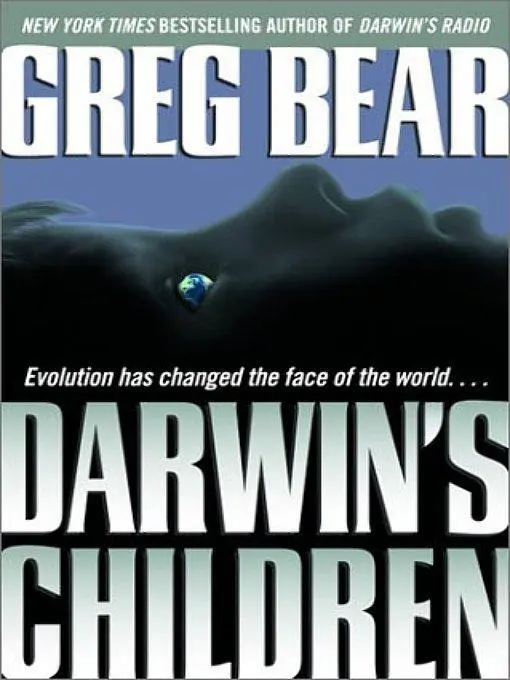
- Название:Darwin's Children
- Автор:
- Издательство:Del Rey Books
- Жанр:
- Год:2010
- Город:New York
- ISBN:9780345448361
- Рейтинг книги:3 / 5. Голосов: 1
-
Избранное:Добавить в избранное
- Отзывы:
-
Ваша оценка:
Darwin's Children: краткое содержание, описание и аннотация
Предлагаем к чтению аннотацию, описание, краткое содержание или предисловие (зависит от того, что написал сам автор книги «Darwin's Children»). Если вы не нашли необходимую информацию о книге — напишите в комментариях, мы постараемся отыскать её.
, painted a chilling portrait of humankind on the threshold of a radical leap in evolution—one that would alter our species forever. Now Bear continues his provocative tale of the human race confronted by an uncertain future, where “survival of the fittest” takes on astonishing and controversial new dimensions.
Eleven years have passed since SHEVA, an ancient retrovirus, was discovered in human DNA—a retrovirus that caused mutations in the human genome and heralded the arrival of a new wave of genetically enhanced humans. Now these changed children have reached adolescence… and face a world that is outraged about their very existence. For these special youths, possessed of remarkable, advanced traits that mark a major turning point in human development, are also ticking time bombs harboring hosts of viruses that could exterminate the “old” human race.
Fear and hatred of the virus children have made them a persecuted underclass, quarantined by the government in special “schools,” targeted by federally sanctioned bounty hunters, and demonized by hysterical segments of the population. But pockets of resistance have sprung up among those opposed to treating the children like dangerous diseases—and who fear the worst if the government’s draconian measures are carried to their extreme.
Scientists Kaye Lang and Mitch Rafelson are part of this small but determined minority. Once at the forefront of the discovery and study of the SHEVA outbreak, they now live as virtual exiles in the Virginia suburbs with their daughter, Stella—a bright, inquisitive virus child who is quickly maturing, straining to break free of the protective world her parents have built around her, and eager to seek out others of her kind.
But for all their precautions, Kaye, Mitch, and Stella have not slipped below the government’s radar. The agencies fanatically devoted to segregating and controlling the new-breed children monitor their every move—watching and waiting for the opportunity to strike the next blow in their escalating war to preserve “humankind” at any cost. DARWIN’S CHILDREN
Darwin's Children — читать онлайн ознакомительный отрывок
Ниже представлен текст книги, разбитый по страницам. Система сохранения места последней прочитанной страницы, позволяет с удобством читать онлайн бесплатно книгу «Darwin's Children», без необходимости каждый раз заново искать на чём Вы остановились. Поставьте закладку, и сможете в любой момент перейти на страницу, на которой закончили чтение.
Интервал:
Закладка:
He walked along the bluff. His eyes swept the ground a few meters ahead, looking for that weathered-out phalange or even bigger bone or chip of bone not worried over by a coyote or hauled off by a ground squirrel, falling out of its little hollow in the ash, that hard little mold of death.
The roar is loud and growing louder, but the cloud seems to be dissipating. What they cannot see, from where they stand, is the lahar breaking up into long fingers, finding channels already carved and ripped in the land, blowing out the last of its energy, reaching, reaching, but growing weaker. What they cannot see clearly is that this new threat is trying with all of its fading might to kill them.
Perhaps they will live.
They would be on his right, if they were anywhere at all, if they were still here. Their bones might have weathered out and fallen from the bluff centuries ago. He was walking so near the edge that there might be nothing left. The river would have been higher then, its bed not so worn and deep; but the bluff might have been high enough to give them pause…
The chief looks northwest. The leading run of the dying lahar roars down the channel. His eyes grow wide, his nostrils flare in rage and disappointment. It is a fuming, curling, leaping torrent of mud and steaming water. It fills his eyes, his brain. It travels faster than they can run. They hunker down and it roars past, below their feet, digging out the embankment. They crawl up the bank to safety, but the lahar vaults up and the spill catches them as they raise their arms. The thick liquid scalds, and the chief hears the others screaming, but only for a moment.
Mitch’s breath hitched.
Their women must have died at the same moment, or within seconds, across the Spent River.
The chief falls with his arms over his head. He and all his sons and the other hunters struggle for tenths of seconds against the scalding mud and then must lie still. It covers them, a blanket more than two feet thick, larded with sticks and chunks of log and rocks the size of fists, with bits of dead animals.
As Mitch walked, he grew calmer. Things seemed to fall into place. When the search was on, his mind became a quiet lake.
The land is hot and steaming. Nothing near the river lives that stood above ground. Bushes denuded of their leaves crouch smashed and wilted along the river course. Corpses lie baked and half-buried under gouts of steaming mud. The ground smells like mud and steamed vegetables. It smells like cooked herbs in a meaty stew.
The mud cools.
And then comes the third fall of ash, entombing the remains of the men, the women, and the ravaged land along the Spent River and for miles around.
It was over.
Mitch kept his head down and pressed one eye with a finger, but the pain was coming anyway. Price to be paid.
Rod Taylor pushes the lever forward on the old time machine. The mud hardens under the gray pall of falling ash. Time flies past. The bodies decay within their molds, staining the hard mud. The flesh seeps away and the bones rattle with earthquakes and the mud and stone cracks and fresh water and mud enters, filling the hollow with mud of different density, different composition, holding the bones, finally, still.
The men can rest.
Mitch knew they were still here, somewhere.
He stopped walking and looked to his right, into a step cut into the bluff by hundreds of centuries of erosion. At first he could not see what had attracted his attention; it was hidden by the painful little sliver of light.
The top of the mudstone step was at least six feet above his head. A streak of dark gray capped the step beneath a superficial wig of soil and brush. But his vision tunneled into a bright ball and all he saw was the shiny brown prominence lying horizontally in the stone.
He hardly dared to breathe.
Mitch stooped, arm hanging, propping his knees against the mound of weathered-out clods and pebbles. Reached out with his right finger and brushed along the compacted gray ash and caked mudstone.
The prominence was firm in the hardened layer. It could have been a bone from a deer, a mountain goat, or a bighorn sheep.
But it was not. It was a human shin, a tibia. In this layer, it had to be at least as old as the bones in the camp. He reached down with one hand, sparks flying in his right eye, and felt for the small piece he had seen there, a dark brown talus of bone amongst the rocky talus.
He held it up, turning it until he could see it clearly. It was small, but also from a human. Homo at least. He replaced it. Position would be important when they surveyed.
He took a dental pick from his jacket and worked at the hardened mud and ash around the tibia until he was sure, fighting the pain in his cranium for long minutes. Then he sat back and drew up his knees.
He could no longer put it off. The migraine had arrived. He hadn’t had one this bad in more than ten years. The dental pick fell from his hand as he curled up on the ground, trying not to moan.
He managed to reach up with one finger and stroke the half-buried length of bone.
“Found you,” Mitch said. Then he closed his eyes and felt his own lahar wash over him.
33
NEW MEXICO
Dicken’s monitor was filled with comparisons of protein expression in embryonic tissues at different stages of development, looking for the elusive retroviral or transposon trigger that might have crept into a complex of developmental genes, promoting the hymen in human females. Even using prior searches and comparisons—incredibly, he had found some in the literature—it looked as if this would take months or years.
Dr. Jurie had shunted Dicken into the safest and least interesting position at Sandia Pathogenics. Putting him in safe, cold storage until needed.
An odd little dance of utility and security. Jurie was keeping Dicken under his thumb, as it were, just to know where he was and what he was up to, and possibly to pick his brain.
But also to confess? To be caught out?
Dicken would not rule out anything where Aram Jurie was concerned.
The man had passed along a list of rambling, long e-mail messages, cryptic, elusive, and a little too evocative for Dicken’s comfort. Jurie might be on to something, Dicken thought, a twisted and crazy but undeniably big insight.
Jurie held the belief—not exactly new—that viruses played a substantial but crude role in nearly every stage of embryonic development. But he had some interesting notions about how they did so:
“Genomic viruses want to play in the big game, but as genetic players go, they’re simple, constrained, fallen from grace. They can’t do the big stuff, so they engage in cryptic little elaborations, and the big game tolerates and then becomes addicted to their subtle plays…
“Weak in themselves, endogenous viruses may rely on a very different form of apoptosis, programmed cell suicide. ERVs express at certain times and present antigen on the cell surface. The cell is inspected by the agents of the immune system and killed. By coordinating how and which cells present antigen, genomic viruses can participate crudely in sculpting the embryo, or even the growing body after birth. Of course, they work to increase their numbers and their position in the species, in the extended genome. They work by maintaining a feeble but persistent control in the face of a constant and powerful assault by the immune system.
“And in mammals, they’ve won. We have surrendered some of the most crucial aspects of our lives to the viruses, just to give our babies time to develop in the womb, rather than in the constraining egg; time to develop more sophisticated nervous systems. A calculated gamble. All our generations are held ransom because of our indebtedness to the viral genes.
Читать дальшеИнтервал:
Закладка:
Похожие книги на «Darwin's Children»
Представляем Вашему вниманию похожие книги на «Darwin's Children» списком для выбора. Мы отобрали схожую по названию и смыслу литературу в надежде предоставить читателям больше вариантов отыскать новые, интересные, ещё непрочитанные произведения.









Обсуждение, отзывы о книге «Darwin's Children» и просто собственные мнения читателей. Оставьте ваши комментарии, напишите, что Вы думаете о произведении, его смысле или главных героях. Укажите что конкретно понравилось, а что нет, и почему Вы так считаете.