Greg Bear - Darwin's Children
Здесь есть возможность читать онлайн «Greg Bear - Darwin's Children» — ознакомительный отрывок электронной книги совершенно бесплатно, а после прочтения отрывка купить полную версию. В некоторых случаях можно слушать аудио, скачать через торрент в формате fb2 и присутствует краткое содержание. Город: New York, Год выпуска: 2010, ISBN: 2010, Издательство: Del Rey Books, Жанр: Фантастика и фэнтези, на английском языке. Описание произведения, (предисловие) а так же отзывы посетителей доступны на портале библиотеки ЛибКат.
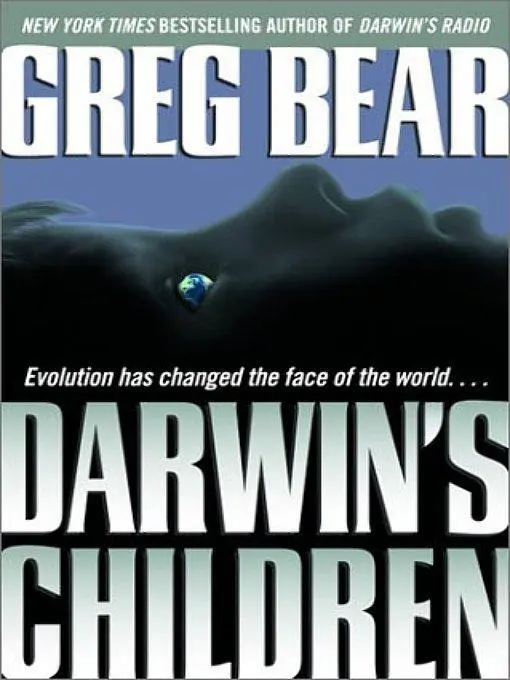
- Название:Darwin's Children
- Автор:
- Издательство:Del Rey Books
- Жанр:
- Год:2010
- Город:New York
- ISBN:9780345448361
- Рейтинг книги:3 / 5. Голосов: 1
-
Избранное:Добавить в избранное
- Отзывы:
-
Ваша оценка:
Darwin's Children: краткое содержание, описание и аннотация
Предлагаем к чтению аннотацию, описание, краткое содержание или предисловие (зависит от того, что написал сам автор книги «Darwin's Children»). Если вы не нашли необходимую информацию о книге — напишите в комментариях, мы постараемся отыскать её.
, painted a chilling portrait of humankind on the threshold of a radical leap in evolution—one that would alter our species forever. Now Bear continues his provocative tale of the human race confronted by an uncertain future, where “survival of the fittest” takes on astonishing and controversial new dimensions.
Eleven years have passed since SHEVA, an ancient retrovirus, was discovered in human DNA—a retrovirus that caused mutations in the human genome and heralded the arrival of a new wave of genetically enhanced humans. Now these changed children have reached adolescence… and face a world that is outraged about their very existence. For these special youths, possessed of remarkable, advanced traits that mark a major turning point in human development, are also ticking time bombs harboring hosts of viruses that could exterminate the “old” human race.
Fear and hatred of the virus children have made them a persecuted underclass, quarantined by the government in special “schools,” targeted by federally sanctioned bounty hunters, and demonized by hysterical segments of the population. But pockets of resistance have sprung up among those opposed to treating the children like dangerous diseases—and who fear the worst if the government’s draconian measures are carried to their extreme.
Scientists Kaye Lang and Mitch Rafelson are part of this small but determined minority. Once at the forefront of the discovery and study of the SHEVA outbreak, they now live as virtual exiles in the Virginia suburbs with their daughter, Stella—a bright, inquisitive virus child who is quickly maturing, straining to break free of the protective world her parents have built around her, and eager to seek out others of her kind.
But for all their precautions, Kaye, Mitch, and Stella have not slipped below the government’s radar. The agencies fanatically devoted to segregating and controlling the new-breed children monitor their every move—watching and waiting for the opportunity to strike the next blow in their escalating war to preserve “humankind” at any cost. DARWIN’S CHILDREN
Darwin's Children — читать онлайн ознакомительный отрывок
Ниже представлен текст книги, разбитый по страницам. Система сохранения места последней прочитанной страницы, позволяет с удобством читать онлайн бесплатно книгу «Darwin's Children», без необходимости каждый раз заново искать на чём Вы остановились. Поставьте закладку, и сможете в любой момент перейти на страницу, на которой закончили чтение.
Интервал:
Закладка:
“Howard Temin is a god in this place,” Dee Dee Blakemore said. “We’ve set up a little shrine in C wing. Prayers every Wednesday.”
“Birth control pills produce conditions in women similar to pregnancy,” Wrigley said. “We decided that women on birth control would make an excellent study group. We have twenty volunteers, five of them our own researchers.”
Blakemore raised her hand. “I’m one,” she said. “I’m feeling testy already.” She growled at Wrigley and bared her canines. Wrigley held up his hands in mock fright.
“Eventually, SHEVA females will be getting pregnant,” Wrigley said, “and some may even use birth control pills. We want to know how that will effect production of potential pathogens.”
“Sexual maturity and pregnancy in the new children is likely to be a time of great danger,” Jurie said. “Retroviruses released in the natural course of a second generation SHEVA pregnancy could transfer to humans. The result could be another HIV-like disease. In fact, Dr. Presky here, among others, believes something similar explains how HIV got into the human population.”
Presky weighed in. “A hunter in search of bush meat could have slaughtered a pregnant chimp.” He shrugged; the hypothesis was still speculation, as Dicken knew well. As a postdoc in the late 1980s, Dicken had spent two years in the Congo and Zaire tracking possible sources for HIV.
“And last but not least, our gardens. Dr. Miller?”
Orlin Miller pointed to flats of greenery and flower gardens spread out under skylights and artificial sun bulbs hanging in imposing phalanxes, like great glassy fruit, on the north side of the warehouse. “My group studies transfer of viral genes between plants and insects, funguses and bacteria. As Dr. Jurie hinted earlier, we’re also studying human genes that may have originated in plants,” Miller added. “I can just see the Nobel hanging from that one.”
“Not that you’ll ever go up on stage to collect,” Jurie warned.
“No, of course not,” Miller said, somewhat deflated.
“Enough. Just a taste,” Jurie said, stopping in front of a basin containing a thick growth of young corn. “Seven other division heads who could not be here tonight extend their congratulations—to me, for landing Dr. Dicken. Not necessarily do they congratulate Dr. Dicken.”
The others smiled.
“Thanks, gentlemen,” Jurie said, and waved bye-bye, as if to a group of school children. The directors said their farewells and filed out of the warehouse. Only Turner remained.
Jurie fixed Dicken with a gaze. “NIH tells me I can find a use for you at Pathogenics,” Jurie said. “NIH funds a substantial portion of my work here, through Emergency Action. Still, I’m curious. Why did you accept this appointment? Not because you love and respect me, Dr. Dicken.” Jurie loosely crossed his arms and his bony fingers engaged in a fit of searching, marching along toward the elbows, drawing the arms into a tighter hug.
“I go where the science is,” Dicken said. “I think you’re primed to discover some interesting things. And I think I can help. Besides…” He paused. “They gave you a list. You picked me.”
Jurie lifted one hand dismissively. “Everything we do here is political. I’d be a fool not to recognize it,” he said. “But, frankly, I think we’re winning. Our work is too important to stop, for whatever reason. And we might as well have the best people working with us, whatever their connections. You’re a fine scientist, and that’s the bottom line.” Jurie strolled before a plastic-wrapped greenhouse filled with banana trees, obscured by the translucent plastic. “If you think you’re ready, I have a theoretical problem for you.”
“Ready as I’ll ever be,” Dicken said.
“I’d like for you to start with something a little off the beaten path. Up for it?”
“I’m listening,” Dicken said.
“You can work with Dr. Wrigley’s volunteers. Assemble a staff from our resident postdocs under Dee Dee’s supervision, no more than two to begin with. They’re analyzing ancient promoter regions associated with sexual characteristics, physiological changes in humans possibly induced by retroviral genes.” Jurie swallowed conspicuously. “Viruses have induced changes quite evident in our SHEVA children. Now, I’d like to study more mundane instances in humans. Can you think of the fold of tissue of which I’m suspicious?” Jurie asked.
“Not really,” Dicken said.
“It’s like an alarm mounted on a gate kept closed until maturity. When the gate is breached, that announces a major accomplishment, a crucial change; announces it with a burst of pain and a whole cascade of hormonal events. The hormones generated by this experience appear to activate HERV and other mobile elements, preparing our bodies for a new phase of life. Reproduction is imminent, this breach tells the body. Time to prepare.”
“The female hymen,” Dicken guessed.
“The female hymen,” Jurie said. “Is there any other kind?” He was not being sarcastic. It was a straight question. “Are there other gates to be opened, other signals?… I don’t know. I’d like to know.” Jurie studied Dicken, eyes glittering with enthusiasm once again. “I’m supposing that viruses have altered our phenotype to produce the hymen. Rupturing the hymen gives them warning that sex is taking place, so they can prepare to do all that they do. By altering expression of key genes, promoting or blocking them, the viruses may change our behavior as well. Let’s find out how.” He reached into his jacket pocket, removed a small plastic case, and handed the case to Dicken. “My notes. If you find them useful, I’ll be content.”
“Good,” Dicken said. He knew very little about hymens; he wondered what his other resources would be.
“SHEVA females don’t have hymens, you know,” Jurie said. “No such membranes. Comparison should bring up fascinating divergences in hormonal pathways and viral activations. And viral activations are what concern me.”
Dicken found himself nodding. He was almost hypnotized by the audacity of the hypothesis. It was perverse; it was perversely brilliant. “You think menarche in SHEVA females will switch on viral mutations?” he asked.
“Possibly,” Jurie said evenly, as if discussing the weather. “Interested?”
“I am,” Dicken said after a thoughtful pause.
“Good.” Jurie reached up and pulled his head to one side, making the bones in his neck pop. His eyes turned elsewhere, and he nodded once and walked away, leaving Turner and Dicken alone in the warehouse between the trailers and the gardens.
The interview was over.
Turner escorted Dicken back through the zoo, the foot baths, and the corridors to the steel door. They stopped off at the maintenance office to get the key to Dicken’s dorm room.
“You’ve survived meeting the Old Man,” Turner said, then showed Dicken the way to the dorm wing for new residents. He held up a key, pinched the key’s tag, turning it from blue to red, and dropped it into Dicken’s palm. He stared at Dicken for a long, uncomfortable moment, then said, “Good luck.”
Turner walked back down the hall, shaking his head. Over his shoulder, he called out, “Jesus! Hymens. What next?”
Dicken closed the door to the room and switched on the overhead light. He sat on the narrow, tightly made-up bed, and rubbed his temples and jaw muscles with trembling fingers, dizzy from repressed emotion.
For the first time in his life, the prey Dicken was after was not microbial.
It was a disease, but it was entirely human.
10
ARIZONA
Stella awoke to the sound of an over-under songfest between barracks. The wake-up bell had not yet rung. She rolled between the crisp white sheets of the top bunk and stared up at the ceiling tiles. She was familiar with the routine: A few dozen boys and girls were hanging out of the windows of their barracks, singing to each other across the razor-wire fence. The over was loud and almost tuneless; the under was subtle and not very clear from where she lay. She had no doubt it carried a lot of early-morning gossip, however.
Читать дальшеИнтервал:
Закладка:
Похожие книги на «Darwin's Children»
Представляем Вашему вниманию похожие книги на «Darwin's Children» списком для выбора. Мы отобрали схожую по названию и смыслу литературу в надежде предоставить читателям больше вариантов отыскать новые, интересные, ещё непрочитанные произведения.









Обсуждение, отзывы о книге «Darwin's Children» и просто собственные мнения читателей. Оставьте ваши комментарии, напишите, что Вы думаете о произведении, его смысле или главных героях. Укажите что конкретно понравилось, а что нет, и почему Вы так считаете.