Frank Schätzing - Limit
Здесь есть возможность читать онлайн «Frank Schätzing - Limit» весь текст электронной книги совершенно бесплатно (целиком полную версию без сокращений). В некоторых случаях можно слушать аудио, скачать через торрент в формате fb2 и присутствует краткое содержание. Город: London, Год выпуска: 2013, ISBN: 2013, Издательство: Jo Fletcher Books, Жанр: Фантастика и фэнтези, на английском языке. Описание произведения, (предисловие) а так же отзывы посетителей доступны на портале библиотеки ЛибКат.
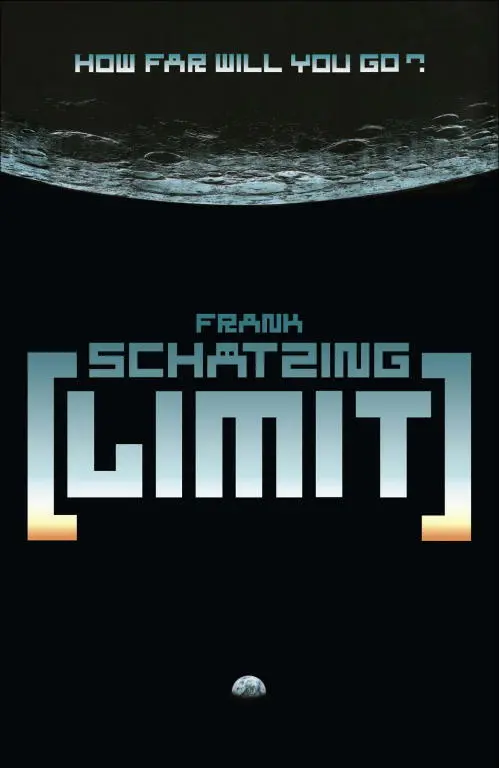
- Название:Limit
- Автор:
- Издательство:Jo Fletcher Books
- Жанр:
- Год:2013
- Город:London
- ISBN:9781849165150
- Рейтинг книги:4 / 5. Голосов: 1
-
Избранное:Добавить в избранное
- Отзывы:
-
Ваша оценка:
Limit: краткое содержание, описание и аннотация
Предлагаем к чтению аннотацию, описание, краткое содержание или предисловие (зависит от того, что написал сам автор книги «Limit»). Если вы не нашли необходимую информацию о книге — напишите в комментариях, мы постараемся отыскать её.
In 2025, entrepreneur Julian Orley opens the first-ever hotel on the moon. But Orley Enterprises deals in more than space tourism—it also operates the world’s only space elevator, which in addition to allowing the very wealthy to play tennis on the lunar surface connects Earth with the moon and enables the transportation of helium-3, the fuel of the future, back to the planet. Julian has invited twenty-one of the world’s richest and most powerful individuals to sample his brand-new lunar accommodation, hoping to secure the finances for a second elevator…
On Earth, meanwhile, cybercop Owen Jericho is sent to Shanghai to find a young female hacker known as Yoyo, who’s been on the run since acquiring access to information that someone seems quite determined to keep quiet. As Jericho closes in on the girl and the conspiracy swirling around her, he finds mounting evidence that connects her to Julian Orley as well as to the entrepreneur’s many competitors and enemies. Soon, the detective realizes that the lunar junket to Orley’s hotel is in real and immediate danger.
Limit — читать онлайн бесплатно полную книгу (весь текст) целиком
Ниже представлен текст книги, разбитый по страницам. Система сохранения места последней прочитанной страницы, позволяет с удобством читать онлайн бесплатно книгу «Limit», без необходимости каждый раз заново искать на чём Вы остановились. Поставьте закладку, и сможете в любой момент перейти на страницу, на которой закончили чтение.
Интервал:
Закладка:
‘Uh-huh,’ said Olympiada dejectedly.
Julian smiled knowingly to himself, relishing the awkward silence that followed his account. All around him cosmic bombs were crashing into their thoughts and converting kinetic energy into questions such as, in the event of a similar impact threatening Earth, whether it would be better to seek refuge in the cellar or to go for one last beer.
‘I guess our atmosphere wouldn’t be of much help?’ Rebecca Hsu suggested.
‘Well…’ Julian pursed his lips. ‘Meteorites are always plummeting down to Earth, around forty tonnes of them a day in fact. Most of them are the size of a grain of sand or pebble and end up burning themselves out. Now and again one the size of a fist will come along, and occasionally something bigger will crash into tundra or the sea. In 1908, for example, a sixty-metre-wide fragment of a comet exploded over Siberia and devastated an area the size of New York.’
‘I remember hearing about that,’ said Rogachev drily. ‘We lost some forest, a few sheep and a shepherd.’
‘You would have lost a lot more if it had hit Moscow. But yes, in the main, the universe is essentially past the worst. Meteorites like the one that caused Copernicus have become few and far between.’
‘How far between exactly?’ drawled Heidrun.
Julian pretended to give it some thought. ‘The last really significant one came down sixty-five million years ago in the area that’s now known as Yucatán. The shock-waves travelled all around the world, causing several years of continuous winter, which led to the loss of considerable amounts of flora and fauna, and unfortunately, almost all the dinosaurs.’
‘That doesn’t answer my question.’
‘You really want to know when the next one will hit?’
‘Just for my own planning purposes, yes.’
‘Well, according to statistical data there’s a global catastrophe every twenty-six million years. How catastrophic exactly depends on the size of the impactor. An asteroid seventy-five metres in diameter has the explosive force of one hundred Hiroshima bombs. Anything exceeding two kilometres can trigger a global winter and would mean the end of mankind.’
‘So, according to that we’re forty million years overdue,’ established O’Keefe. ‘How big was the dinosaur-killer again?’
‘Ten kilometres.’
‘Thank you, Julian, I’m very glad you’ve brought us up here away from it all.’
‘So what can we do about it?’ asked Rebecca.
‘Very little. The nations with space programmes have avoided dealing with the problem for years, preferring instead to devote their energy to building up an expensive battery of mid-range missiles. But what we really need is a functioning meteorite defence system. When the hammer falls it won’t matter whether you’re a Muslim, Jew, Hindu or Christian, atheist or fundamentalist, or who you’re fighting with, none of that will matter. Crash, and that’s it! We don’t need weapons against each other. What we really need is one that can save us all.’
‘So true.’ Rogachev looked at him, expressionless. Then he glided over, took Julian by the arm and pulled him slightly apart from the others.
‘But haven’t you had that for ages already?’ he added, quietly. ‘Aren’t you in the process of developing weapons against meteorites too?’
‘We’ve created a development team, yes.’ Julian nodded.
‘You’re developing weapons on the OSS?’
‘Defence systems.’
‘How reassuring for all of us.’ The Russian smiled thinly.
‘It’s a research group, Oleg.’
‘Well, I hear the Pentagon are very interested in this research group.’
‘Don’t worry.’ Julian smiled back. ‘I know the rumours. Both Russia and China are constantly accusing us of producing space weapons for the Americans. But it’s all nonsense! The sole purpose of our research is to be able to act if the laws of probability come into their own. I sure as hell want to be able to shoot if something like that’s on a collision course.’
‘Weapons can be used against all kinds of things, Julian. You’ve secured America a position of power in space. You yourself are striving to rule over the energy supply by controlling the technologies. You’re wielding a great deal of power, and you’re trying to tell me you’re not pursuing your own interests?’
‘Look out of the window,’ said Julian calmly. ‘Look at that blue-white jewel.’
‘I see it.’
‘And? Are you homesick?’
Rogachev hesitated. ‘I don’t really use terms like that.’
‘You can choose whether to believe me on this or not, Oleg, but once this trip is behind you, you’ll be a different person. You’ll have realised that our planet is a fragile little Christmas tree bauble, covered by a wafer-thin layer of breathable air, so far at least. No borders or national states, just land, sea and a few billion people who have to share the bauble because it’s the only one they’ve got. Every decision that’s not aimed at keeping our planet together, every aggression for some resource or religious idea will sicken you. Perhaps you’ll stand on the peak of some crater and cry, or maybe you’ll just ask a few sensible questions, but it will change you. There’s no way back once you’ve seen the Earth from space, from the distance of the Moon. There’s nothing you can do but fall in love with it. Do you really think I would allow someone to misuse my technologies?’
Rogachev fell silent for a while.
‘I don’t believe you would want to allow it,’ he said. ‘I’m just asking myself whether you have any choice in the matter.’
‘I do, the more friends I get.’
‘But you’re a world champion in making enemies! I know you have a league of extraordinary gentlemen in mind, a world power of independent investors, but for that you’re intruding massively into national interests. How does it fit together? You want my money, Russian money, but on the other hand you don’t want anything to do with Moscow.’
‘So is it Russian money just because you’re Russian?’
‘Well, I’m sure they’d prefer it there if I invested my fortune in national space travel.’
‘Good luck. Let me know when you’ve managed to get your own space elevator.’
‘You don’t think we can?’
‘You don’t even believe it yourself! I own the patents. But still, I have to admit that I wouldn’t have got this far without America. We’ve both invested astronomical sums in space travel. But Russia is broke. Putin founded his Mafia state on oil and gas, and now no one wants it. You played poker and you lost. Don’t forget, Oleg, that Orley Enterprises is ten times the size of Rogamittel. We’re the biggest technology company in the world, but my investors and I still need each other nonetheless. But no one in Moscow would do you any favours. It may be a patriotic gesture, sponsoring Russia’s ramshackle space travel, but your money would just drain away. You wouldn’t last long enough to catch up with me, because your State would have sucked the very last drop out of you before you even had the chance, and without creating any decent results either.’
This time Rogachev was silent for even longer. Then he smiled again.
‘Moscow would give you more of a free hand than Washington. Are you sure you don’t want to switch sides?’
‘I guessed you’d be obliged to ask me that.’
‘I was asked to test the waters, see how willing you might be.’
‘Firstly, we’re not in the Cold War any more. Secondly, Russia can’t afford my exclusivity. Thirdly, I’m not on anyone’s side. Does that answer your question?’
‘Let’s put it a different way. With the right conditions, would you be willing to sell your technologies to Russia too ?’
Читать дальшеИнтервал:
Закладка:
Похожие книги на «Limit»
Представляем Вашему вниманию похожие книги на «Limit» списком для выбора. Мы отобрали схожую по названию и смыслу литературу в надежде предоставить читателям больше вариантов отыскать новые, интересные, ещё непрочитанные произведения.




Обсуждение, отзывы о книге «Limit» и просто собственные мнения читателей. Оставьте ваши комментарии, напишите, что Вы думаете о произведении, его смысле или главных героях. Укажите что конкретно понравилось, а что нет, и почему Вы так считаете.