Frank Schätzing - Limit
Здесь есть возможность читать онлайн «Frank Schätzing - Limit» весь текст электронной книги совершенно бесплатно (целиком полную версию без сокращений). В некоторых случаях можно слушать аудио, скачать через торрент в формате fb2 и присутствует краткое содержание. Город: London, Год выпуска: 2013, ISBN: 2013, Издательство: Jo Fletcher Books, Жанр: Фантастика и фэнтези, на английском языке. Описание произведения, (предисловие) а так же отзывы посетителей доступны на портале библиотеки ЛибКат.
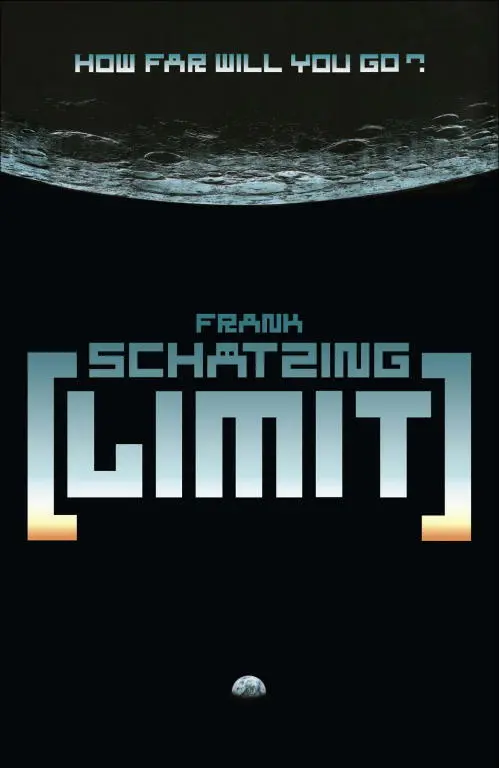
- Название:Limit
- Автор:
- Издательство:Jo Fletcher Books
- Жанр:
- Год:2013
- Город:London
- ISBN:9781849165150
- Рейтинг книги:4 / 5. Голосов: 1
-
Избранное:Добавить в избранное
- Отзывы:
-
Ваша оценка:
Limit: краткое содержание, описание и аннотация
Предлагаем к чтению аннотацию, описание, краткое содержание или предисловие (зависит от того, что написал сам автор книги «Limit»). Если вы не нашли необходимую информацию о книге — напишите в комментариях, мы постараемся отыскать её.
In 2025, entrepreneur Julian Orley opens the first-ever hotel on the moon. But Orley Enterprises deals in more than space tourism—it also operates the world’s only space elevator, which in addition to allowing the very wealthy to play tennis on the lunar surface connects Earth with the moon and enables the transportation of helium-3, the fuel of the future, back to the planet. Julian has invited twenty-one of the world’s richest and most powerful individuals to sample his brand-new lunar accommodation, hoping to secure the finances for a second elevator…
On Earth, meanwhile, cybercop Owen Jericho is sent to Shanghai to find a young female hacker known as Yoyo, who’s been on the run since acquiring access to information that someone seems quite determined to keep quiet. As Jericho closes in on the girl and the conspiracy swirling around her, he finds mounting evidence that connects her to Julian Orley as well as to the entrepreneur’s many competitors and enemies. Soon, the detective realizes that the lunar junket to Orley’s hotel is in real and immediate danger.
Limit — читать онлайн бесплатно полную книгу (весь текст) целиком
Ниже представлен текст книги, разбитый по страницам. Система сохранения места последней прочитанной страницы, позволяет с удобством читать онлайн бесплатно книгу «Limit», без необходимости каждый раз заново искать на чём Вы остановились. Поставьте закладку, и сможете в любой момент перейти на страницу, на которой закончили чтение.
Интервал:
Закладка:
Incredible. So that was the grand summary of six expensive landings on a rock hundreds of thousands of kilometres away from Earth? That no one even knew what colour it was?
‘It looks kind of yellow to me,’ said Rebecca Hsu, after gazing silently out of the small porthole for a long while. Hardly any of them were venturing over to the row of windows any more. From there, throughout the two days since their launch, they had watched their home planet get smaller and smaller, a ghostly dwindling of familiarity. It was as if they were dividing their loyalty equally at the midway point between the Earth and Moon before fully succumbing to the fascination of the satellite. From 10,000 kilometres away it could still be seen in its entirety, starkly silhouetted against the blackness of outer space around it. And yet this object of romantic contemplation had billowed to become a sphere with menacing presence, a battlefield, scarred by billions of years of celestial bombardment. In complete silence, unbroken by the soundtrack of civilisation, they raced towards this strange, alien world. Only the tinnitus-like hiss of the life-support systems indicated that there was any technological activity on board at all. Beyond that, the silence made their heartbeats thunder like bush drums and the blood swirl in their veins. It roused lively chatter within the body about the state of its chemical processes and pushed their imaginations to the very limit.
Olympiada Rogacheva paddled up, in awe of her weightlessness. They had advanced another thousand kilometres towards the satellite, and could now see only three-quarters of it.
‘It doesn’t look yellow,’ she murmured. ‘To me it seems more mouse-grey.’
‘Metallic grey,’ Rogachev corrected her coldly.
‘I’m not so sure,’ Evelyn Chambers looked over from the next window. ‘Metallic? Really?’
‘Yes, really. Look. Up there to the right, the big, round patch. Dark, like molten iron.’
‘You’ve been in the steel industry for too long, Oleg. You could find something metallic in a chocolate pudding.’
‘Of course he could – the spoon! Woohoo!’ Miranda Winter did a somersault, cheering gleefully. Most of the others had tired of doing zero-gravity acrobatics. But Miranda couldn’t get enough of them and was rapidly getting on the others’ nerves. She was incapable of holding a conversation without rolling through the air, squealing and cackling, thumping people in the ribs or whacking them on the chin as she did. Evelyn, on the receiving end of a kick in the small of her back, snapped: ‘You’re not a merry-go-round, Miranda. Give it a rest, will you!’
‘But I feel like one!’
‘Then close yourself down for repairs or something. It’s too cramped in here for all that.’
‘Hey, Miranda.’ O’Keefe looked up from reading his book: ‘Why don’t you try imagining you’re a blue whale instead?’
‘What? Why?’
‘Blue whales wouldn’t act like that. They’re content to just hang around, more or less motionless, and eat plankton.’
‘They blow water too,’ Heidrun commented. ‘Do you want to see Miranda blow water?’
‘Sure, why not?’
‘You’re all being silly,’ Miranda concluded. ‘By the way, I think it’s kind of blue. The moon, I mean. It’s almost eerie.’
‘Uhhh,’ O’Keefe shuddered.
‘So what colour is it?’ Olympiada wanted to know.
‘It’s every colour, and yet none.’ Julian Orley came through the connecting hatch that separated the living quarters of the Charon from the landing module. ‘No one knows.’
‘How come?’ Rogachev wrinkled his forehead. ‘I mean, surely we’ve had enough time to figure that out?’
‘Of course. The problem is that no one has seen it through anything other than toned or filtered windows and visors yet. And on top of that, the Moon doesn’t have a particularly high albedo—’
‘A what?’ asked Miranda, rotating like a pig on a spit.
‘Reflectivity. The fraction of solar energy which is reflected back to space. The reflection rate of lunar rock is not especially high, particularly not in the maria—’
‘I’m not following a word you say.’
‘The dry plains on the surface of the Moon,’ explained Julian patiently. ‘Collectively, they’re called maria. The plural of mare. They appear to be even darker than the mountain rings in the craters.’
‘So why does the Moon look white when we look at it from Earth?’
‘Because it has no atmosphere. Sunlight hits its surface unfiltered, in just the same way it would an astronaut’s unprotected retina. The UV rays outside are far more dangerous to our eyes than they would be on Earth, that’s why the spaceship’s windows are tinted.’
‘But loads of lunar samples have been brought back to Earth,’ said Rogachev. ‘What colour are they?’
‘Dark grey. But that doesn’t necessarily mean that the whole moon is dark grey. Perhaps some parts of it are brown, or even yellow.’
‘Exactly,’ said O’Keefe from behind his book.
‘Everyone sees it slightly differently. Everyone has their own moon, one might say.’ Julian went over to join Evelyn. They were passing over a lone gigantic crater which lay far below them. Molten light seemed to stream from its slopes down to the surface surrounding it. ‘That’s Copernicus by the way. According to popular opinion it’s the most spectacular of all the lunar craters and over eight hundred million years old. It’s a good ninety kilometres wide, with slopes that would present a challenge to any mountaineer, but the most impressive thing about it is how deep it is. Do you see that massive shadow inside it? It’s almost four kilometres down to the very bottom.’
‘There are mountains right in the middle of it,’ observed Evelyn.
‘How is that possible?’ wondered Olympiada. ‘I mean, in the middle of the point of impact? Shouldn’t it all be flat?’
Julian fell silent for a while.
‘Imagine it like this,’ he said. ‘Picture the surface of the Moon, just as you see it now, but without Copernicus. Okay? Everything is still and peaceful. So far! Then, a boulder eleven kilometres in diameter rushes up from the depths of outer space at a speed of seventy kilometres per second, two hundred times the speed of sound. There’s no atmosphere, nothing at all that could slow it down. Imagine what kind of impact it would make crashing into the surface. That alone would happen in just a few thousandths of a second. The meteor would penetrate the surface by about a hundred metres – not particularly deep you might say, and an eleven-kilometre crater like that wouldn’t be such a big deal. But there’s a little more to it than that. The complex thing about meteorites is that they transform all their kinetic energy into heat at the moment of impact. In other words, they explode! It’s this explosion that can create a hole ten to twenty times bigger than the meteorite itself. Millions of tonnes of rock are blasted in all directions and, in a flash, a wall forms around the crater. The whole thing happens at such speed, the displaced layers of lunar basalt can’t be restructured as quickly, so the surface gives in to the shock pressure and is compressed many kilometres deep. Meanwhile, huge clouds of debris are collecting overhead. The meteorite, of course, is now fully transformed into heat and no longer exists in its previous form, so the ground rebounds, shooting upwards to form a massive peak in the centre of the crater. The rock clouds continue to spread rapidly and once again the absence of any atmosphere to contain the radius of the cloud makes itself felt. Instead the debris is flung further and further out before descending, hundreds of kilometres away, like billions of missiles. You can still see this ring of fall-out today, known as an ejecta blanket, especially when there’s a full moon. It has a different albedo to the darker volcanic rock around it, and seems to glow from within. In actual fact it’s just reflecting a little more sunlight. So, that’s how you should picture Copernicus coming about. Victor Hugo, by the way, claimed to see an eye within it that looked back at whoever was looking at the Moon.’
Читать дальшеИнтервал:
Закладка:
Похожие книги на «Limit»
Представляем Вашему вниманию похожие книги на «Limit» списком для выбора. Мы отобрали схожую по названию и смыслу литературу в надежде предоставить читателям больше вариантов отыскать новые, интересные, ещё непрочитанные произведения.







Обсуждение, отзывы о книге «Limit» и просто собственные мнения читателей. Оставьте ваши комментарии, напишите, что Вы думаете о произведении, его смысле или главных героях. Укажите что конкретно понравилось, а что нет, и почему Вы так считаете.