Frank Schätzing - Limit
Здесь есть возможность читать онлайн «Frank Schätzing - Limit» весь текст электронной книги совершенно бесплатно (целиком полную версию без сокращений). В некоторых случаях можно слушать аудио, скачать через торрент в формате fb2 и присутствует краткое содержание. Город: London, Год выпуска: 2013, ISBN: 2013, Издательство: Jo Fletcher Books, Жанр: Фантастика и фэнтези, на английском языке. Описание произведения, (предисловие) а так же отзывы посетителей доступны на портале библиотеки ЛибКат.
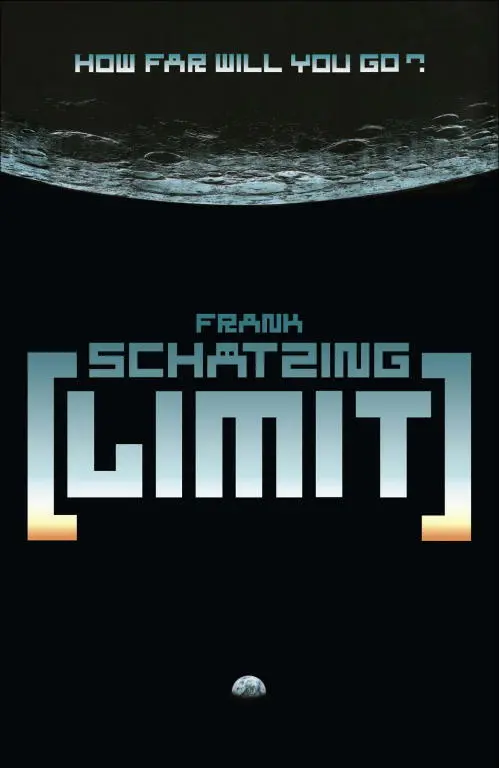
- Название:Limit
- Автор:
- Издательство:Jo Fletcher Books
- Жанр:
- Год:2013
- Город:London
- ISBN:9781849165150
- Рейтинг книги:4 / 5. Голосов: 1
-
Избранное:Добавить в избранное
- Отзывы:
-
Ваша оценка:
Limit: краткое содержание, описание и аннотация
Предлагаем к чтению аннотацию, описание, краткое содержание или предисловие (зависит от того, что написал сам автор книги «Limit»). Если вы не нашли необходимую информацию о книге — напишите в комментариях, мы постараемся отыскать её.
In 2025, entrepreneur Julian Orley opens the first-ever hotel on the moon. But Orley Enterprises deals in more than space tourism—it also operates the world’s only space elevator, which in addition to allowing the very wealthy to play tennis on the lunar surface connects Earth with the moon and enables the transportation of helium-3, the fuel of the future, back to the planet. Julian has invited twenty-one of the world’s richest and most powerful individuals to sample his brand-new lunar accommodation, hoping to secure the finances for a second elevator…
On Earth, meanwhile, cybercop Owen Jericho is sent to Shanghai to find a young female hacker known as Yoyo, who’s been on the run since acquiring access to information that someone seems quite determined to keep quiet. As Jericho closes in on the girl and the conspiracy swirling around her, he finds mounting evidence that connects her to Julian Orley as well as to the entrepreneur’s many competitors and enemies. Soon, the detective realizes that the lunar junket to Orley’s hotel is in real and immediate danger.
Limit — читать онлайн бесплатно полную книгу (весь текст) целиком
Ниже представлен текст книги, разбитый по страницам. Система сохранения места последней прочитанной страницы, позволяет с удобством читать онлайн бесплатно книгу «Limit», без необходимости каждый раз заново искать на чём Вы остановились. Поставьте закладку, и сможете в любой момент перейти на страницу, на которой закончили чтение.
Интервал:
Закладка:
Jericho had often crossed the island during trips to Berlin, taking one of the many bridges that moored it to the city, without ever having set foot in one of the museums. There had never been time. Now, as he hurried along the banks of the Spree, the thought that the time had finally come was not a cheering one. His jackets bulged with all the packets of money which made up Vogelaar’s payment. His Glock was in its holster, invisible to all. He looked like any other tourist, but he felt like the proverbial goose, off to meet the fox for dinner. As long as Vogelaar actually had the dossier, the two of them would make the exchange quite quietly and calmly, cash for information, and be on their way. If he didn’t, there would be trouble in store. The mercenary would want the money by hook or by crook, and he would certainly not rely on a smile and a kind word to get it.
Jericho felt his ear and slowed his pace.
The Pergamon Museum’s temple façade seemed to stare at him, each window a watchful eye. In the fourth wing, crowds of culture vultures jostled along the glass hallway, among the last surviving traces of lost empires. He walked on, glancing at his watch. Quarter past eleven. They had agreed on twelve o’clock, but Jericho wanted to get to know the location first. On his right, a long, modern building abutted the rest, its lower storey modelled after the older architecture while the top was a tall, airy colonnade: the James Simon Gallery, entrance to the museum island’s web of walkways. Visitors bustled across to the island in a chattering, sweating throng. Jericho joined the crowd crossing this arm of the Spree and was carried along up a grandiose stairway to the top floor of the gallery. He bought his ticket in a spacious hall lined with terraces and cafés, and followed the signs for the Pergamon Museum.
His first impression as he entered the southern wing of the museum was that he had walked into nirvana. The only feature in the room which tied it to earthly time and space was the Romanesque arched window towards the river. The exhibits were lifted clean out of any historical context, displayed in a space so huge it could almost be hyperspace, and looked splendid yet lonely at one and the same time, a chilly, hypothetical view of history. Jericho turned right and walked along a kind of street, with walls on either side, its frieze and battlements glowing with rich colour, reading the explanatory captions as he went. The animals in the frieze represented the Babylonian gods, with stately lions for Ishtar, goddess of love and protector of armies, serpentine dragons for Marduk, god of fertility and eternal life, patron of the city of Babylon, and wild bulls for Adad, lord of storms. Nebuchadnezzar II had ordered an inscription for the walls, reading ‘May ye walk in joy upon this Processional Way, oh ye gods.’ He could never have dreamed that the moment would come when groups of Japanese and Korean tourists would mill about in confusion here, losing their bearings amidst the grandeur of the past, hurrying to catch up with the wrong tour guide, confused by identical tabards. There was a model of Babylon in a glass cube, with a truncated pyramid in the middle soaring heavenwards; this was the ziggurat, the temple of Marduk. So that was where the God of the Old Testament had poured out his wrath, onto this surprisingly low tower, where he had confounded their language. Right then. This street had originally led to the ziggurat from the Ishtar Gate, which dominated the next hall, blue and yellow, glorious, shining like the sun, covered like the walls of the Way with the gods’ totem animals. The mass of visitors crowding the Way gave some idea of what it must have been like here at the time of the great processions.
Rush hour in Babylon.
Jericho went through the gate of Babylon and emerged 660 years later from a Roman gate that took up the whole wall of the next hall: the Market Gate of Miletus, two storeys high, a showpiece of transitional architecture, halfway between Hellenistic and Roman. He kept a constant lookout for exit routes. So far, it was easy to keep his bearings in the museum. The only thing that might slow him down was the density of the crowd of visitors, moving only at glacial speeds. Next to him, a Korean man was gesticulating furiously, telling his tour guide that he had lost his wife to the Japanese, only to learn that he had ended up with the Japanese. This was the modern equivalent of the Tower of Babel, with languages mixing in confusion: the tourist group huddled into a knot. Jericho edged his way around them and escaped to the next hall.
He knew where he was at once.
This was where Vogelaar had chosen for the meeting. The room was the size of a hangar, but more than half of it was taken up by the front of a colossal Roman temple. Even the stairway leading up to the colonnades had to be a good twenty metres wide. All around the base of the temple ran a comic strip in marble, twice the height of a man, which the museum signs announced as the famous frieze of the Gigantomachy, showing the story of the Greek gods’ battle against the giants. It was the tale of an attempted coup, making it the perfect place to meet Vogelaar: Zeus had slighted Gaia by imprisoning her monstrous children, the Titans, in Tartarus – a sort of primordial Black Beach Prison. Gaia was determined to free them from the underworld and get rid of the hated father of the gods and all his corrupt crew, so she roused up to rebellion her children who were still at liberty. These were the giants, and Gaia knew that they could not be killed at the hands of a god. The giants were well-known ruffians, and just to make them scarier, they had giant snakes for legs. They leapt at the chance to protect their mother’s honour, and this gave Zeus the pretext to indulge in yet another of his many dalliances with human women – This is just a strategic move, Hera, it’s not how it looks! – and to father Hercules, a mortal, who would be able to sort the giants out. The giants put up a fight, chucking around hilltops and tree-trunks, so Athena rose to the challenge – Anything you can do, I can do better! – and flung whole islands at them, burying one of the ringleaders, Enkelados, under nothing less than Sicily; from that moment on, the giant blew his fiery breath up through Etna, while another, Mimas, was trapped beneath Vesuvius, and Poseidon scored a square hit on a third giant with the island of Kos. Most of them, though, succumbed to Hercules’ poisoned arrows, until the whole serpent-legged brood was exterminated. The frieze told the same old story, of a struggle for power, with the same old weapons. Who were the Fang, who were the Bubi, and who were the colonialists? Who bankrolled whom, and why? Had there been a dossier back then as well, containing the whole story, something like ‘The Truth about the Gigantomachy’ or ‘The Olympus Files’? A dossier like the one that the last surviving giant from Equatorial Guinea claimed to have?
Jericho’s gaze turned to the stairway.
There were three entrances to the pillared central hall, where the altar had once stood. Vogelaar had said he’d be waiting there. He climbed the gleaming marble steps, went through the columns and found himself in a large, rectangular space, brightly lit, with another, smaller frieze running around its walls. From up here there was a good view of everything happening down at the bottom of the stairs, as long as you didn’t mind being seen in turn. Further back in the room, and you were safely out of sight.
Jericho looked at his watch.
Half past eleven. Time to explore the rest of the museum.
He left the temple hall the other way and went into the north wing, where he found other examples of Hellenistic architecture. And what if Vogelaar didn’t have a dossier? He paced along the façade of the Mshatta palace, a desert castle from the eighth century. He was increasingly worried that the whole thing might be a trap. Romanesque windows marked the end of the north wing, but he couldn’t have said what he had seen in this part of the museum. As a scouting trip to learn the lie of the land, this was a wash-out. Stone faces stared down at him. He turned left. The way through to the fourth wing of the museum, the glass wing, led between rams and sphinxes, past pharaohs, through the temple gate from Kalabsha and beneath artefacts from the pyramid temple of Sahuré. Suddenly Jericho felt reminded of another glass corridor, the one where the ill-fated Grand Cherokee Wang had met Kenny Xin. An omen? With a grating sound, arms lifted, spear-tips were raised, granite fingers closed on the hilts of swords carved from stone. He went on, the daylight flooding in on him. To his right he could look through the windows that covered the whole wall, down to one of the bridges over this arm of the Spree, while to his left the inner courtyard of the museum stretched away. In front of him was an obelisk showing priest-kings gesturing strangely from the backs of glaring beasts, and in the corner was a statue of the weather god Hadad. Here the glass corridor joined the museum’s south wing and completed the circuit, leading back to the Babylonian Processional Way.
Читать дальшеИнтервал:
Закладка:
Похожие книги на «Limit»
Представляем Вашему вниманию похожие книги на «Limit» списком для выбора. Мы отобрали схожую по названию и смыслу литературу в надежде предоставить читателям больше вариантов отыскать новые, интересные, ещё непрочитанные произведения.







Обсуждение, отзывы о книге «Limit» и просто собственные мнения читателей. Оставьте ваши комментарии, напишите, что Вы думаете о произведении, его смысле или главных героях. Укажите что конкретно понравилось, а что нет, и почему Вы так считаете.