Frank Schätzing - Limit
Здесь есть возможность читать онлайн «Frank Schätzing - Limit» весь текст электронной книги совершенно бесплатно (целиком полную версию без сокращений). В некоторых случаях можно слушать аудио, скачать через торрент в формате fb2 и присутствует краткое содержание. Город: London, Год выпуска: 2013, ISBN: 2013, Издательство: Jo Fletcher Books, Жанр: Фантастика и фэнтези, на английском языке. Описание произведения, (предисловие) а так же отзывы посетителей доступны на портале библиотеки ЛибКат.
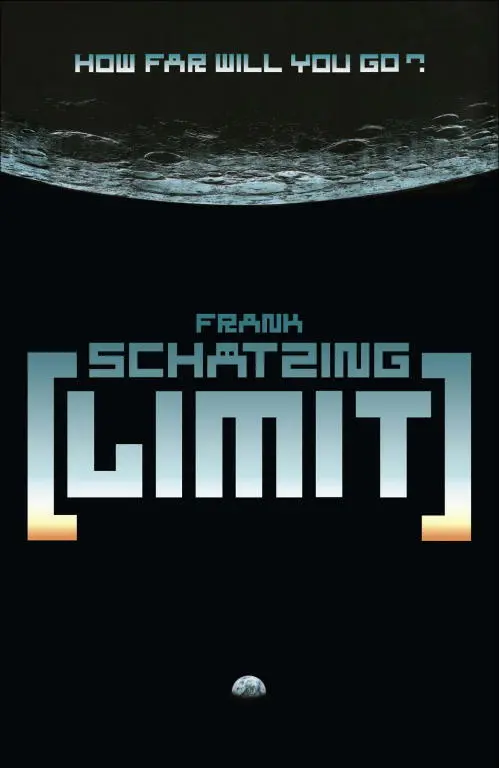
- Название:Limit
- Автор:
- Издательство:Jo Fletcher Books
- Жанр:
- Год:2013
- Город:London
- ISBN:9781849165150
- Рейтинг книги:4 / 5. Голосов: 1
-
Избранное:Добавить в избранное
- Отзывы:
-
Ваша оценка:
Limit: краткое содержание, описание и аннотация
Предлагаем к чтению аннотацию, описание, краткое содержание или предисловие (зависит от того, что написал сам автор книги «Limit»). Если вы не нашли необходимую информацию о книге — напишите в комментариях, мы постараемся отыскать её.
In 2025, entrepreneur Julian Orley opens the first-ever hotel on the moon. But Orley Enterprises deals in more than space tourism—it also operates the world’s only space elevator, which in addition to allowing the very wealthy to play tennis on the lunar surface connects Earth with the moon and enables the transportation of helium-3, the fuel of the future, back to the planet. Julian has invited twenty-one of the world’s richest and most powerful individuals to sample his brand-new lunar accommodation, hoping to secure the finances for a second elevator…
On Earth, meanwhile, cybercop Owen Jericho is sent to Shanghai to find a young female hacker known as Yoyo, who’s been on the run since acquiring access to information that someone seems quite determined to keep quiet. As Jericho closes in on the girl and the conspiracy swirling around her, he finds mounting evidence that connects her to Julian Orley as well as to the entrepreneur’s many competitors and enemies. Soon, the detective realizes that the lunar junket to Orley’s hotel is in real and immediate danger.
Limit — читать онлайн бесплатно полную книгу (весь текст) целиком
Ниже представлен текст книги, разбитый по страницам. Система сохранения места последней прочитанной страницы, позволяет с удобством читать онлайн бесплатно книгу «Limit», без необходимости каждый раз заново искать на чём Вы остановились. Поставьте закладку, и сможете в любой момент перейти на страницу, на которой закончили чтение.
Интервал:
Закладка:
‘During a business trip. You see, I’m interested to find out whether the attack in Calgary has any precedents. Whether it was perhaps less about you personally and more about what you represent. So I put Ruiz’s files together. Happily married, two healthy children, no debts. But he does have opponents in his own field for whom he was too liberal, too environmentally aware; he was a moralist – nicknamed Ruiz El Verde. For example, he spoke out against oil-sand exploitation and pushed for more exploration of the deep sea. Now, I don’t need to tell you that the companies always shied away from cost-intensive exploration proposals when oil prices were low, and three years ago the demise was already well under way. Ruiz urged Repsol to strengthen their involvement with alternative energies. Does that remind you of anyone? Yourself perhaps?’
Incredible, thought Palstein.
‘It could all be a coincidence,’ Loreena continued. ‘Ruiz’s disappearance. China’s engagement in the oil-sand trade. Even the Asian man your people allowed into the house. Perhaps he’s just harmless and I’m seeing ghosts, but my gut instinct and common sense are telling me that we’re on the right track.’
‘And what do you think I should do now?’
‘Don’t trust Gudmundsson and his people. If it should all turn out to be a mistake, I’ll be the first one to eat humble pie. Until then: rack your brains! About Ruiz. About critical overlaps with China. About pitfalls in your own business; and another thing too – have a think about who might have had a vested interest in your not going along on the moon flight. You can call me, or we can meet up, at any time. Try to find out who the Asian in the photo is, perhaps he might be on EMCO’s internal database. Invest in personal security, throw Gudmundsson and his team out on their ear as far as I’m concerned, but don’t go to the police. That’s the only thing I’m asking of you.’
‘Then you’re asking a lot!’
‘Just not for the moment.’
‘This could all be evidence.’
‘Gerald,’ said Loreena insistently, ‘I promise you, I won’t do anything that puts you in danger, nor keep things from the police. It’s just for the moment. I need a head start to be able to get an exclusive on the story.’
‘Do you realise what you’re telling me here? What you’re asking of me?’
‘We have a deal, Gerald. I may have found your would-be assassin, and that’s more than the police managed in four weeks. Give me time. We’re working on it under extreme pressure. I’ll serve those pigs up to you on a silver platter.’
Palstein fell silent. Then he sighed.
‘Fine,’ he said. ‘Do whatever you think is right.’
29 May 2025
THE MERCENARY
Night Flight
There was one good thing you could say about Teodoro Obiang Nguema Mbasogo: after he’d come to power in August 1979, the human rights situation in Equatorial Guinea had visibly improved. From that point on, there were no more mass crucifixions along the highway to the airport, and the skulls of the opposition were no longer impaled on stakes for all to see.
‘A true philanthropist,’ scoffed Yoyo.
‘But not the first,’ said Jericho. ‘Have you heard of Fernão do Pó?’
Heading towards Berlin at twice the speed of sound, they travelled backwards in time, from the Shanghai dawn to the Berlin night, from the year 2025 to the beginnings of a continent in which it seemed everything that could go wrong, always did. Africa, the unloved cradle of humanity, characterised by dead-straight borders which severed its ancient tendons and nerves, creating countries of bizarre geometry, the smallest of which lay patchwork-like on the western fringes, its history reading like a chronicle of continual rape.
‘Fernão do Pó? Who on earth is he?’
‘Another philanthropist. After a fashion.’
As Tu had insisted on flying his company jet himself, Jericho and Yoyo had the luxurious, twelve-seater passenger cabin to themselves. They were using two monitors, supported by Diane, to familiarise themselves with Equatorial Guinea in the hope of finding answers to the questions of the last two days. The picture only became more and more confusing with each piece of information the computer provided, and the only thing that had become clear was that the events in Equatorial Guinea could only be understood if one looked at their development from the very beginning. And that beginning started with:
Fernão do Pó.
A stagnant lake. Dead calm. Curtains of rain billow out over the coastline.
Sweat and rainwater mix on skin, making it look as though it’s been boiled in steam. Orchestrated by the cries of small seabirds, the boats are lowered into the water. The oarsman pulling, a man upright in the bow. The shore comes closer, vegetation takes shape against the deepening grey. The man walks onto the shore, looks around. Once again, an area’s transformation into a state-like zone starts with a Portuguese man.
In 1469, do Pó’s caravels anchor beneath the elbow of Africa, right where the continent tapers off dramatically. The discoverer, the legitimate successor of Henry the Navigator, lands on a small island and calls it Formosa on account of its beauty. Bantus live here, the Bubi tribe. They welcome the visitors in a friendly manner, unaware that their kingdom has just changed hands. From the very moment when do Pó left his bootprints in the sand, they are now subjects of his majesty Alfonso V of Portugal, to whom Pope Nicholas had handed over the entire African island, along with monopoly on trade and sole maritime law, a few years before. At least, the Pope believed that Africa was an island, sharing that misconception with Western Christianity. Do Pó provided proof to the contrary. It was discovered that Africa was in actual fact a continent, and one with a long and fertile coastline, inhabited by dark-skinned people who seemed to have very little to do and who were in dire need of Christianisation. This, in turn, corresponded perfectly with the crux of the papal bull, which decreed that non-believers were to be steamrollered into slavery – a recommendation with which Alfonso and his seafarers were happy to comply.
The day that do Pó arrived changed everything. And yet, ultimately, nothing. If he hadn’t come, then sooner or later someone else would have. Many followed in his footsteps, and the slave trade thrived for three hundred years. Then the Portuguese crown exchanged its ownership of African territory for colonies in Brazil, and the Bantu changed masters. Spain was the new owner. The British, French and Germans began to get involved, all of them fighting for the areas from Cape Santa Clara right up to the Niger Delta—
‘And then they tried to oppress the natives, a task which was made easier by the discord amongst the Bantu, or to be more precise, the growing rivalry between the Bubi and Fang.’
‘Fang?’ grinned Yoyo. ‘Fang Bubi?’
‘It’s no laughing matter,’ said Jericho. ‘This is Africa’s traumatic past.’
‘Yes, I know. The colonialists thought about everything, just not about ethnic roots. Look at Rwanda, Hutu and Tutsi—’
‘Okay.’ Jericho massaged the back of his neck. ‘On the other hand let’s not pretend that it’s a purely African invention.’
‘No, you Europeans of all people should keep quiet on that matter.’
‘Why?’
Yoyo’s eyes widened. ‘Oh, come on! Look at Serbia and Kosovo. There’s still no peace even seventeen years after independence! Then the Basques, the Scottish and the Welsh. Northern Ireland.’
Jericho listened, his arms crossed.
‘Taiwan,’ he said. ‘Tibet.’
Читать дальшеИнтервал:
Закладка:
Похожие книги на «Limit»
Представляем Вашему вниманию похожие книги на «Limit» списком для выбора. Мы отобрали схожую по названию и смыслу литературу в надежде предоставить читателям больше вариантов отыскать новые, интересные, ещё непрочитанные произведения.






Обсуждение, отзывы о книге «Limit» и просто собственные мнения читателей. Оставьте ваши комментарии, напишите, что Вы думаете о произведении, его смысле или главных героях. Укажите что конкретно понравилось, а что нет, и почему Вы так считаете.