Frank Schätzing - Limit
Здесь есть возможность читать онлайн «Frank Schätzing - Limit» весь текст электронной книги совершенно бесплатно (целиком полную версию без сокращений). В некоторых случаях можно слушать аудио, скачать через торрент в формате fb2 и присутствует краткое содержание. Город: London, Год выпуска: 2013, ISBN: 2013, Издательство: Jo Fletcher Books, Жанр: Фантастика и фэнтези, на английском языке. Описание произведения, (предисловие) а так же отзывы посетителей доступны на портале библиотеки ЛибКат.
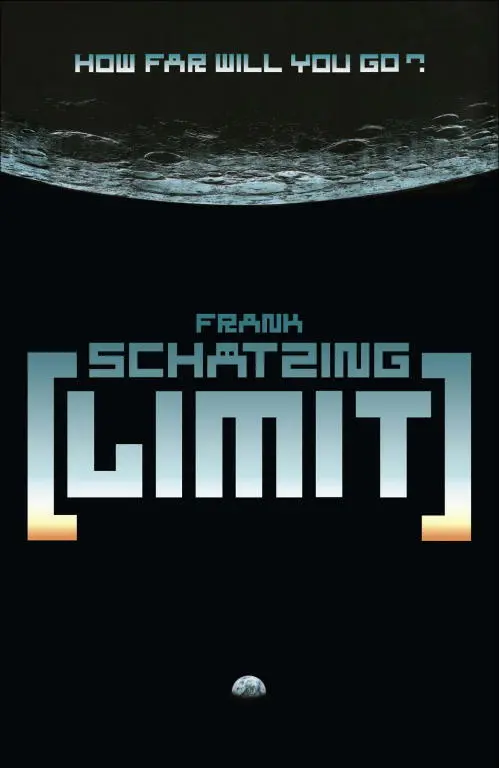
- Название:Limit
- Автор:
- Издательство:Jo Fletcher Books
- Жанр:
- Год:2013
- Город:London
- ISBN:9781849165150
- Рейтинг книги:4 / 5. Голосов: 1
-
Избранное:Добавить в избранное
- Отзывы:
-
Ваша оценка:
Limit: краткое содержание, описание и аннотация
Предлагаем к чтению аннотацию, описание, краткое содержание или предисловие (зависит от того, что написал сам автор книги «Limit»). Если вы не нашли необходимую информацию о книге — напишите в комментариях, мы постараемся отыскать её.
In 2025, entrepreneur Julian Orley opens the first-ever hotel on the moon. But Orley Enterprises deals in more than space tourism—it also operates the world’s only space elevator, which in addition to allowing the very wealthy to play tennis on the lunar surface connects Earth with the moon and enables the transportation of helium-3, the fuel of the future, back to the planet. Julian has invited twenty-one of the world’s richest and most powerful individuals to sample his brand-new lunar accommodation, hoping to secure the finances for a second elevator…
On Earth, meanwhile, cybercop Owen Jericho is sent to Shanghai to find a young female hacker known as Yoyo, who’s been on the run since acquiring access to information that someone seems quite determined to keep quiet. As Jericho closes in on the girl and the conspiracy swirling around her, he finds mounting evidence that connects her to Julian Orley as well as to the entrepreneur’s many competitors and enemies. Soon, the detective realizes that the lunar junket to Orley’s hotel is in real and immediate danger.
Limit — читать онлайн бесплатно полную книгу (весь текст) целиком
Ниже представлен текст книги, разбитый по страницам. Система сохранения места последней прочитанной страницы, позволяет с удобством читать онлайн бесплатно книгу «Limit», без необходимости каждый раз заново искать на чём Вы остановились. Поставьте закладку, и сможете в любой момент перейти на страницу, на которой закончили чтение.
Интервал:
Закладка:
‘No?’ said the giant, surprised.
‘Not at that price.’
‘Fine. Name your price.’
‘I’ll give you another idea. An A with a frayed ring around it and four mysterious letters beneath. You remember? I go there, I come back. Then we do business.’
The giant wrinkled his brow laboriously. He was thinking, Jericho had to assume. Then he described a route which seemed to run the whole length and breadth of Quyu.
What had the kid said just now? Not really far?
‘And what do the letters mean?’
‘NDRO?’ The giant laughed. ‘This friend of yours must really have been in a hurry. It’s Andromeda.’
‘Ah!’
‘It’s a live concert venue.’
‘Thanks.’
‘Your knowledge of Quyu seems to rest on the very slightest acquaintance, if you don’t mind my saying so.’
Jericho had to raise his eyebrows. He would never have expected that a man-mountain like this, with such a tough-looking skull, would produce such a refined turn of phrase.
‘It’s true, I hardly know the place.’
‘Then take care of yourself.’
‘Of course. I’ll see you later, umm – May I ask your name?’
A grin spread across the huge face.
‘Daxiong. Just Daxiong.’
Aha. Six Koreans had come away with injuries. Slowly, the story was becoming clearer.
Jericho had never been in Quyu before. He had no idea what was lying in wait for him when he drove through beneath the freeway. But in fact nothing happened. Quyu didn’t begin at any clearly marked spot, at least not in this part. It simply just – began. With rows of low-built houses like the ones he had just left. Hardly any shops as such, but instead street vendors cheek by jowl, who had spread out onto their sheets and carpets anything that seemed saleable and couldn’t run away. A woman in a rickety rattan chair, dozing in the shadow of a jury-rigged canopy, a basket of aubergines in front of her. A shopper took two of these, put money in her apron and went on without waking her. Old people chatting, some in pyjamas, others bare-chested. Jostling crowds on crumbling pavements. Criss-crossing the street, overhead, the flapping banners of washing hung out to dry, smocks and shirts waving their sleeves at one another whenever the wind found its way between the houses. Murmurs, chatting and shouting, melodic, booming, shrill or low, all woven together into a cacophony. Cheap pedal-bikes everywhere, clawing at the nerves, squeaking and rattling, the thud of hammers and the whine of drills, the sounds of running repairs, maintenance of the make-do-and-mend school. Some traders spotted Jericho’s head of blond hair, leapt to their feet and yelled ‘Looka, looka!’ across the street, waving handbags, watches, sculptures; he ignored them, concentrating on not running anyone over. In Shanghai, downtown Shanghai, traffic was a state of war. Lorries hunted buses, buses chased cars which chased bikes, and all of them together had sworn death to all pedestrians. In Quyu it was less aggressive, but that made it no better. Rather than attacking one another, road users simply ignored one another. Folk who had just now been haggling over chickens or kitchen-ware would hop down into the road, or stand there in little knots, debating the weather, the price of groceries, their families’ health.
With every street he went down, Jericho saw fewer traders aiming at the tourist market. The goods offered for sale became poorer. As the number of cars on the street dropped, there were more and more pedestrians and bicycles, and the throng thinned out. More and more often he saw half-demolished houses, their missing walls meagrely patched with cardboard and corrugated iron, all of them inhabited. In between, years and years of rubble. A cluster of grey and dull blue modular blocks appeared at the side of the road as though cast carelessly down like dice, arthritic trees twisted double in front of them, the randomly parked cars dating back to the days when Deng Xiaoping had proclaimed the economic miracle which had never quite taken place in this part of China.
All of a sudden it was dark around him.
The deeper Jericho went into the heart of Quyu, the less clearly structured it became. Every possible style of architecture seemed to have been thrown on the heap here. High-rise blocks abandoned halfway alternated with derelict low-rises and silos several storeys high, their hideousness emphasised by the peeling remains of several colours of paint. Jericho was most moved by the pathetic attempts to make the uninhabitable look like a habitation. There was something almost like an architectural vernacular going on here in the tangle of hand-built shacks, most little more than posts rammed into the ground and covered over with tarpaulin. At least there was life here, while the silos looked like post-atomic tombs.
In the midst of a wasteland of rubbish he stopped and looked at women and children loading whatever they thought they could use onto barrows. Whole swathes here looked as though once-intact city blocks had been pulverised by bombing raids. He tried to remember what he knew about districts like these. A number that he had noticed somewhere flitted through his mind. In 2025, there were one and a half billion people living in slums worldwide. Twenty years before it had been one billion. Every year, twenty or thirty million came to join them. A new arrival in the slums had to fight his way up bizarre hierarchies, where those on the lowest rung collected trash and made from it whatever they could sell or trade. According to Daxiong’s description, he would need at least another hour to get to the Andromeda. He drove on, thought of the quarter he had wound up living in years ago, shortly before it had been torn down to make room for the development where Yoyo lived. At the time he hadn’t been able to understand why the residents were so attached to their ruins. He understood that they had no choice, except that some of them could have taken up the offer of being relocated in relatively luxurious apartments outside Shanghai, with running water, baths and toilets, lifts and electricity.
‘Here, we exist,’ they had answered, smiling. ‘Outside, we are ghosts.’
It was only later that he realised that the measure of human misery is not in the condition of the housing. Scarce drinking water, overflowing gutters, blocked drains, all these had their place in the annals of hell. But while people were living on the streets, at least they could meet. It was where they sold their wares. It was where they cooked for the labourers who never otherwise had a chance to make a meal. Food preparation alone provided a living for millions of families, and fed them in turn, a livelihood that could only be earned down at street level, just as the street provided social cohesion. People stood by their doorways, deep in conversation. Life at ground level, the openness of houses, all this spread warmth and comfort. Nobody dropped in to buy something on the tenth floor of a high-rise, and if you stepped outside the door, all you could see was a wall. The road took him to a hill. From up here, he could see in every direction, as much as he could see anything through the dirty brown blanket of smog. The COD was air-conditioned, but Jericho thought he could feel the sun on his skin. All around him was a sight he had grown used to by now. Shacks, high-rise blocks, all more or less shabby, poles standing drunkenly festooned with dangling power cables, rubble, dirt.
Should he go on?
Baffled, he told his phone to take bearings. It projected him right in the middle of no man’s land. Off the maps. It was only when he zoomed out that it deigned to show him a couple of main roads that ran through Quyu, if the data was still up-to-date.
Was Yoyo really hiding in this desolation?
He entered the coordinates from where the blog post had been uploaded to Brilliant Shit. The computer showed him a spot not far from Demon Point, near the freeway.
Читать дальшеИнтервал:
Закладка:
Похожие книги на «Limit»
Представляем Вашему вниманию похожие книги на «Limit» списком для выбора. Мы отобрали схожую по названию и смыслу литературу в надежде предоставить читателям больше вариантов отыскать новые, интересные, ещё непрочитанные произведения.







Обсуждение, отзывы о книге «Limit» и просто собственные мнения читателей. Оставьте ваши комментарии, напишите, что Вы думаете о произведении, его смысле или главных героях. Укажите что конкретно понравилось, а что нет, и почему Вы так считаете.