Robert Heinlein - Variable Star
Здесь есть возможность читать онлайн «Robert Heinlein - Variable Star» весь текст электронной книги совершенно бесплатно (целиком полную версию без сокращений). В некоторых случаях можно слушать аудио, скачать через торрент в формате fb2 и присутствует краткое содержание. Город: New York, Год выпуска: 2006, ISBN: 2006, Издательство: Tor, Жанр: Фантастика и фэнтези, на английском языке. Описание произведения, (предисловие) а так же отзывы посетителей доступны на портале библиотеки ЛибКат.
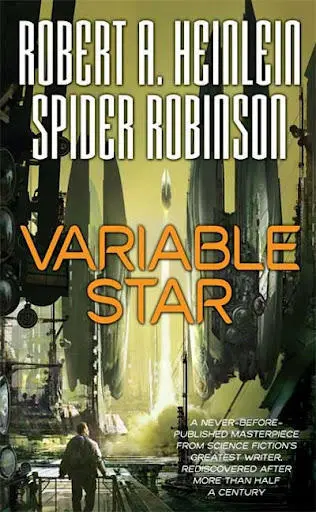
- Название:Variable Star
- Автор:
- Издательство:Tor
- Жанр:
- Год:2006
- Город:New York
- ISBN:978-0-7653-5168-5
- Рейтинг книги:4 / 5. Голосов: 1
-
Избранное:Добавить в избранное
- Отзывы:
-
Ваша оценка:
Variable Star: краткое содержание, описание и аннотация
Предлагаем к чтению аннотацию, описание, краткое содержание или предисловие (зависит от того, что написал сам автор книги «Variable Star»). Если вы не нашли необходимую информацию о книге — напишите в комментариях, мы постараемся отыскать её.
When Joel Johnston first met Jinny Hamilton, it seemed like a dream come true. And when she finally agreed to marry him, he felt like the luckiest man in the universe.
There was just one small problem. He was broke. His only goal in life was to become a composer, and he knew it would take years before he was earning enough to support a family.
But Jinny wasn’t willing to wait. And when Joel asked her what they were going to do for money, she gave him a most unexpected answer. She told him that her name wasn’t really Jinny Hamilton—it was Jinny Conrad, and she was the granddaughter of Richard Conrad, the wealthiest man in the solar system.
And now that she was sure that Joel loved her for herself, not for her wealth, she revealed her family’s plans for him—he would be groomed for a place in the vast Conrad empire and sire a dynasty to carry on the family business.
Most men would have jumped at the opportunity. But Joel Johnston wasn’t most men. To Jinny’s surprise, and even his own, he turned down her generous offer and then set off on the mother of all benders. And woke up on a colony ship heading out into space, torn between regret over his rash decision and his determination to forget Jinny and make a life for himself among the stars.
He was on his way to succeeding when his plans—and the plans of billions of others—were shattered by a cosmic cataclysm so devastating it would take all of humanity’s strength and ingenuity just to survive.
Variable Star — читать онлайн бесплатно полную книгу (весь текст) целиком
Ниже представлен текст книги, разбитый по страницам. Система сохранения места последней прочитанной страницы, позволяет с удобством читать онлайн бесплатно книгу «Variable Star», без необходимости каждый раз заново искать на чём Вы остановились. Поставьте закладку, и сможете в любой момент перейти на страницу, на которой закончили чтение.
Интервал:
Закладка:
Throughout all the terrible days since, I had been focused intently and exclusively on what I did not want to do.
Well, that had been silly of me, hadn’t it? Now that I was finally and forever safe from the terrible danger of becoming one of the richest humans alive, married to the girl of my dreams, perhaps it was time to give some quantum of thought to what I might find preferable. If anything.
Great blathering mother of morons, what was I going to do with the next twenty years? Or the twenty after that, if it came to it?
Herb was saying something. Why did I know that? Oh. He had touched my hand to get my attention. I rewound my ears. “—don’t have to come up with an answer right this minute,” he had said.
I wasn’t absolutely sure I agreed—but just then I heard my name called. It was Solomon Short, in a larger nearby booth with three companions. He waved emphatically to us to come and join them. I looked to Herb for help, and he shrugged, so we got up and went over to the other booth. Sol’s companions slid over to make room for us, while he made introductions.
As I’d guessed, his friends were all Relativists like him. I had now met five of the six people on whom our whole voyage depended. Nearest me was Tenzin Hideo Itokawa, a tiny man whom I learned later was a Zen Buddhist monk; then, I got only that he had twinkling eyes and seemed to lack vocal cords. Between him and Sol was a hearty and voluptuous woman named London McBee, who turned out to be married to George R Marsden, the Relativist I’d literally bumped into in my first seconds aboard. She and Sol volleyed with words, vying to outpun each other. But the most striking of the three was clearly the man on the other side of the table, Peter Kindred, and for the life of me I could not decide why.
There was something electric and sheepish about him, that’s the best I can say it—he gave off the disconcerting sensation that at any moment he was likely to switch from talking to quacking like a duck, or barking like a dog—that at any given time there was utterly no way of telling what he might take it into his head to do—and that at the same time, he was just a little embarrassed by it. It was more than just mad eyes, though he surely had those. His name seemed ironically chosen; he had “Loose Cannon” written all over him. Sol and London both seemed to find him delightful.
I was overawed. Most of the ship’s power, literally, was seated at that table. I’m used to famous people, even great people. This was different. In a pinch, the Sheffield could have gotten by without her captain—but her Relativists were essential . These men and woman spent their days reaching into the cosmic vacuum with their naked organic brains, and persuaded it to yield up its inconceivable energy in a measured fashion.
I realize that description has about as much meaning as saying that a nuclear fission plant works because the gods breathe upon its mojo in such a way as to cause it to be far out. One of my hopes, as I sat down, was to perhaps solicit a better explanation from one or more of the Relativists I was privileged to talk to. But I got off to a bad start.
Things went fine at first. Sol introduced his companions to us. Then he introduced Herb to them, giving them a two-sentence thumbnail bio. Then he introduced me—and that’s where it went sour. His second sentence for me began, inevitably, with, “His father was the—”
But by the second word, Peter Kindred had gone berserk. He kicked his chair over backward with his butt, leaped backward over it, landed several feet away in combat crouch, making finger gestures to ward off evil.
At me.
I opened my mouth—
“SHUT UP!” he screamed.
I blinked.
“Not a word! AIYEEE!” He averted his gaze. “No facial expressions!”
I looked at Herb, then Sol, then everybody else, without finding anything I could use. I decided I needed to leave, started to rise.
He screamed, hopped back a pace, and snatched a plate from someone’s table, holding it like a cream pie in an ancient comedy. “Back!” he shrieked. “You lunatic! Are you crazy? What the fuck are you trying to do to me?”
I shrugged. I had to: it was all he had left me.
It was the last straw. He shut his eyes, made a strangling sound, turned, and left the room at high speed. Taking the plate with him, despite loud protest from its owner.
“Don’t mind Peter,” Sol said imperturbably.
“He’s terrified of Centipede’s Dilemma,” said London.
“Ahhh,” I said. “Of course.”
“He’s rude,” Herb said.
“No, no,” I said. “I think I actually get it.” And after I explained my thinking, they agreed that I did.
Without its Relativists, no starship can operate its primary drive, open the Ikimono Portal into the dark energy universe. Not without becoming a Gamma Ray Burst in short order, anyway.
That monstrous engine of mass creation had not been invoked, yet, and could not be until we’d gotten a little farther away from Sol—but without it and its kind, most star travel would have been impossible, and the rest would have awaited the development of suspended animation to accomplish. And thanks to the Prophet’s distaste for fiddling with God’s allegedly clear intentions, safe suspended animation still seems to lie as far in the future as it did centuries ago.
Thanks to Relativists, though, mankind finally had a drive that could really take it to the stars, within normal human life span. The only problem was that, countless generations of folklore to the contrary, the relativistic engine really was the first engine ever invented that literally required the constant attention of a human operator to function: the Relativist. Somehow, an organic brain was able— some organic brains were able—to ensure that every time Doc Schrödinger opened his box, what came out was a live cat. Even if none had been in there to start with.
The last I’d heard, the entire Solar System held something less than two hundred humans—out of dozens of billions!—who had the necessary combination of talents, skills, attitudes, and education to perform that task reliably. More than half of them, I had read, wanted to do something else. The rest probably commanded a higher salary than Jinny’s father.
When the mathematician/poet and Soto Zen Buddhist priest Hoitsu Ikimono Roshi (whose name means “life,” “living creatures,” “farm products,” or “uncooked food”) discovered the first practical star drive in 2237—or perhaps was merely the first such discoverer to survive—he thereby created the profession called “Relativist.” The best definition ever offered to the layman of what a Relativist does is (naturally) the Roshi’s: he said they meditate on and with the engine, in order to make it happy enough to function.
He held back the part about how they dissuade the star drive from becoming a star… until humankind had invested heavily in star travel, both economically and emotionally. Fortunately that did not take long: the Roshi’s only significant character flaw was reluctance to keep a joke to himself. (A great pity: it finally killed him… a joke he must have loved.)
Technically one could argue that Relativists should be called relativistic engineers. Without them, no engine; res ipse loquitur . But as it happens, the term “engineer” is already in use—by people who find the very kind of science that relativism requires to be witchcraft, spooky science, mumbo jumbo, perhaps even hocus-pocus. To them, it stops just short of being that most despised of all modes of thinking: a religion. The very first word in its technical description ruins all hope of conversation, sets engineers’ teeth on edge, and makes all the hairs bristle at the backs of their necks.
Читать дальшеИнтервал:
Закладка:
Похожие книги на «Variable Star»
Представляем Вашему вниманию похожие книги на «Variable Star» списком для выбора. Мы отобрали схожую по названию и смыслу литературу в надежде предоставить читателям больше вариантов отыскать новые, интересные, ещё непрочитанные произведения.

Обсуждение, отзывы о книге «Variable Star» и просто собственные мнения читателей. Оставьте ваши комментарии, напишите, что Вы думаете о произведении, его смысле или главных героях. Укажите что конкретно понравилось, а что нет, и почему Вы так считаете.